
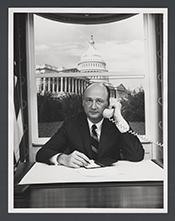
Historical · U.S. House · New York · District 18
Edward Koch
Former U.S. Representative · New York District 18 · 1969–1979 · Democratic
Edward Koch represented New York's District 18 in the United States House of Representatives (1969–1979) for the Democratic party. The page below collects sourced biographical facts, term history, committee roles, and provenance for Koch.
Bioguide ID: K000302
Key facts
- Full name
- Edward Koch
- State
- New York
- District
- District 18
- Party
- Democratic
- House service
- 1969–1979
- First House term
- 1969
- Status
- Left office
- Current term ends
- —
- Born
- 1924
- Bioguide ID
- K000302
- Committee assignments
- —
- Dataset version
- 1.20260605
Biographical narrative
800 words · sourced from the Wikipedia REST extract
Edward I. Koch was an American politician who served as a U.S. Representative for New York's 18th congressional district from 1969 to 1977. A member of the Democratic Party, Koch was known for his engaging personality and his commitment to public service. After his tenure in Congress, he went on to become the mayor of New York City, a position he held from 1978 to 1989. His political career was marked by a focus on urban issues, public safety, and housing reform, and he became a prominent figure in New York City politics.
Early life and career
Edward Irving Koch was born on December 12, 1924, in the Crotona Park East neighborhood of the Bronx, New York City. He was the son of Yetta and Louis Koch, Polish-Jewish immigrants who came from the region of Galicia, now part of western Ukraine. Koch grew up in a Conservative Jewish household and spent part of his childhood in Newark, New Jersey, where his father worked in a theater. As a young man, Koch worked various jobs, including serving as a hatcheck boy in a local dance hall. He graduated from South Side High School in Newark in 1941.
Koch's life took a significant turn when he was drafted into the United States Army during World War II. He underwent basic training at Camp Croft in South Carolina and later joined the 104th Infantry Division. His service included deployment to Europe, where he participated in combat operations and earned several military honors, including the European-African-Middle Eastern Campaign Medal and the Combat Infantryman Badge. After the war, he returned to New York City, where he pursued higher education. He attended the City College of New York, graduating in 1945, and later earned a law degree from New York University School of Law in 1948.
Following his education, Koch began his legal career as a sole practitioner and later became a partner in a law firm. His interest in politics grew during this time, particularly as he became involved in reform efforts against the political machine of Tammany Hall. In 1962, Koch made his first attempt at public office by running for the New York State Assembly, although he was not successful. However, he gained prominence within the Democratic Party, defeating Carmine DeSapio to become the party leader for his district in 1963 and again in 1965. Koch served on the New York City Council from 1967 to 1969, further establishing his political credentials.
House tenure
Koch's congressional career began when he ran for the U.S. House of Representatives in 1968, seeking to represent New York's 17th congressional district after the retirement of Republican Theodore Roosevelt Kupferman. Koch won the election, securing 48.5% of the vote against his Republican opponent and a Conservative candidate. He was re-elected in 1970 with a substantial majority, receiving 62% of the vote. Following redistricting, he successfully contested the newly drawn 18th congressional district in 1972, winning with 70% of the vote.
Throughout his time in Congress, Koch continued to build on his electoral success. He was re-elected in 1974 with a career-best 76.7% of the vote, and again in 1976 with 75.7%. His tenure in the House was characterized by a focus on urban issues, reflecting his background and the needs of his constituents. In 1973, he briefly sought the Democratic nomination for mayor of New York City but withdrew before the primary election. His congressional service concluded in January 1977 when he decided to run for mayor, a position that would further elevate his political profile.
Legislative focus and committees
During his time in the House of Representatives, Edward Koch was involved in a range of legislative initiatives and served on several committees. His work primarily focused on issues pertinent to urban development, housing, and public safety, which were critical concerns for his constituents in New York City. Koch's background as a lawyer and his experience on the City Council informed his legislative priorities, enabling him to advocate effectively for policies that addressed the challenges faced by urban areas.
Koch's approach to governance was characterized by a pragmatic style, often seeking bipartisan support for his initiatives. He was known for his ability to engage with constituents and communicate effectively, which helped him maintain a strong connection with the electorate. His tenure in Congress laid the groundwork for his subsequent mayoral campaign, where he would further implement his vision for New York City.
In summary, Edward I. Koch's career as a U.S. Representative was marked by significant electoral successes and a focus on urban issues that would define his later work as mayor. His legislative efforts and commitment to public service reflected his dedication to improving the lives of New Yorkers and addressing the challenges faced by the city during a transformative period in its history.
Notable legislation
Sponsored and co-sponsored legislation for Edward Koch is pending operator curation. The biographical narrative above carries the same provenance trail until per-bill rows are written.
Sources
- [1]https://en.wikipedia.org/wiki/Ed_KochWikipedia · retrieved 2026-06-05
Notable quotes
Sourced quotes for Edward Koch are pending operator curation. Narrative-scope provenance remains attached below.
Sources
- [1]https://en.wikipedia.org/wiki/Ed_KochWikipedia · retrieved 2026-06-05
Key positions
Curated policy positions for Edward Koch are pending operator review. The biographical narrative above carries the same provenance trail until per-topic positions are written.
Sources
- [1]https://en.wikipedia.org/wiki/Ed_KochWikipedia · retrieved 2026-06-05
Terms served
- 1969–1971U.S. House · Term 1 · Democratic
- 1971–1973U.S. House · Term 2 · Democratic
- 1973–1975U.S. House · Term 3 · Democratic
- 1975–1977U.S. House · Term 4 · Democratic
- 1977–1979U.S. House · Term 5 · Democratic
Sources & provenance
Every attributable claim above carries a per-section [N] marker that resolves to the corresponding URL below. Each entry records the upstream provider, the canonical URL, and the timestamp at which the source was retrieved by the ingest pipeline.
Key facts
- https://bioguide.congress.gov/search/bio/K000302bioguide · retrieved 2026-06-05
- https://www.govtrack.us/congress/members/406458govtrack · retrieved 2026-06-05
Biographical narrative
- https://en.wikipedia.org/wiki/Ed_Kochwikipedia · retrieved 2026-06-05
Find your representative
Every U.S. state elects representatives by district. Browse New York’s delegation, the full former-representative roster, or explore the role and term length.
Related on The Candidate
- Preceded by Alfred SantangeloEarlier holder of the New York District 18 House seat · Democratic.Open
- Succeeded by Sean MaloneyLater holder of the New York District 18 House seat · Democratic.Open
- Abel HuntingtonFormer U.S. Representative · New York District 1 · JacksonOpen
- Alfred ChapinFormer U.S. Representative · New York District 1 · DemocraticOpen
- Cadwallader ColdenFormer U.S. Representative · New York District 1 · FederalistOpen
- Charles FloydFormer U.S. Representative · New York District 1 · DemocraticOpen