
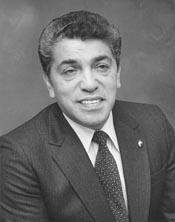
Historical · U.S. House · New York · District 18
Robert Garcia
Former U.S. Representative · New York District 18 · 1977–1990 · Democratic
Robert Garcia represented New York's District 18 in the United States House of Representatives (1977–1990) for the Democratic party. The page below collects sourced biographical facts, term history, committee roles, and provenance for Garcia.
Bioguide ID: G000047
Key facts
- Full name
- Robert Garcia
- State
- New York
- District
- District 18
- Party
- Democratic
- House service
- 1977–1990
- First House term
- 1977
- Status
- Left office
- Current term ends
- —
- Born
- 1933
- Bioguide ID
- G000047
- Committee assignments
- —
- Dataset version
- 1.20260605
Biographical narrative
1,024 words · sourced from the Wikipedia REST extract
Robert Garcia was a U.S. Representative who served in the House of Representatives from 1978 until 1990, representing New York's 18th congressional district. A member of the Democratic Party, Garcia was notable for his contributions to various legislative efforts and his role in advocating for the interests of Hispanic Americans, particularly those from Puerto Rico. His political career was marked by significant achievements, as well as challenges, including a legal investigation that ultimately led to his resignation.
Early life and career
Robert Garcia was born on January 9, 1933, in the Bronx, New York City, to parents who had migrated from Puerto Rico. His father, originally from Spain, had immigrated to Puerto Rico and worked in the Central Aguirre sugar mill, while his mother was a native of Ponce, Puerto Rico. Due to their residency in Puerto Rico at the time of the Treaty of Paris in 1898, they became U.S. nationals and later U.S. citizens under the Jones Act of 1917 when they moved to New York City in the 1920s.
Garcia's education began in the New York City public school system, culminating in his graduation from Haaren High School in Manhattan in 1950. Following high school, he served in the United States Army from 1950 to 1953 during the Korean War, where he held the position of a radio operator with the Third Infantry Division and earned two Bronze Stars for his service. After his military service, Garcia pursued higher education at the City College of New York, while also attending the Community College of New York and the RCA Institute. He graduated in 1957 and subsequently worked as a computer engineer for IBM Control Data until 1965.
Garcia's initial foray into politics began with his involvement in the 1960 presidential campaign of John F. Kennedy, where he helped circulate nominating petitions. This experience ignited his interest in public service, leading him to become active in local politics alongside figures like Herman Badillo, under the mentorship of Felipe Torres. His political career took off when he was elected as a Democratic member of the New York State Assembly in 1966. He was subsequently elected to the New York State Senate in 1967, filling a vacancy left by the resignation of Eugene Rodriguez. Garcia served in the State Senate until 1978, during which he held the position of Deputy Minority Leader from 1975 to 1978 and participated as a delegate at the 1976 Democratic National Convention.
Throughout his time in the New York State Senate, Garcia focused on various issues, including prison reform, which became particularly relevant during the Attica Prison riot in 1971. He was appointed to a mediation committee by Republican Governor Nelson Rockefeller to address the crisis, which resulted in significant casualties.
House tenure
Garcia was first elected to the U.S. House of Representatives in a special election on February 14, 1978, to fill the vacancy left by Herman Badillo. He was elected as a Democrat but initially appeared on the Republican and Liberal tickets. He officially took his seat in the House on February 21, 1978, and went on to serve a total of seven terms in Congress, representing New York's 21st congressional district from 1978 to 1982 and then the 18th congressional district from 1983 until his resignation in 1990.
During his tenure, Garcia was recognized for his active role in international relations, particularly as the official representative of the U.S. Congress to NATO. He worked to foster improved relations between Spain and Latin America, engaging with both the Carter and Reagan administrations. His diplomatic efforts included advocating for the release of DEA agents held by Cuba, which involved multiple meetings with then-President Fidel Castro.
Garcia was also instrumental in the establishment of the Martin Luther King National Holiday and collaborated with Republican Congressman Jack Kemp to draft and pass the Kemp-Garcia Enterprise Zone law aimed at creating jobs in inner-city neighborhoods. His participation in significant diplomatic events included being part of the U.S. delegation that celebrated the establishment of diplomatic relations with the People's Republic of China in 1979, where he met with Chinese leaders, including Chairman Deng Xiaoping.
As a congressman of Puerto Rican descent, Garcia played a vital role in representing the interests of the Puerto Rican community in Congress. He was the only Representative of Puerto Rican heritage with voting rights on the House floor, which allowed him to advocate for the approximately 3.6 million U.S. citizens living in Puerto Rico. His efforts included persuading President Carter to include "Hispanic" as an option in the 1980 U.S. Census for the first time, which was a significant step in recognizing the growing Hispanic population in the United States.
Legislative focus and committees
Throughout his congressional career, Garcia was involved in a variety of legislative initiatives and served on several committees. His work often focused on issues pertinent to his constituents, including economic development, civil rights, and social justice. Garcia's commitment to improving the lives of his constituents was evident in his advocacy for job creation and economic opportunities, particularly in underserved communities.
In addition to his legislative accomplishments, Garcia's role in Congress was characterized by his dedication to enhancing the political representation of Hispanic Americans. He recognized the importance of ensuring that the voices of Hispanic communities were heard in the legislative process and worked tirelessly to address their needs and concerns.
Despite his legislative successes, Garcia's career was overshadowed by legal challenges in the late 1980s. He resigned from Congress on January 7, 1990, following a trial related to the Wedtech scandal, which involved allegations of corruption linked to the Bronx defense contractor Wedtech Corporation. The scandal implicated numerous individuals in both government and business, and Garcia's involvement led to significant scrutiny of his actions during his time in office.
Following his resignation, Garcia's legacy remained a topic of discussion, particularly regarding his contributions to the representation of Hispanic Americans in politics and his efforts to address critical issues facing his constituents. Robert Garcia passed away on January 25, 2017, leaving behind a complex legacy shaped by both his achievements and the controversies that marked the latter part of his career.
Notable legislation
Sponsored and co-sponsored legislation for Robert Garcia is pending operator curation. The biographical narrative above carries the same provenance trail until per-bill rows are written.
Sources
- [1]https://en.wikipedia.org/wiki/Robert_Garcia_(New_York_politician)Wikipedia · retrieved 2026-06-05
Notable quotes
Sourced quotes for Robert Garcia are pending operator curation. Narrative-scope provenance remains attached below.
Sources
- [1]https://en.wikipedia.org/wiki/Robert_Garcia_(New_York_politician)Wikipedia · retrieved 2026-06-05
Key positions
Curated policy positions for Robert Garcia are pending operator review. The biographical narrative above carries the same provenance trail until per-topic positions are written.
Sources
- [1]https://en.wikipedia.org/wiki/Robert_Garcia_(New_York_politician)Wikipedia · retrieved 2026-06-05
Terms served
- 1977–1979U.S. House · Term 1 · Democratic
- 1979–1981U.S. House · Term 2 · Democratic
- 1981–1983U.S. House · Term 3 · Democratic
- 1983–1985U.S. House · Term 4 · Democratic
- 1985–1987U.S. House · Term 5 · Democratic
- 1987–1989U.S. House · Term 6 · Democratic
- 1989–1990U.S. House · Term 7 · Democratic
Sources & provenance
Every attributable claim above carries a per-section [N] marker that resolves to the corresponding URL below. Each entry records the upstream provider, the canonical URL, and the timestamp at which the source was retrieved by the ingest pipeline.
Key facts
- https://bioguide.congress.gov/search/bio/G000047bioguide · retrieved 2026-06-05
- https://www.govtrack.us/congress/members/404422govtrack · retrieved 2026-06-05
Biographical narrative
- https://en.wikipedia.org/wiki/Robert_Garcia_(New_York_politician)wikipedia · retrieved 2026-06-05
Find your representative
Every U.S. state elects representatives by district. Browse New York’s delegation, the full former-representative roster, or explore the role and term length.
Related on The Candidate
- Preceded by Adam Powell Jr.Earlier holder of the New York District 18 House seat · Democratic.Open
- Succeeded by Sean MaloneyLater holder of the New York District 18 House seat · Democratic.Open
- Abel HuntingtonFormer U.S. Representative · New York District 1 · JacksonOpen
- Alfred ChapinFormer U.S. Representative · New York District 1 · DemocraticOpen
- Cadwallader ColdenFormer U.S. Representative · New York District 1 · FederalistOpen
- Charles FloydFormer U.S. Representative · New York District 1 · DemocraticOpen