
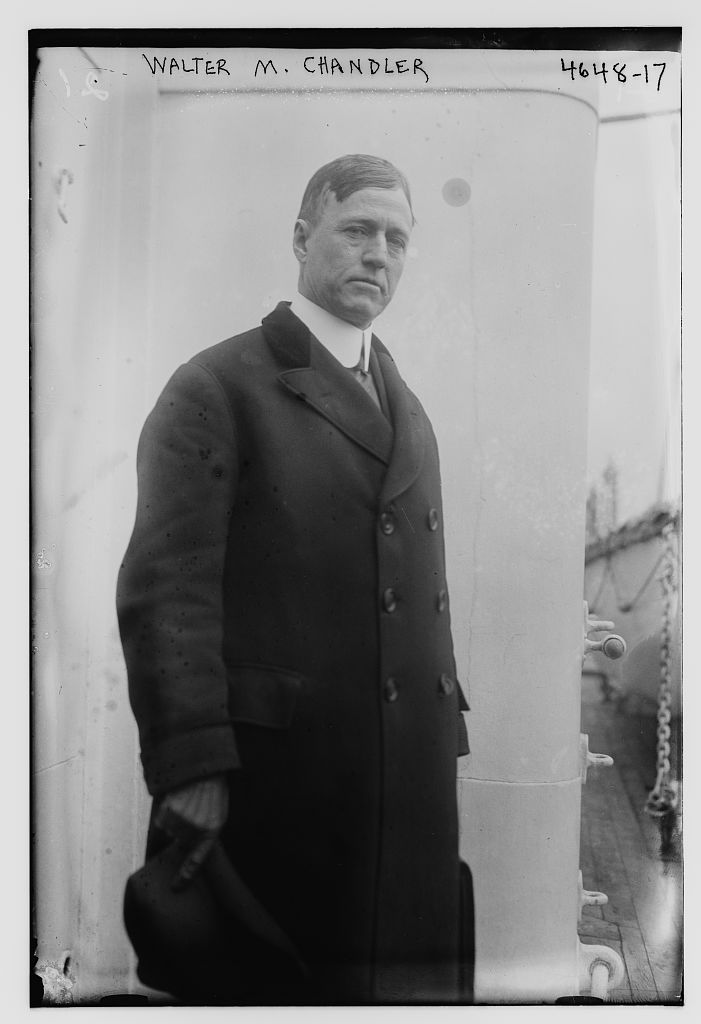
Historical · U.S. House · New York · District 19
Walter Chandler
Former U.S. Representative · New York District 19 · 1913–1923 · Republican
Walter Chandler represented New York's District 19 in the United States House of Representatives (1913–1923) for the Republican party. The page below collects sourced biographical facts, term history, committee roles, and provenance for Chandler.
Bioguide ID: C000297
Key facts
- Full name
- Walter Chandler
- State
- New York
- District
- District 19
- Party
- Republican
- House service
- 1913–1923
- First House term
- 1913
- Status
- Left office
- Current term ends
- —
- Born
- 1867
- Bioguide ID
- C000297
- Committee assignments
- —
- Dataset version
- 1.20260606
Biographical narrative
1,034 words · sourced from the Wikipedia REST extract
Walter Chandler was a U.S. Representative from New York, serving in the House of Representatives for four terms during the early 20th century. Initially elected as a member of the Progressive Party, he later aligned with the Republican Party. His congressional career spanned from 1913 until 1923, during which he engaged in various legislative activities and contributed to the political landscape of his time. After leaving Congress, Chandler returned to his legal practice in New York City, where he continued to be active until his death in 1935.
Early life and career
Walter Marion Chandler was born on December 8, 1867, near Yazoo City in Mississippi. He received his early education in public schools, which laid the foundation for his academic pursuits. He later attended the University of Virginia in Charlottesville and the University of Mississippi in Oxford, where he furthered his education. In 1897, Chandler graduated from the University of Michigan in Ann Arbor, where he earned a degree that would enable him to embark on a career in law.
Chandler's academic journey did not end with his graduation. He sought to deepen his understanding of history and jurisprudence by studying abroad in Germany. He attended both the University of Berlin and the University of Heidelberg, where he was exposed to various intellectual traditions and legal theories that would shape his future career. After completing his studies in Germany, he established a law practice in Dallas, Texas, where he began to build his professional reputation.
In 1900, Chandler relocated to New York City, where he continued his law practice. In addition to his legal work, he engaged in writing and lecturing, contributing to public discourse on various issues. His experiences in both Texas and New York provided him with a diverse perspective on American society and politics, which would later inform his legislative priorities.
Chandler's entry into politics was marked by his election to the U.S. House of Representatives in 1912. He was initially elected as a member of the Progressive Party, a political movement that sought to address the social and economic issues of the time through reform. His alignment with the Progressives reflected his commitment to progressive ideals, which included advocating for social justice, labor rights, and government accountability.
House tenure
Walter Chandler's congressional career began in 1913 when he was elected to represent New York's 19th congressional district. His first term in office was characterized by his involvement in various legislative initiatives that aligned with the Progressive agenda. During this period, he worked on issues related to labor rights, social welfare, and government reform. His commitment to these causes resonated with his constituents, and he was re-elected for a second term.
In 1916, Chandler secured a third term in Congress, this time as a member of the Republican Party. This shift in party affiliation reflected the changing political landscape of the time, as the Progressive Party's influence began to wane. Despite the challenges posed by the political environment, Chandler remained active in legislative matters, focusing on issues that were important to his constituents and the broader American public.
Chandler faced electoral challenges during his time in Congress. In 1918, he was an unsuccessful candidate for re-election, despite the fact that it was a heavily Republican year. This defeat marked a temporary setback in his political career, but he did not remain out of the political arena for long. In 1920, he was elected to a fourth, nonconsecutive term, again representing New York's 19th district. His return to Congress allowed him to continue his legislative work, which included addressing the pressing issues of the post-World War I era.
Chandler's final term in Congress lasted from March 4, 1921, to March 3, 1923. After leaving office, he attempted to return to Congress by contesting a vacancy created by the resignation of Sol Bloom. However, he was unsuccessful in this endeavor, as well as in subsequent attempts to regain a congressional seat in 1924. These electoral defeats marked the end of his formal political career, but his contributions to public service and the legal profession continued.
Legislative focus and committees
During his tenure in the U.S. House of Representatives, Walter Chandler was involved in a range of legislative activities that reflected his commitment to progressive reform and the needs of his constituents. His work in Congress was characterized by a focus on social issues, labor rights, and government accountability. As a member of the Progressive Party and later the Republican Party, he sought to address the challenges faced by American society during a time of significant change.
Chandler's legislative focus included advocating for policies that supported workers' rights and improved labor conditions. He recognized the importance of addressing the needs of the working class, particularly in the wake of industrialization and the economic changes that accompanied it. His commitment to social welfare was evident in his support for initiatives aimed at improving the quality of life for ordinary citizens.
In addition to his focus on labor issues, Chandler was also involved in broader governmental reforms. His experiences as a lawyer and educator informed his understanding of the legal and political systems, allowing him to contribute meaningfully to discussions about governance and accountability. He sought to promote transparency and efficiency within government institutions, reflecting the Progressive ideals that initially propelled him into politics.
Chandler's involvement in various committees during his time in Congress allowed him to engage with specific legislative issues in greater depth. His work on these committees provided him with opportunities to influence policy and advocate for the interests of his constituents. Although specific committee assignments are not detailed, it is clear that his legislative activities were aligned with the broader goals of the Progressive movement and the Republican Party.
After leaving Congress in 1923, Chandler returned to his law practice in New York City. He continued to be active in legal circles until his death on March 16, 1935. His contributions to American politics and law, as well as his commitment to public service, left a lasting impact on the communities he served. Walter Chandler was interred in West Evergreen Cemetery in Jacksonville, Florida, marking the end of a life dedicated to the pursuit of justice and reform.
Notable legislation
Sponsored and co-sponsored legislation for Walter Chandler is pending operator curation. The biographical narrative above carries the same provenance trail until per-bill rows are written.
Sources
- [1]https://en.wikipedia.org/wiki/Walter_M._ChandlerWikipedia · retrieved 2026-06-06
Notable quotes
Sourced quotes for Walter Chandler are pending operator curation. Narrative-scope provenance remains attached below.
Sources
- [1]https://en.wikipedia.org/wiki/Walter_M._ChandlerWikipedia · retrieved 2026-06-06
Key positions
Curated policy positions for Walter Chandler are pending operator review. The biographical narrative above carries the same provenance trail until per-topic positions are written.
Sources
- [1]https://en.wikipedia.org/wiki/Walter_M._ChandlerWikipedia · retrieved 2026-06-06
Terms served
- 1913–1915U.S. House · Term 1 · Progressive
- 1915–1917U.S. House · Term 2 · Progressive
- 1917–1919U.S. House · Term 3 · Republican
- 1921–1923U.S. House · Term 4 · Republican
Sources & provenance
Every attributable claim above carries a per-section [N] marker that resolves to the corresponding URL below. Each entry records the upstream provider, the canonical URL, and the timestamp at which the source was retrieved by the ingest pipeline.
Key facts
- https://bioguide.congress.gov/search/bio/C000297bioguide · retrieved 2026-06-06
- https://www.govtrack.us/congress/members/402439govtrack · retrieved 2026-06-06
Biographical narrative
- https://en.wikipedia.org/wiki/Walter_M._Chandlerwikipedia · retrieved 2026-06-06
Find your representative
Every U.S. state elects representatives by district. Browse New York’s delegation, the full former-representative roster, or explore the role and term length.
Related on The Candidate
- Preceded by John AndrusEarlier holder of the New York District 19 House seat · Republican.Open
- Succeeded by Samuel DicksteinLater holder of the New York District 19 House seat · Democratic.Open
- Abel HuntingtonFormer U.S. Representative · New York District 1 · JacksonOpen
- Alfred ChapinFormer U.S. Representative · New York District 1 · DemocraticOpen
- Cadwallader ColdenFormer U.S. Representative · New York District 1 · FederalistOpen
- Charles FloydFormer U.S. Representative · New York District 1 · DemocraticOpen