
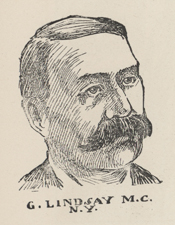
Historical · U.S. House · New York · District 2
George Lindsay
Former U.S. Representative · New York District 2 · 1901–1913 · Democratic
George Lindsay represented New York's District 2 in the United States House of Representatives (1901–1913) for the Democratic party. The page below collects sourced biographical facts, term history, committee roles, and provenance for Lindsay.
Bioguide ID: L000324
Key facts
- Full name
- George Lindsay
- State
- New York
- District
- District 2
- Party
- Democratic
- House service
- 1901–1913
- First House term
- 1901
- Status
- Left office
- Current term ends
- —
- Born
- 1837
- Bioguide ID
- L000324
- Committee assignments
- —
- Dataset version
- 1.20260606
Biographical narrative
844 words · sourced from the Wikipedia REST extract
George Lindsay was an American businessman and politician who served as a United States Representative from New York's 2nd congressional district for six consecutive terms from 1901 to 1913. A member of the Democratic Party, Lindsay's political career included various roles at the local and state levels before his election to Congress. He was born in Manhattan and later moved to Brooklyn, where he engaged in real estate and investment, alongside his political endeavors. After his congressional service, he chose not to seek re-nomination in 1912 and lived in retirement until his death in 1916.
Early life and career
George Lindsay was born on January 7, 1837, in Manhattan, New York City. In 1843, when he was six years old, his family relocated to Brooklyn, where he spent much of his formative years. Lindsay attended local public schools, which provided him with a foundational education that would support his later business and political pursuits. He entered the real estate and investment sectors, where he developed a career that would complement his growing interest in public service.
Lindsay's political career began in the New York State Assembly, where he represented Kings County's 7th District. He served multiple terms in the Assembly from 1882 to 1886, which allowed him to gain experience in legislative processes and governance. His involvement in local politics continued as he was elected Coroner of Kings County, a position he held from 1886 to 1892. This role further solidified his reputation in the community and provided him with insights into the legal and administrative aspects of public service.
In 1898, Lindsay was appointed as an assistant tax commissioner, a position that involved overseeing tax assessments and regulations. His experience in this role, along with his previous political positions, contributed to his understanding of fiscal policy and governance. Additionally, he participated as a delegate in various national and state conventions, further expanding his political network and influence.
House tenure
George Lindsay was elected to the United States House of Representatives as a Democrat in 1900, beginning his first term on March 4, 1901. He was elected to the Fifty-seventh Congress and subsequently re-elected to five additional terms, serving until March 3, 1913. His tenure in Congress was marked by a commitment to representing the interests of his constituents in New York's 2nd congressional district.
During his time in the House, Lindsay was involved in various legislative activities and discussions that reflected the priorities and concerns of his district. His experience in local governance and his background in business likely informed his approach to policymaking and constituent services. As a member of Congress, he participated in the broader political landscape of the early 20th century, a period characterized by significant social and economic changes in the United States.
Lindsay chose not to seek re-nomination in 1912, concluding his congressional career after more than a decade of service. His decision to retire from politics marked the end of an era in which he had established himself as a prominent figure in both local and national politics. After leaving office, he returned to private life and resided in Brooklyn until his passing in 1916.
Legislative focus and committees
While specific details regarding the legislative initiatives and committee assignments during George Lindsay's time in Congress are not extensively documented, it can be inferred that his background in real estate, investment, and local governance influenced his legislative priorities. Members of Congress often focus on issues pertinent to their constituents, and Lindsay's experience in the New York State Assembly and as a coroner likely shaped his understanding of the needs and challenges faced by the people he represented.
Given the era in which he served, Lindsay would have been involved in discussions surrounding economic development, urban infrastructure, and social issues that were prevalent in the early 1900s. The rapid industrialization and urbanization of cities like New York during this period necessitated a focus on policies that addressed housing, labor rights, and public services.
Lindsay's participation in national and state conventions prior to his congressional service suggests that he was engaged with broader political movements and trends, which may have influenced his legislative agenda. His experience as a delegate would have provided him with insights into party dynamics and national issues, further informing his work in the House.
After concluding his congressional career, Lindsay's legacy continued through his family, as his son, George Washington Lindsay, also served as a U.S. Representative from New York. This familial connection to public service underscores the impact that George Lindsay had on the political landscape, both during his lifetime and beyond.
In summary, George Lindsay's career as a U.S. Representative was characterized by his commitment to public service and his engagement with the political issues of his time. His background in business and local governance provided a foundation for his legislative work, and his decision to retire from politics in 1912 marked the end of a significant chapter in his life. He passed away in 1916, leaving behind a legacy that would continue through his family and the community he served.
Notable legislation
Sponsored and co-sponsored legislation for George Lindsay is pending operator curation. The biographical narrative above carries the same provenance trail until per-bill rows are written.
Sources
- [1]https://en.wikipedia.org/wiki/George_H._LindsayWikipedia · retrieved 2026-06-06
Notable quotes
Sourced quotes for George Lindsay are pending operator curation. Narrative-scope provenance remains attached below.
Sources
- [1]https://en.wikipedia.org/wiki/George_H._LindsayWikipedia · retrieved 2026-06-06
Key positions
Curated policy positions for George Lindsay are pending operator review. The biographical narrative above carries the same provenance trail until per-topic positions are written.
Sources
- [1]https://en.wikipedia.org/wiki/George_H._LindsayWikipedia · retrieved 2026-06-06
Terms served
- 1901–1903U.S. House · Term 1 · Democratic
- 1903–1905U.S. House · Term 2 · Democratic
- 1905–1907U.S. House · Term 3 · Democratic
- 1907–1909U.S. House · Term 4 · Democratic
- 1909–1911U.S. House · Term 5 · Democratic
- 1911–1913U.S. House · Term 6 · Democratic
Sources & provenance
Every attributable claim above carries a per-section [N] marker that resolves to the corresponding URL below. Each entry records the upstream provider, the canonical URL, and the timestamp at which the source was retrieved by the ingest pipeline.
Key facts
- https://bioguide.congress.gov/search/bio/L000324bioguide · retrieved 2026-06-06
- https://www.govtrack.us/congress/members/406817govtrack · retrieved 2026-06-06
Biographical narrative
- https://en.wikipedia.org/wiki/George_H._Lindsaywikipedia · retrieved 2026-06-06
Find your representative
Every U.S. state elects representatives by district. Browse New York’s delegation, the full former-representative roster, or explore the role and term length.
Related on The Candidate
- Preceded by Denis HurleyEarlier holder of the New York District 2 House seat · Republican.Open
- Succeeded by Denis O’LearyLater holder of the New York District 2 House seat · Democratic.Open
- Abel HuntingtonFormer U.S. Representative · New York District 1 · JacksonOpen
- Alfred ChapinFormer U.S. Representative · New York District 1 · DemocraticOpen
- Cadwallader ColdenFormer U.S. Representative · New York District 1 · FederalistOpen
- Charles FloydFormer U.S. Representative · New York District 1 · DemocraticOpen