
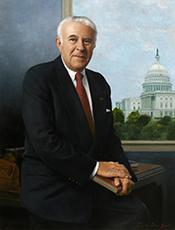
Historical · U.S. House · New York · District 20
Benjamin Gilman
Former U.S. Representative · New York District 20 · 1973–2003 · Republican
Benjamin Gilman represented New York's District 20 in the United States House of Representatives (1973–2003) for the Republican party. The page below collects sourced biographical facts, term history, committee roles, and provenance for Gilman.
Bioguide ID: G000212
Key facts
- Full name
- Benjamin Gilman
- State
- New York
- District
- District 20
- Party
- Republican
- House service
- 1973–2003
- First House term
- 1973
- Status
- Left office
- Current term ends
- —
- Born
- 1922
- Bioguide ID
- G000212
- Committee assignments
- —
- Dataset version
- 1.20260605
Biographical narrative
955 words · sourced from the Wikipedia REST extract
Benjamin A. Gilman was an American politician who served as a Republican member of the United States House of Representatives, representing New York's 20th congressional district from January 3, 1973, until January 3, 2003. Over his 30-year tenure in Congress, Gilman became known for his involvement in foreign affairs, particularly in relation to U.S. policy in Asia, as well as for his advocacy on issues such as world hunger and the rights of prisoners of war. His legislative work and leadership roles in various committees contributed to his reputation as a moderate Republican.
Early life and career
Benjamin Arthur Gilman was born on December 6, 1922, in Poughkeepsie, New York, to parents who were Austrian Jewish immigrants. He grew up in Middletown, New York, where he completed his high school education at Middletown High School in 1941. Following his graduation, Gilman enlisted in the United States Army Air Corps during World War II, serving from 1942 to 1945. He participated in 35 missions over Japan, earning recognition for his service with the Distinguished Flying Cross and the Air Medal with Oak Leaf Clusters.
After the war, Gilman pursued higher education, earning a Bachelor of Science degree from the Wharton School of Business at the University of Pennsylvania in 1946. He later attended New York Law School, where he received his Bachelor of Laws (LL.B.) degree in 1950. Following his legal education, Gilman began his career in public service as an assistant attorney general for the State of New York from 1953 to 1955. He then transitioned to private legal practice in his hometown of Middletown.
Gilman’s political career began in earnest when he was elected to the New York State Assembly, where he served from 1967 to 1972. During his time in the Assembly, he participated in the 177th, 178th, and 179th New York State Legislatures. He was also involved with the New York State Southeastern Water Commission, further establishing his commitment to public service and governance.
House tenure
Gilman was first elected to the U.S. House of Representatives in 1972, representing New York's newly drawn 26th congressional district. He defeated the incumbent Democrat, John G. Dow, in a competitive election. Gilman's congressional career spanned three decades, during which he served a total of 15 terms. His tenure in the House began on January 3, 1973, and concluded on January 3, 2003, when he retired after the redistricting process resulted in the dissolution of his district.
Throughout his time in Congress, Gilman was recognized as a moderate Republican, often aligning with the centrist policies associated with New York's political landscape. He held significant leadership roles, including serving as the chair of the House Committee on International Relations during the 104th through 106th Congresses. His involvement in this committee underscored his focus on foreign affairs and international relations.
Gilman was also active in various congressional delegations and commissions. He served as a Congressional delegate to the United Nations under Ambassador Jeane Kirkpatrick in 1981 and was a member of the Ukraine Famine Commission. His participation in international conferences included engagements with European, Canadian, and Mexican parliamentarians, as well as serving as a Congressional Advisor to the U.N. Law of the Sea Conference. Additionally, he co-chaired the Committee on Irish Affairs and was involved with the International Task Force on Narcotics.
During the 1970s, Gilman became particularly associated with issues concerning prisoners of war and those missing in action in Southeast Asia. He was a member of the Select Congressional Committee focused on this issue and was noted for his stance against closing the investigation into the POW/MIA situation. His advocacy in this area highlighted his commitment to veterans and military families.
Legislative focus and committees
Gilman's legislative focus was characterized by a strong emphasis on foreign policy and international relations, particularly regarding U.S. engagement in Asia. As chair of the House Committee on Foreign Affairs from 1995 to 2002, he advocated for stronger ties with India, viewing it as a strategic counterbalance to Chinese influence in the region. His efforts during the Kargil War between India and Pakistan included urging American lawmakers to apply pressure on Pakistan to withdraw from the conflict, reflecting his proactive approach to foreign policy.
In addition to his work on foreign affairs, Gilman was deeply concerned with issues of global hunger. He authored legislation that led to the establishment of a presidential Commission Against Hunger and was appointed to this commission by President Jimmy Carter. His commitment to addressing world hunger was a significant aspect of his legislative agenda, demonstrating his focus on humanitarian issues.
Gilman also played a key role in promoting educational exchange programs. He was instrumental in the passage of the International Academic Opportunity Act of 2000, which aimed to create opportunities for American students to study abroad. In recognition of his contributions to international education, the Benjamin A. Gilman International Scholarship was established, providing financial support for Pell Grant-eligible students to study or intern overseas.
Throughout his congressional career, Gilman was a member of the House Post Office and Civil Service Committee, which later evolved into the Government Reform and Oversight Committee. He was also a co-founder of the House Select Committee on Narcotics, serving as a senior member until the committee was dissolved in 1993.
Gilman's tenure concluded in 2003 after the redistricting process altered the congressional map in New York, leading to the dissolution of the 20th congressional district. His departure from Congress marked the end of a significant chapter in his political career, during which he had established himself as a prominent figure in U.S. foreign policy and legislative affairs. After leaving office, Gilman continued to be recognized for his contributions to public service until his passing on December 17, 2016.
Notable legislation
Sponsored and co-sponsored legislation for Benjamin Gilman is pending operator curation. The biographical narrative above carries the same provenance trail until per-bill rows are written.
Sources
- [1]https://en.wikipedia.org/wiki/Benjamin_GilmanWikipedia · retrieved 2026-06-05
Notable quotes
Sourced quotes for Benjamin Gilman are pending operator curation. Narrative-scope provenance remains attached below.
Sources
- [1]https://en.wikipedia.org/wiki/Benjamin_GilmanWikipedia · retrieved 2026-06-05
Key positions
Curated policy positions for Benjamin Gilman are pending operator review. The biographical narrative above carries the same provenance trail until per-topic positions are written.
Sources
- [1]https://en.wikipedia.org/wiki/Benjamin_GilmanWikipedia · retrieved 2026-06-05
Terms served
- 1973–1975U.S. House · Term 1 · Republican
- 1975–1977U.S. House · Term 2 · Republican
- 1977–1979U.S. House · Term 3 · Republican
- 1979–1981U.S. House · Term 4 · Republican
- 1981–1983U.S. House · Term 5 · Republican
- 1983–1985U.S. House · Term 6 · Republican
- 1985–1987U.S. House · Term 7 · Republican
- 1987–1989U.S. House · Term 8 · Republican
- 1989–1991U.S. House · Term 9 · Republican
- 1991–1993U.S. House · Term 10 · Republican
- 1993–1995U.S. House · Term 11 · Republican
- 1995–1997U.S. House · Term 12 · Republican
- 1997–1999U.S. House · Term 13 · Republican
- 1999–2001U.S. House · Term 14 · Republican
- 2001–2003U.S. House · Term 15 · Republican
Sources & provenance
Every attributable claim above carries a per-section [N] marker that resolves to the corresponding URL below. Each entry records the upstream provider, the canonical URL, and the timestamp at which the source was retrieved by the ingest pipeline.
Key facts
- https://bioguide.congress.gov/search/bio/G000212bioguide · retrieved 2026-06-05
- https://www.govtrack.us/congress/members/400536govtrack · retrieved 2026-06-05
Biographical narrative
- https://en.wikipedia.org/wiki/Benjamin_Gilmanwikipedia · retrieved 2026-06-05
Find your representative
Every U.S. state elects representatives by district. Browse New York’s delegation, the full former-representative roster, or explore the role and term length.
Related on The Candidate
- Preceded by William RyanEarlier holder of the New York District 20 House seat · Democratic.Open
- Succeeded by Scott MurphyLater holder of the New York District 20 House seat · Democratic.Open
- Abel HuntingtonFormer U.S. Representative · New York District 1 · JacksonOpen
- Alfred ChapinFormer U.S. Representative · New York District 1 · DemocraticOpen
- Cadwallader ColdenFormer U.S. Representative · New York District 1 · FederalistOpen
- Charles FloydFormer U.S. Representative · New York District 1 · DemocraticOpen