
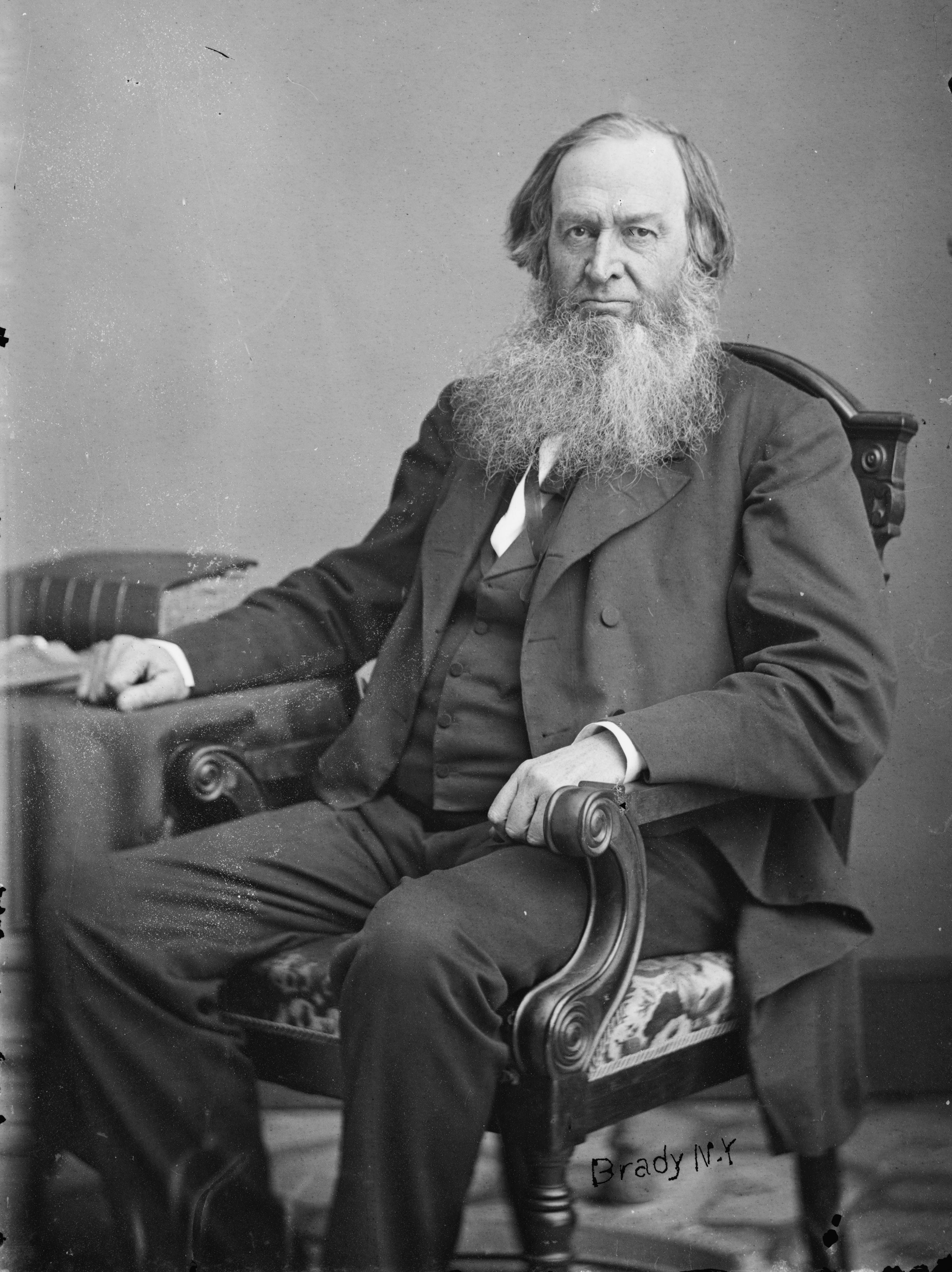
Historical · U.S. House · New York · District 22
Gerrit Smith
Former U.S. Representative · New York District 22 · 1853–1855 · Free Soil
Gerrit Smith represented New York's District 22 in the United States House of Representatives (1853–1855) for the Free Soil party. The page below collects sourced biographical facts, term history, committee roles, and provenance for Smith.
Bioguide ID: S000542
Key facts
- Full name
- Gerrit Smith
- State
- New York
- District
- District 22
- Party
- Free Soil
- House service
- 1853–1855
- First House term
- 1853
- Status
- Left office
- Current term ends
- —
- Born
- 1797
- Bioguide ID
- S000542
- Committee assignments
- —
- Dataset version
- 1.20260606
Biographical narrative
921 words · sourced from the Wikipedia REST extract
Gerrit Smith was an American social reformer, abolitionist, businessman, public intellectual, and philanthropist who served as a U.S. Representative for New York's 22nd congressional district from 1853 to 1855. A member of the Free Soil Party, Smith was deeply committed to political reform, particularly the abolition of slavery, and was known for his significant contributions to various social causes throughout his life. His legacy includes a strong emphasis on civil rights and social justice, as well as a notable involvement in the political movements of his time.
Early life and career
Gerrit Smith was born on March 6, 1797, in Utica, New York, during a period when the area was still an unincorporated village. He was the son of Peter Gerrit Smith and Elizabeth Livingston Smith. His father, a prominent figure in Madison County, was known for his wealth and influence, having amassed considerable fortune through ventures in the fur trade and real estate. Peter Smith was a slave owner and served as the first judge of Madison County, which contributed to the family's prominence in the region. Gerrit was one of four children, and his upbringing was marked by a combination of privilege and the complexities of his father's character, who was described as both devout and self-centered.
Gerrit Smith's education began at Hamilton Oneida Academy, where he excelled academically. He later attended Hamilton College, graduating in 1818 as the first valedictorian of the institution. His time at Hamilton College was characterized by active engagement in campus life and the development of his public speaking skills, which would later serve him well in his political career. Following his graduation, Smith married Wealtha Ann Backus, the daughter of the college's first president, but she died shortly after their marriage. In 1822, he married Ann Carroll Fitzhugh, with whom he had eight children, though only two survived to adulthood.
Smith inherited a vast estate from his father, including significant land holdings that made him one of the wealthiest individuals in New York. His wealth allowed him to engage in various philanthropic endeavors, including the establishment of an African-American community known as Timbuctoo in North Elba, New York. Smith's early life was thus shaped by both his privileged background and his growing commitment to social reform, particularly in the areas of abolition and civil rights.
House tenure
Gerrit Smith's political career began in earnest when he was elected to the U.S. House of Representatives as a member of the Free Soil Party, which was founded on the principle of opposing the expansion of slavery into the territories of the United States. He served a single term in the House from 1853 to 1855, during a tumultuous period in American history marked by intense debates over slavery and states' rights. Although Smith's tenure was brief, it was significant in the context of the growing abolitionist movement.
During his time in Congress, Smith was known for his strong advocacy against slavery and his support for various reform movements. His election to the House was part of a broader effort by the Free Soil Party to challenge the established political order and to promote the rights of free men and women. Smith's commitment to abolition was deeply rooted in his personal beliefs and experiences, as he had long been involved in efforts to assist fugitive slaves and support the abolitionist cause.
Despite the challenges faced by the Free Soil Party, Smith's election to Congress represented a critical moment for the abolitionist movement. His presence in the House contributed to the growing visibility of anti-slavery sentiments in national politics. However, his term ended on March 3, 1855, and he did not seek re-election, marking the conclusion of his formal political career in Congress.
Legislative focus and committees
Throughout his time in the House of Representatives, Gerrit Smith focused primarily on issues related to slavery, civil rights, and social reform. His legislative priorities reflected his lifelong commitment to the abolition of slavery and the promotion of equality for all individuals, regardless of race. Smith's involvement in the abolitionist movement was not limited to his congressional duties; he was also a prominent figure in various social reform initiatives outside of Congress.
In addition to his work on slavery, Smith was an advocate for women's rights and temperance, although his efforts in these areas were less successful than his abolitionist activities. He was a significant financial supporter of both the Liberty Party and the Republican Party, contributing to the broader political landscape that sought to address the moral and social issues of the time. Smith's financial contributions and activism played a crucial role in supporting the abolitionist cause and advancing the rights of marginalized groups.
Smith was also known for his involvement in the Secret Six, a group of abolitionists who provided financial support to John Brown's raid at Harpers Ferry in 1859. This connection further underscored his commitment to the abolitionist movement and his willingness to take bold actions in pursuit of social justice. His legacy as a reformer and advocate for civil rights continues to be recognized as an important part of American history.
In summary, Gerrit Smith's life and career were marked by a strong dedication to social reform, particularly in the areas of abolition and civil rights. His tenure in the U.S. House of Representatives, though brief, was significant in the context of the growing abolitionist movement and the political challenges of his time. Smith's contributions to various social causes and his commitment to equality have left a lasting impact on American society.
Notable legislation
Sponsored and co-sponsored legislation for Gerrit Smith is pending operator curation. The biographical narrative above carries the same provenance trail until per-bill rows are written.
Sources
- [1]https://en.wikipedia.org/wiki/Gerrit_SmithWikipedia · retrieved 2026-06-06
Notable quotes
Sourced quotes for Gerrit Smith are pending operator curation. Narrative-scope provenance remains attached below.
Sources
- [1]https://en.wikipedia.org/wiki/Gerrit_SmithWikipedia · retrieved 2026-06-06
Key positions
Curated policy positions for Gerrit Smith are pending operator review. The biographical narrative above carries the same provenance trail until per-topic positions are written.
Sources
- [1]https://en.wikipedia.org/wiki/Gerrit_SmithWikipedia · retrieved 2026-06-06
Terms served
- 1853–1855U.S. House · Term 1 · Free Soil
Sources & provenance
Every attributable claim above carries a per-section [N] marker that resolves to the corresponding URL below. Each entry records the upstream provider, the canonical URL, and the timestamp at which the source was retrieved by the ingest pipeline.
Key facts
- https://bioguide.congress.gov/search/bio/S000542bioguide · retrieved 2026-06-06
- https://www.govtrack.us/congress/members/410024govtrack · retrieved 2026-06-06
Biographical narrative
- https://en.wikipedia.org/wiki/Gerrit_Smithwikipedia · retrieved 2026-06-06
Find your representative
Every U.S. state elects representatives by district. Browse New York’s delegation, the full former-representative roster, or explore the role and term length.
Related on The Candidate
- Preceded by Ausburn BirdsallEarlier holder of the New York District 22 House seat · Democratic.Open
- Succeeded by Andrew McCartyLater holder of the New York District 22 House seat · Ind. Republican-Democrat.Open
- Abel HuntingtonFormer U.S. Representative · New York District 1 · JacksonOpen
- Alfred ChapinFormer U.S. Representative · New York District 1 · DemocraticOpen
- Cadwallader ColdenFormer U.S. Representative · New York District 1 · FederalistOpen
- Charles FloydFormer U.S. Representative · New York District 1 · DemocraticOpen