
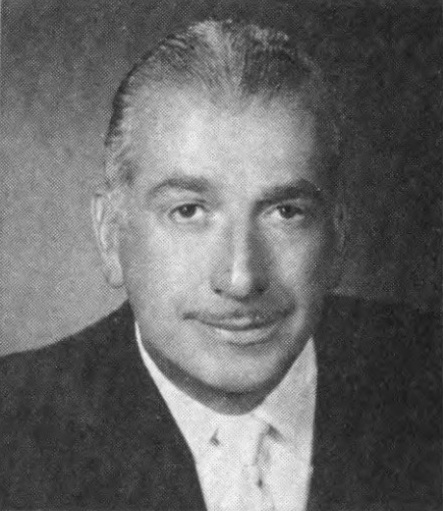
Historical · U.S. House · New York · District 24
Paul Fino
Former U.S. Representative · New York District 24 · 1953–1969 · Republican
Paul Fino represented New York's District 24 in the United States House of Representatives (1953–1969) for the Republican party. The page below collects sourced biographical facts, term history, committee roles, and provenance for Fino.
Bioguide ID: F000137
Key facts
- Full name
- Paul Fino
- State
- New York
- District
- District 24
- Party
- Republican
- House service
- 1953–1969
- First House term
- 1953
- Status
- Left office
- Current term ends
- —
- Born
- 1913
- Bioguide ID
- F000137
- Committee assignments
- —
- Dataset version
- 1.20260605
Biographical narrative
1,014 words · sourced from the Wikipedia REST extract
Paul Fino was an American lawyer and politician who served as a U.S. Representative for New York's 24th congressional district. A member of the Republican Party, Fino's political career spanned several decades, during which he held various significant positions, including serving as a New York state senator and a justice of the New York Supreme Court. His tenure in the U.S. House of Representatives lasted from 1953 until 1969, during which he was known for his conservative positions on certain issues while also supporting various liberal programs.
Early life and career
Paul Albert Fino was born on December 15, 1913, in the Bronx, New York City, to Isidore and Lucia Fino. He pursued higher education at St. John's University School of Law, where he graduated in 1937. Following his education, Fino began his career as a lawyer, which laid the foundation for his future political endeavors.
Fino's initial foray into politics came in the late 1930s and early 1940s when he ran unsuccessfully for the New York State Assembly in 1940 and the New York State Senate in 1942. However, his persistence paid off when he successfully ran for the New York State Senate in 1944, defeating the Minority Leader of the State Senate, John J. Dunnigan. Fino represented the 27th district in the New York State Senate from 1945 to 1950, during which he participated in the 165th, 166th, and 167th New York State Legislatures. His experience in state politics helped him build a network and gain recognition, setting the stage for his future congressional career.
House tenure
In 1952, Fino entered the race for the U.S. House of Representatives, where he defeated incumbent Bernard O'Connell to secure a seat in the 83rd Congress. Fino's congressional career spanned eight terms, as he was re-elected for seven additional terms, serving in the 84th, 85th, 86th, 87th, 88th, 89th, and 90th Congresses. His time in Congress lasted from January 3, 1953, until his resignation on December 31, 1968.
Throughout his congressional tenure, Fino was known for his conservative leanings, particularly in his opposition to racial busing and abortion. Despite these conservative positions, he also voted in favor of several significant civil rights measures, including the Civil Rights Acts of 1957, 1960, 1964, and 1968, as well as the Voting Rights Act of 1965 and the 24th Amendment to the U.S. Constitution. This duality in his political stance reflected a complex approach to governance, where he balanced conservative values with a commitment to civil rights.
Fino was an advocate for innovative revenue-generating ideas, notably proposing the establishment of a national lottery. He believed that such a lottery could provide the federal government with additional funds to support essential programs without the need to raise taxes. Additionally, he introduced legislation aimed at outlawing the Communist Party, reflecting the political climate of the time and the concerns surrounding communism during the Cold War era.
Fino's legislative priorities also included support for programs traditionally associated with liberal policies. He was a proponent of Medicare and national health insurance, demonstrating a commitment to expanding healthcare access. Furthermore, he advocated for Social Security reforms that would allow recipients to begin drawing benefits at the age of 60 without income limitations, a proposal that was more generous than those put forth by the Democratic Party at the time. He also supported mass transit initiatives, indicating a focus on infrastructure and public services.
Fino's political career was not without conflict. He became a notable opponent of John Lindsay, who served alongside him in Congress and later became the Mayor of New York City. Their rivalry intensified after Lindsay's election as mayor in 1966, particularly when Fino sought the appointment of a law partner to a key sanitation position and was denied. Following this, Fino publicly criticized Lindsay's liberal policies and initiatives, which he believed were detrimental to the city. The tensions between the two figures were emblematic of the broader ideological divides within the Republican Party during that era.
In addition to his legislative work, Fino was active in party politics, serving as a delegate to the Republican National Conventions in 1960, 1964, and 1968. He held the position of Republican leader in The Bronx from 1961 to 1968, further solidifying his influence within the party at the local level. In 1961, he ran unsuccessfully for the position of City Council president alongside Louis J. Lefkowitz, who was competing against Mayor Robert F. Wagner. This campaign is remembered for its catchy jingle that highlighted the diverse ethnic backgrounds of the candidates.
Legislative focus and committees
During his time in the House of Representatives, Fino served on various committees that shaped his legislative agenda and allowed him to influence key issues. His work on these committees enabled him to advocate for policies aligned with his beliefs, particularly in areas such as civil rights, healthcare, and public finance. His support for civil rights legislation, despite his conservative stance on other issues, illustrated his ability to navigate complex political landscapes and respond to the needs of his constituents.
Fino's tenure in Congress concluded in 1968 when he resigned to pursue a newly created seat on the New York Supreme Court. His departure from the House marked the end of a significant chapter in his political career, but he continued to be involved in public service. He served on the Supreme Court until 1972, where he gained a reputation for imposing strict sentences, including a notable case involving a lengthy prison term for a minor drug offense.
After leaving the bench, Fino sought to return to politics by running for a seat on the New York City Council in 1972. However, he was unsuccessful in the Republican primary election. In 1986, he published his autobiography, providing insights into his life and career in politics and public service.
Fino passed away on June 16, 2009, in North Woodmere, New York, and was laid to rest at Woodlawn Cemetery in the Bronx. His legacy as a politician who navigated the complexities of mid-20th-century American politics continues to be recognized in discussions of New York's political history.
Notable legislation
Sponsored and co-sponsored legislation for Paul Fino is pending operator curation. The biographical narrative above carries the same provenance trail until per-bill rows are written.
Sources
- [1]https://en.wikipedia.org/wiki/Paul_A._FinoWikipedia · retrieved 2026-06-05
Notable quotes
Sourced quotes for Paul Fino are pending operator curation. Narrative-scope provenance remains attached below.
Sources
- [1]https://en.wikipedia.org/wiki/Paul_A._FinoWikipedia · retrieved 2026-06-05
Key positions
Curated policy positions for Paul Fino are pending operator review. The biographical narrative above carries the same provenance trail until per-topic positions are written.
Sources
- [1]https://en.wikipedia.org/wiki/Paul_A._FinoWikipedia · retrieved 2026-06-05
Terms served
- 1953–1955U.S. House · Term 1 · Republican
- 1955–1957U.S. House · Term 2 · Republican
- 1957–1959U.S. House · Term 3 · Republican
- 1959–1961U.S. House · Term 4 · Republican
- 1961–1963U.S. House · Term 5 · Republican
- 1963–1965U.S. House · Term 6 · Republican
- 1965–1967U.S. House · Term 7 · Republican
- 1967–1969U.S. House · Term 8 · Republican
Sources & provenance
Every attributable claim above carries a per-section [N] marker that resolves to the corresponding URL below. Each entry records the upstream provider, the canonical URL, and the timestamp at which the source was retrieved by the ingest pipeline.
Key facts
- https://bioguide.congress.gov/search/bio/F000137bioguide · retrieved 2026-06-05
- https://www.govtrack.us/congress/members/404092govtrack · retrieved 2026-06-05
Biographical narrative
- https://en.wikipedia.org/wiki/Paul_A._Finowikipedia · retrieved 2026-06-05
Find your representative
Every U.S. state elects representatives by district. Browse New York’s delegation, the full former-representative roster, or explore the role and term length.
Related on The Candidate
- Preceded by Benjamin RabinEarlier holder of the New York District 24 House seat · Democratic.Open
- Succeeded by Sherry BoehlertLater holder of the New York District 24 House seat · Republican.Open
- Abel HuntingtonFormer U.S. Representative · New York District 1 · JacksonOpen
- Alfred ChapinFormer U.S. Representative · New York District 1 · DemocraticOpen
- Cadwallader ColdenFormer U.S. Representative · New York District 1 · FederalistOpen
- Charles FloydFormer U.S. Representative · New York District 1 · DemocraticOpen