
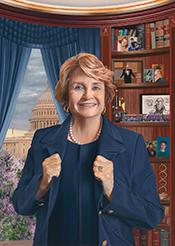
Historical · U.S. House · New York · District 25
Louise Slaughter
Former U.S. Representative · New York District 25 · 1987–2018 · Democratic
Louise Slaughter represented New York's District 25 in the United States House of Representatives (1987–2018) for the Democratic party. The page below collects sourced biographical facts, term history, committee roles, and provenance for Slaughter.
Bioguide ID: S000480
Key facts
- Full name
- Louise Slaughter
- State
- New York
- District
- District 25
- Party
- Democratic
- House service
- 1987–2018
- First House term
- 1987
- Status
- Left office
- Current term ends
- —
- Born
- 1929
- Bioguide ID
- S000480
- Committee assignments
- —
- Dataset version
- 1.20260605
Biographical narrative
875 words · sourced from the Wikipedia REST extract
Dorothy Louise Slaughter (née McIntosh) was an American politician who served as a U.S. Representative for New York's 25th congressional district from 2013 until her death in 2018. A member of the Democratic Party, she had a long and distinguished career in public service, spanning over three decades in the U.S. House of Representatives. Slaughter was known for her legislative efforts in areas such as public health and women's rights, and she was recognized as one of the longest-serving female members of Congress.
Early life and career
Louise McIntosh Slaughter was born on August 14, 1929, in Lynch, Kentucky, a small coal mining town established by a subsidiary of U.S. Steel. She was the daughter of Daisy Grace Byers and Oscar Lewis McIntosh, who worked as a blacksmith in the coal mines. Growing up in a family with two brothers and two sisters, Slaughter faced personal tragedy early in her life when her sister Virginia died from pneumonia. This loss profoundly influenced her educational pursuits, motivating her to study microbiology and public health.
Slaughter graduated from Somerset High School in Somerset, Kentucky, and subsequently enrolled at the University of Kentucky in Lexington. There, she earned a bachelor's degree in bacteriology and later a master's degree in public health, completing her thesis on the overuse and misuse of antibiotics in 1954. Following her education, she began her professional career at Procter & Gamble in New York, where she worked in market research.
Her entry into politics began in 1975 when she was elected to the Monroe County Legislature, where she was one of only two women serving at that time. During her tenure, she accepted a position as the regional coordinator for then-New York Secretary of State Mario Cuomo in the Rochester area. After Cuomo was elected lieutenant governor in 1979, Slaughter continued to serve as his regional coordinator.
In 1982, Slaughter was encouraged by local Democratic leaders to run for the New York State Assembly against the Republican incumbent, Thomas A. Hanna. She successfully won the election with a majority of the vote and was re-elected in 1984. During her time in the Assembly, she participated in the 185th and 186th New York State Legislatures, establishing herself as a committed public servant.
House tenure
After serving four years in the New York State Assembly, Slaughter sought the Democratic nomination for New York's 30th congressional district in 1986. At that time, the district included downtown and eastern Rochester, as well as parts of eastern Monroe County, Genesee County, and northern Livingston and Ontario counties. The seat had been held by moderate Republican Barber Conable for two decades before being contested by the more conservative Fred J. Eckert. Slaughter narrowly defeated Eckert in the 1986 midterm elections, becoming the first Democrat to represent the district since 1963.
Following her initial victory, Slaughter faced John D. Bouchard in the 1988 Congressional Election. As the political landscape shifted in her favor, she garnered significant support, winning with a substantial majority of the votes. The redistricting process after the 1990 census resulted in a renumbering of her district to the 28th District, which became more compact and solidly Democratic. This change allowed her to retain her seat as her district continued to evolve politically.
In the years that followed, Slaughter's district underwent further changes due to redistricting after the 2000 census, merging with the 29th District of fellow Democratic Representative John LaFalce. This new configuration retained Slaughter's district number but altered its geographic boundaries. LaFalce's decision not to seek re-election effectively secured Slaughter's position in Congress.
After the 2010 census, Slaughter's district was renumbered again, becoming the 25th District. This iteration was more compact than its predecessor and primarily encompassed Monroe County. Throughout her tenure, Slaughter was re-elected multiple times, demonstrating her sustained popularity and support among constituents.
Legislative focus and committees
During her time in the U.S. House of Representatives, Slaughter was known for her active participation in various legislative initiatives, particularly in the areas of public health, women's rights, and civil rights. She served as chair of the House Rules Committee from 2007 to 2011 and was the ranking minority member of the committee both before and after her chairmanship. Her leadership roles allowed her to influence key legislative processes and discussions.
Slaughter was the lead House sponsor of the Genetic Information Nondiscrimination Act, which was enacted into law in 2008. This legislation aimed to protect individuals from discrimination based on their genetic information in health insurance and employment contexts. Additionally, she co-sponsored the Violence Against Women Act alongside Senator Joe Biden, highlighting her commitment to addressing issues of domestic violence and supporting victims.
Throughout her career, Slaughter was recognized for her advocacy on behalf of women's health issues and reproductive rights. She was an outspoken supporter of policies aimed at improving access to healthcare services for women and families. Her legislative efforts often reflected her background in public health and her dedication to improving the well-being of her constituents.
At the time of her passing in March 2018, Slaughter was the oldest sitting member of Congress and the last member born in the 1920s. Her extensive career and contributions to American politics left a lasting impact on her district and the broader legislative landscape.
Notable legislation
Sponsored and co-sponsored legislation for Louise Slaughter is pending operator curation. The biographical narrative above carries the same provenance trail until per-bill rows are written.
Sources
- [1]https://en.wikipedia.org/wiki/Louise_SlaughterWikipedia · retrieved 2026-06-05
Notable quotes
Sourced quotes for Louise Slaughter are pending operator curation. Narrative-scope provenance remains attached below.
Sources
- [1]https://en.wikipedia.org/wiki/Louise_SlaughterWikipedia · retrieved 2026-06-05
Key positions
Curated policy positions for Louise Slaughter are pending operator review. The biographical narrative above carries the same provenance trail until per-topic positions are written.
Sources
- [1]https://en.wikipedia.org/wiki/Louise_SlaughterWikipedia · retrieved 2026-06-05
Terms served
- 1987–1989U.S. House · Term 1 · Democratic
- 1989–1991U.S. House · Term 2 · Democratic
- 1991–1993U.S. House · Term 3 · Democratic
- 1993–1995U.S. House · Term 4 · Democratic
- 1995–1997U.S. House · Term 5 · Democratic
- 1997–1999U.S. House · Term 6 · Democratic
- 1999–2001U.S. House · Term 7 · Democratic
- 2001–2003U.S. House · Term 8 · Democratic
- 2003–2005U.S. House · Term 9 · Democratic
- 2005–2007U.S. House · Term 10 · Democratic
- 2007–2009U.S. House · Term 11 · Democratic
- 2009–2011U.S. House · Term 12 · Democratic
- 2011–2013U.S. House · Term 13 · Democratic
- 2013–2015U.S. House · Term 14 · Democratic
- 2015–2017U.S. House · Term 15 · Democratic
- 2017–2018U.S. House · Term 16 · Democratic
Sources & provenance
Every attributable claim above carries a per-section [N] marker that resolves to the corresponding URL below. Each entry records the upstream provider, the canonical URL, and the timestamp at which the source was retrieved by the ingest pipeline.
Key facts
- https://bioguide.congress.gov/search/bio/S000480bioguide · retrieved 2026-06-05
- https://louise.house.govhouse.gov · retrieved 2026-06-05
Biographical narrative
- https://en.wikipedia.org/wiki/Louise_Slaughterwikipedia · retrieved 2026-06-05
Find your representative
Every U.S. state elects representatives by district. Browse New York’s delegation, the full former-representative roster, or explore the role and term length.
Related on The Candidate
- Preceded by Robert BarryEarlier holder of the New York District 25 House seat · Republican.Open
- Abel HuntingtonFormer U.S. Representative · New York District 1 · JacksonOpen
- Alfred ChapinFormer U.S. Representative · New York District 1 · DemocraticOpen
- Cadwallader ColdenFormer U.S. Representative · New York District 1 · FederalistOpen
- Charles FloydFormer U.S. Representative · New York District 1 · DemocraticOpen
- Democratic PartyFederal candidates and office holders on the Democratic line.Open