
Historical · U.S. House · New York · District 26
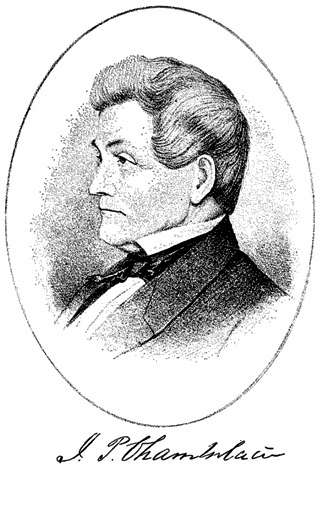
Jacob Chamberlain
Former U.S. Representative · New York District 26 · 1861–1863 · Republican
Jacob Chamberlain represented New York's District 26 in the United States House of Representatives (1861–1863) for the Republican party. The page below collects sourced biographical facts, term history, committee roles, and provenance for Chamberlain.
Bioguide ID: C000278
Key facts
- Full name
- Jacob Chamberlain
- State
- New York
- District
- District 26
- Party
- Republican
- House service
- 1861–1863
- First House term
- 1861
- Status
- Left office
- Current term ends
- —
- Born
- 1802
- Bioguide ID
- C000278
- Committee assignments
- —
- Dataset version
- 1.20260606
Biographical narrative
825 words · sourced from the Wikipedia REST extract
Jacob Chamberlain was a U.S. Representative from New York who served during the tumultuous period of the American Civil War. A member of the Republican Party, he represented New York's 26th congressional district in the House of Representatives from 1861 to 1863. Chamberlain's career spanned various roles, including educator, farmer, and businessman, and he was actively involved in local governance and social issues, particularly women's rights.
Early life and career
Jacob Payson Chamberlain was born on August 1, 1802, in Dudley, Massachusetts. In 1807, when he was just five years old, his family relocated to western New York, where he would spend much of his formative years. Chamberlain received his education in this region, which laid the groundwork for his later professional endeavors. Initially, he embarked on a career as a school teacher, a role that allowed him to contribute to the education of his community. Alongside teaching, he also engaged in farming, which was a common occupation in rural America during that era.
Chamberlain's involvement in local governance began when he served as the Town Clerk of Varick, New York. His career took a significant turn when he settled in Seneca Falls, New York, where he transitioned into business. Over the years, he became a prominent figure in the local economy, owning and operating various enterprises, including farms, flour mills, malthouses, distilleries, and woolen mills. His entrepreneurial spirit also led him to be one of the original organizers of the first bank in Seneca Falls, highlighting his influence in the financial sector of the community.
Politically, Chamberlain's affiliations evolved over time. He began his political journey as a Bucktail Democrat but later became a member of the Whig Party. With the formation of the Republican Party in the mid-1850s, he aligned himself with this new political movement, which sought to address the pressing issues of the day, including the expansion of slavery and the preservation of the Union. His local political involvement included serving as a member of the school board and as village president, roles that further demonstrated his commitment to public service.
Chamberlain was also an active supporter of the Methodist Episcopal Church, reflecting his engagement in the social and moral issues of his time. His commitment to social justice was evident when he attended the Seneca Falls Convention in 1848, a landmark event in the women's rights movement. He was one of the signers of the Declaration of Sentiments, a document that called for equal rights for women, showcasing his progressive stance on gender equality.
House tenure
Chamberlain's political career reached a new height when he was elected to the United States House of Representatives. He served as a Republican in the Thirty-seventh Congress from March 4, 1861, to March 3, 1863. His election came during a critical period in American history, as the nation was embroiled in the Civil War. Chamberlain's tenure in Congress was marked by the challenges and complexities of wartime governance.
During his time in the House, Chamberlain participated in legislative discussions and decisions that were crucial to the war effort and the future of the nation. However, specific details regarding his voting record or the bills he supported are not available. His service in Congress was relatively brief, as he chose not to seek renomination after his first term ended. Following his departure from the House, Chamberlain returned to his business and farming interests, continuing to contribute to the local economy and community.
Legislative focus and committees
While specific details about Chamberlain's legislative focus and committee assignments during his time in Congress are not documented, it can be inferred that, given the historical context of his tenure, he likely engaged with issues pertinent to the Civil War and its implications for the Union. As a member of the Republican Party, he would have aligned with the party's platform, which included a strong stance against the expansion of slavery and support for the Union war effort.
Chamberlain's background as a businessman and his involvement in local governance may have influenced his perspectives on economic policies and social issues. His earlier commitment to women's rights, as evidenced by his participation in the Seneca Falls Convention, suggests that he may have also been attuned to social justice issues, which were gaining prominence during this period.
After completing his term in the House, Chamberlain returned to his previous pursuits, indicating a preference for local engagement over continued national political involvement. His decision not to seek re-election reflects a common trend among politicians of the time who often balanced public service with personal and professional commitments.
Jacob Chamberlain passed away on October 5, 1878, in Seneca Falls, New York. He was interred in Restvale Cemetery, leaving behind a legacy as a local leader and a participant in significant social movements of his time. His life and career illustrate the multifaceted roles that individuals played in shaping their communities and the nation during a pivotal era in American history.
Notable legislation
Sponsored and co-sponsored legislation for Jacob Chamberlain is pending operator curation. The biographical narrative above carries the same provenance trail until per-bill rows are written.
Sources
- [1]https://en.wikipedia.org/wiki/Jacob_P._ChamberlainWikipedia · retrieved 2026-06-06
Notable quotes
Sourced quotes for Jacob Chamberlain are pending operator curation. Narrative-scope provenance remains attached below.
Sources
- [1]https://en.wikipedia.org/wiki/Jacob_P._ChamberlainWikipedia · retrieved 2026-06-06
Key positions
Curated policy positions for Jacob Chamberlain are pending operator review. The biographical narrative above carries the same provenance trail until per-topic positions are written.
Sources
- [1]https://en.wikipedia.org/wiki/Jacob_P._ChamberlainWikipedia · retrieved 2026-06-06
Terms served
- 1861–1863U.S. House · Term 1 · Republican
Sources & provenance
Every attributable claim above carries a per-section [N] marker that resolves to the corresponding URL below. Each entry records the upstream provider, the canonical URL, and the timestamp at which the source was retrieved by the ingest pipeline.
Key facts
- https://bioguide.congress.gov/search/bio/C000278bioguide · retrieved 2026-06-06
- https://www.govtrack.us/congress/members/402421govtrack · retrieved 2026-06-06
Biographical narrative
- https://en.wikipedia.org/wiki/Jacob_P._Chamberlainwikipedia · retrieved 2026-06-06
Find your representative
Every U.S. state elects representatives by district. Browse New York’s delegation, the full former-representative roster, or explore the role and term length.
Related on The Candidate
- Preceded by Emory PottleEarlier holder of the New York District 26 House seat · Republican.Open
- Succeeded by Giles HotchkissLater holder of the New York District 26 House seat · Republican.Open
- Abel HuntingtonFormer U.S. Representative · New York District 1 · JacksonOpen
- Alfred ChapinFormer U.S. Representative · New York District 1 · DemocraticOpen
- Cadwallader ColdenFormer U.S. Representative · New York District 1 · FederalistOpen
- Charles FloydFormer U.S. Representative · New York District 1 · DemocraticOpen