
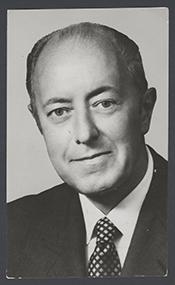
Historical · U.S. House · New York · District 27
Howard Robison
Former U.S. Representative · New York District 27 · 1957–1975 · Republican
Howard Robison represented New York's District 27 in the United States House of Representatives (1957–1975) for the Republican party. The page below collects sourced biographical facts, term history, committee roles, and provenance for Robison.
Bioguide ID: R000357
Key facts
- Full name
- Howard Robison
- State
- New York
- District
- District 27
- Party
- Republican
- House service
- 1957–1975
- First House term
- 1957
- Status
- Left office
- Current term ends
- —
- Born
- 1915
- Bioguide ID
- R000357
- Committee assignments
- —
- Dataset version
- 1.20260605
Biographical narrative
987 words · sourced from the Wikipedia REST extract
Howard W. Robison was an American attorney and politician who served as a U.S. Representative for New York's 27th congressional district. A member of the Republican Party, he held office from 1958 until 1975, completing a total of nine terms in the House of Representatives. Robison's political career was marked by his involvement in significant legislative actions during a transformative period in American history, particularly in relation to civil rights. His professional background as an attorney and his military service during World War II also shaped his approach to governance and public service.
Early life and career
Howard W. Robison was born on October 30, 1915, in Owego, New York, to Addison J. Robison and Pluma (Moe) Robison. Growing up in Owego, he received his early education in the local school system and graduated from Owego Free Academy. His academic pursuits led him to Cornell University, where he earned a Bachelor of Arts degree in 1937. Following his undergraduate studies, Robison continued at Cornell Law School, obtaining his LL.B. degree in 1939. Upon completing his legal education, he was admitted to the bar and began practicing law in his hometown of Owego.
Robison's legal career was interrupted by World War II, during which he enlisted in the United States Army in 1942. He underwent initial training and was subsequently assigned to the Counterintelligence Corps (CIC), where he served as an investigator until his discharge in 1946. Throughout his military service, he attained the rank of Staff Sergeant, gaining valuable experience that would later inform his work in public service.
After returning from the war, Robison resumed his legal practice in Owego and became actively involved in local governance. He served as the county attorney for Tioga County, New York, from 1946 to 1957, during which time he developed a reputation for his legal expertise and commitment to public service. Additionally, he was a member of the Owego town board from 1947 to 1956 and held the position of town attorney from 1957 to 1958. These roles provided him with a solid foundation in local politics and governance, paving the way for his future endeavors at the federal level.
House tenure
Robison's entry into national politics came in 1958 when he was elected to the U.S. House of Representatives in a special election to fill the vacancy left by the resignation of W. Sterling Cole. His election marked the beginning of a lengthy congressional career that would span nearly two decades. Robison was reelected every two years, serving continuously from January 14, 1958, until January 3, 1975. Throughout his tenure, he represented New York's 27th congressional district, which encompassed a diverse constituency.
During his time in Congress, Robison participated in numerous legislative initiatives and debates, reflecting the evolving political landscape of the United States during the 1960s and early 1970s. His voting record indicates a commitment to several key issues, particularly civil rights. He voted in favor of the Civil Rights Acts of 1960, 1964, and 1968, as well as the Voting Rights Act of 1965 and the 24th Amendment to the U.S. Constitution. These legislative actions were significant in the context of the civil rights movement, which sought to eliminate racial discrimination and ensure equal rights for all citizens.
Robison's legislative focus was not limited to civil rights; he also addressed various other issues pertinent to his constituents and the nation. His experience as an attorney likely influenced his approach to legal and regulatory matters, as he sought to navigate the complexities of federal legislation. His ability to engage with a wide range of topics allowed him to contribute meaningfully to discussions on economic policy, healthcare, and infrastructure, among other areas.
Legislative focus and committees
Throughout his congressional career, Robison served on several committees that shaped his legislative priorities and allowed him to influence policy in key areas. His committee assignments provided him with the opportunity to engage with experts, constituents, and fellow lawmakers, facilitating a collaborative approach to governance. While specific committee assignments during his tenure are not detailed in the available information, it is common for members of Congress to serve on committees related to their areas of expertise or the interests of their constituents.
Robison's legislative focus was characterized by a commitment to addressing the needs of his district while also engaging with broader national issues. His support for civil rights legislation demonstrated an alignment with the progressive movements of the time, reflecting a recognition of the importance of equality and justice in American society. His votes on significant legislative measures highlighted his willingness to take a stand on contentious issues, positioning him as a representative who was responsive to the changing dynamics of the nation.
In addition to his legislative work, Robison's background as an attorney likely informed his understanding of the legal implications of the policies he supported. This legal expertise would have been beneficial in navigating the complexities of federal law and advocating for measures that aligned with his constituents' needs and values.
After leaving Congress in 1975, Robison transitioned to a role in the private sector, serving as vice president for congressional relations at the American Railroad Association. This position allowed him to leverage his experience in government to advocate for the interests of the railroad industry, further demonstrating his ongoing engagement with public policy and legislative affairs.
Robison spent his later years residing in Rehoboth Beach, Delaware, where he continued to be involved in various community and civic activities. He passed away on September 26, 1987, in Rehoboth Beach, and was laid to rest at Evergreen Cemetery in Owego, New York. His legacy as a public servant and advocate for civil rights remains a notable aspect of his life and career, reflecting the impact of his work in the U.S. House of Representatives. Robison's marriage to Gertrude L. Frederick, with whom he had two sons, further underscores his commitment to family and community throughout his life.
Notable legislation
Sponsored and co-sponsored legislation for Howard Robison is pending operator curation. The biographical narrative above carries the same provenance trail until per-bill rows are written.
Sources
- [1]https://en.wikipedia.org/wiki/Howard_W._RobisonWikipedia · retrieved 2026-06-05
Notable quotes
Sourced quotes for Howard Robison are pending operator curation. Narrative-scope provenance remains attached below.
Sources
- [1]https://en.wikipedia.org/wiki/Howard_W._RobisonWikipedia · retrieved 2026-06-05
Key positions
Curated policy positions for Howard Robison are pending operator review. The biographical narrative above carries the same provenance trail until per-topic positions are written.
Sources
- [1]https://en.wikipedia.org/wiki/Howard_W._RobisonWikipedia · retrieved 2026-06-05
Terms served
- 1957–1959U.S. House · Term 1 · Republican
- 1959–1961U.S. House · Term 2 · Republican
- 1961–1963U.S. House · Term 3 · Republican
- 1963–1965U.S. House · Term 4 · Republican
- 1965–1967U.S. House · Term 5 · Republican
- 1967–1969U.S. House · Term 6 · Republican
- 1969–1971U.S. House · Term 7 · Republican
- 1971–1973U.S. House · Term 8 · Republican
- 1973–1975U.S. House · Term 9 · Republican
Sources & provenance
Every attributable claim above carries a per-section [N] marker that resolves to the corresponding URL below. Each entry records the upstream provider, the canonical URL, and the timestamp at which the source was retrieved by the ingest pipeline.
Key facts
- https://bioguide.congress.gov/search/bio/R000357bioguide · retrieved 2026-06-05
- https://www.govtrack.us/congress/members/409328govtrack · retrieved 2026-06-05
Biographical narrative
- https://en.wikipedia.org/wiki/Howard_W._Robisonwikipedia · retrieved 2026-06-05
Find your representative
Every U.S. state elects representatives by district. Browse New York’s delegation, the full former-representative roster, or explore the role and term length.
Related on The Candidate
- Preceded by Lewis RockefellerEarlier holder of the New York District 27 House seat · Republican.Open
- Succeeded by George WortleyLater holder of the New York District 27 House seat · Republican.Open
- Abel HuntingtonFormer U.S. Representative · New York District 1 · JacksonOpen
- Alfred ChapinFormer U.S. Representative · New York District 1 · DemocraticOpen
- Cadwallader ColdenFormer U.S. Representative · New York District 1 · FederalistOpen
- Charles FloydFormer U.S. Representative · New York District 1 · DemocraticOpen