
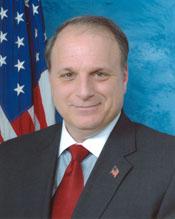
Historical · U.S. House · New York · District 29
Eric Massa
Former U.S. Representative · New York District 29 · 2009–2010 · Democratic
Eric Massa represented New York's District 29 in the United States House of Representatives (2009–2010) for the Democratic party. The page below collects sourced biographical facts, term history, committee roles, and provenance for Massa.
Bioguide ID: M001173
Key facts
- Full name
- Eric Massa
- State
- New York
- District
- District 29
- Party
- Democratic
- House service
- 2009–2010
- First House term
- 2009
- Status
- Left office
- Current term ends
- —
- Born
- 1959
- Bioguide ID
- M001173
- Committee assignments
- —
- Dataset version
- 1.20260605
Biographical narrative
969 words · sourced from the Wikipedia REST extract
Eric J. J. Massa is a former U.S. Representative who served New York's 29th congressional district as a member of the Democratic Party. His tenure in the House of Representatives began in January 2009 and concluded with his resignation in March 2010. Massa's time in office was marked by a focus on military and veterans' issues, as well as a controversial resignation amid allegations of sexual misconduct.
Early life and career
Eric James Joseph Massa was born on September 16, 1959, in Charleston, South Carolina. He was raised in a military family, as the son of a career naval officer. This upbringing led him to experience life in various locations, including Argentina and New Orleans. Massa pursued higher education at the U.S. Naval Academy in Annapolis, where he graduated and subsequently served on active duty in the Navy for 24 years. His military career included participation in the Persian Gulf War, and he held a position as an aide to General Wesley Clark.
During the latter part of his military service, Massa faced significant health challenges when he was diagnosed with non-Hodgkin's lymphoma. After recovering from this illness, he transitioned to civilian life, moving to Corning, New York, in 2001 to work for the Corning Glass Company. However, he lost his job due to company downsizing, which prompted a shift in his career path. In 2003, he relocated to Washington, D.C., where he worked as a staffer for the House Armed Services Committee under the Republican Party. His tenure in this role was short-lived, as he was dismissed after it became public that he had communicated with his former boss, General Wesley Clark, offering advice on Clark's presidential campaign.
Following this experience, Massa switched his political affiliation to the Democratic Party and became involved in veterans' outreach efforts in New Hampshire and Virginia during Clark's unsuccessful bid for the presidency in 2004.
House tenure
Massa's political career took a significant turn when he decided to run for Congress in 2006, seeking to represent New York's 29th congressional district. He campaigned on the strength of his military background and experience. On election night, Massa faced incumbent Republican Representative Randy Kuhl, who initially led the race with a margin of 52% to 48%. Massa contested the results, requesting a recount and an accounting of absentee ballots, as there were still 10,000 votes left to be counted. However, after a week of waiting, the recount confirmed Kuhl's victory, leading Massa to concede the election.
Undeterred by this setback, Massa prepared for a rematch against Kuhl in 2008. The race was closely contested, but Massa ultimately emerged victorious, defeating Kuhl by a margin of approximately 4,000 votes, with a final tally of 51% to 49%. Kuhl did not concede immediately, and the voting machines were impounded at his request pending a recount of the 12,000 absentee ballots. The recount confirmed Massa's victory, and Kuhl conceded on November 21, 2008. Massa's success was attributed in part to his appeal among voters in Cattaraugus County, which had previously supported Kuhl in earlier elections.
Once in office, Massa was assigned to several committees, including the House Armed Services Committee, the Agriculture Committee, and the House Homeland Security Committee. His legislative activities included support for the American Recovery and Reinvestment Act of 2009, although he expressed concerns about its effectiveness in stimulating the economy in his district. Massa criticized the allocation of stimulus funds, claiming they were primarily directed to state governments and interests in New York City rather than benefiting the Southern Tier region.
In April 2009, Massa made headlines for his suggestion to close the U.S.-Mexico border in response to the outbreak of the swine flu pandemic. He also became a vocal critic of Time Warner Cable's proposed tiered service rates for high-speed Internet, advocating against what he viewed as unfair practices.
Massa's stance on health care reform was complex; while he supported the idea of reform, he opposed the specific plans proposed by the Obama administration, citing concerns over costs. He favored a single-payer health care system and expressed a willingness to vote against the preferences of his constituents if he believed it was in their best interest.
Legislative focus and committees
During his brief tenure in Congress, Massa's legislative focus reflected his military background and commitment to veterans' issues. His assignments to the House Armed Services Committee and the Homeland Security Committee allowed him to engage with matters related to national security and defense, as well as issues affecting veterans.
Massa's involvement in the American Recovery and Reinvestment Act highlighted his interest in economic stimulus and job creation, although he was critical of the implementation and outcomes of the legislation. His advocacy for closing the U.S.-Mexico border during the swine flu pandemic showcased his willingness to address public health concerns and border security.
Despite his initial support for health care reform, Massa's opposition to the Obama administration's proposals underscored a tension within the Democratic Party regarding health care policy. His preference for a single-payer system placed him at odds with many of his colleagues, and he was known for making statements that sparked controversy, such as his comments regarding the implications of end-of-life care discussions.
Massa's congressional career came to an abrupt end in March 2010 amid allegations of sexual misconduct. He announced that he would not seek re-election due to the return of his cancer and the ongoing investigation by the House Ethics Committee into allegations made by a staff member. Massa's resignation was effective March 8, 2010, and he cited both his health issues and the investigation as reasons for his departure. His resignation marked a significant and controversial conclusion to his time in public office, leaving behind a mixed legacy characterized by both his military service and the serious allegations that led to his exit from Congress.
Notable legislation
Sponsored and co-sponsored legislation for Eric Massa is pending operator curation. The biographical narrative above carries the same provenance trail until per-bill rows are written.
Sources
- [1]https://en.wikipedia.org/wiki/Eric_MassaWikipedia · retrieved 2026-06-05
Notable quotes
Sourced quotes for Eric Massa are pending operator curation. Narrative-scope provenance remains attached below.
Sources
- [1]https://en.wikipedia.org/wiki/Eric_MassaWikipedia · retrieved 2026-06-05
Key positions
Curated policy positions for Eric Massa are pending operator review. The biographical narrative above carries the same provenance trail until per-topic positions are written.
Sources
- [1]https://en.wikipedia.org/wiki/Eric_MassaWikipedia · retrieved 2026-06-05
Terms served
- 2009–2010U.S. House · Term 1 · Democratic
Sources & provenance
Every attributable claim above carries a per-section [N] marker that resolves to the corresponding URL below. Each entry records the upstream provider, the canonical URL, and the timestamp at which the source was retrieved by the ingest pipeline.
Key facts
- https://bioguide.congress.gov/search/bio/M001173bioguide · retrieved 2026-06-05
- http://massa.house.govhouse.gov · retrieved 2026-06-05
Biographical narrative
- https://en.wikipedia.org/wiki/Eric_Massawikipedia · retrieved 2026-06-05
Find your representative
Every U.S. state elects representatives by district. Browse New York’s delegation, the full former-representative roster, or explore the role and term length.
Related on The Candidate
- Preceded by Randy Kuhl Jr.Earlier holder of the New York District 29 House seat · Republican.Open
- Abel HuntingtonFormer U.S. Representative · New York District 1 · JacksonOpen
- Alfred ChapinFormer U.S. Representative · New York District 1 · DemocraticOpen
- Cadwallader ColdenFormer U.S. Representative · New York District 1 · FederalistOpen
- Charles FloydFormer U.S. Representative · New York District 1 · DemocraticOpen
- Democratic PartyFederal candidates and office holders on the Democratic line.Open