
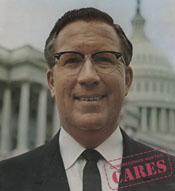
Historical · U.S. House · New York · District 29
Frank Horton
Former U.S. Representative · New York District 29 · 1963–1993 · Republican
Frank Horton represented New York's District 29 in the United States House of Representatives (1963–1993) for the Republican party. The page below collects sourced biographical facts, term history, committee roles, and provenance for Horton.
Bioguide ID: H000797
Key facts
- Full name
- Frank Horton
- State
- New York
- District
- District 29
- Party
- Republican
- House service
- 1963–1993
- First House term
- 1963
- Status
- Left office
- Current term ends
- —
- Born
- 1919
- Bioguide ID
- H000797
- Committee assignments
- —
- Dataset version
- 1.20260605
Biographical narrative
807 words · sourced from the Wikipedia REST extract
Frank J. Horton was a prominent American politician who served as a U.S. Representative for New York's 29th congressional district. A member of the Republican Party, Horton had a lengthy career in the House of Representatives, spanning from 1963 until 1993. His tenure was marked by his reputation as a moderate Republican and his involvement in various legislative initiatives, particularly those related to government oversight and civil rights.
Early life and career
Frank J. Horton was born on December 12, 1919, in Cuero, Texas. He pursued higher education at Louisiana State University, where he earned a Bachelor of Arts degree in 1941. During his time at university, he became a member of the Kappa Sigma fraternity, specifically the Gamma chapter. Following his graduation, Horton enlisted in the United States Army in 1941, serving his country throughout World War II. His military service concluded with the war's end, after which he sought to further his education in law.
Horton attended Cornell Law School in Ithaca, New York, where he received his Bachelor of Laws degree in 1947. That same year, he was admitted to the New York Bar, marking the beginning of his legal career. Before entering politics, Horton was involved in the sports industry, serving as the President of Rochester Community Baseball, Inc. from 1956 to 1962. He also held the position of Executive Vice President of the International Baseball League from 1959 to 1961, during which he acted as the league's attorney.
Horton began his political career as a member of the Rochester City Council, serving from 1955 to 1961. His local political experience laid the groundwork for his subsequent election to the U.S. House of Representatives. In 1962, he successfully ran for Congress as a Republican, representing New York's 29th congressional district.
House tenure
Horton was first elected to the House of Representatives in 1962, and he went on to serve a total of 15 consecutive terms until his retirement in 1993. His long tenure in Congress was characterized by a commitment to public service and engagement in various legislative matters. Throughout his time in office, Horton was recognized for his moderate stance within the Republican Party, often aligning with the Rockefeller wing, which was known for its more liberal positions on social issues.
During his congressional career, Horton was involved in significant political events and discussions. In 1966, he was one of several Republican lawmakers who signed a telegram addressed to Georgia Governor Carl E. Sanders. This telegram expressed concern over the Georgia legislature's refusal to seat Julian Bond, an elected representative who had been outspoken against the Vietnam War. The signatories, including Horton, emphasized the importance of representative government and the right of elected officials to express their views, regardless of disagreement with their positions.
Horton’s approach to governance was often described as bipartisan, and he was known for his collaborative efforts across party lines. His leadership capabilities were recognized when he rose to the position of Ranking Minority Member of the Government Operations Committee, which is now known as the House Committee on Oversight and Government Reform. In this role, Horton played a crucial part in overseeing government operations and advocating for accountability within federal agencies.
In 1992, Horton announced his retirement from Congress, a decision influenced by redistricting that placed him in the same district as his colleague and friend, Representative Louise Slaughter. His departure marked the end of a significant chapter in his political career, during which he had established himself as a respected figure in the House.
Legislative focus and committees
Throughout his time in Congress, Frank Horton was involved in a range of legislative initiatives that reflected his interests and the needs of his constituents. He was particularly focused on issues related to government oversight, civil rights, and environmental protection. One of his notable contributions was the proposal to elevate the United States Environmental Protection Agency (EPA) to a cabinet-level agency, underscoring his commitment to environmental issues and regulatory oversight.
Horton also played a key role in the introduction of the Whistleblower Protection Act in 1987, legislation aimed at protecting federal employees who disclose information about illegal or unethical activities within the government. This act was part of his broader commitment to transparency and accountability in government operations.
In addition to his work on environmental and whistleblower issues, Horton was instrumental in designating May as Asian Pacific American Heritage Month. This initiative highlighted the contributions of Asian Pacific Americans to the United States and aimed to promote awareness and appreciation of their cultural heritage.
Overall, Frank Horton’s legislative focus and committee work reflected his dedication to public service and his belief in the importance of government accountability and civil rights. His long-standing career in the House of Representatives left a lasting impact on the legislative landscape, particularly in the areas of oversight and environmental policy.
Notable legislation
Sponsored and co-sponsored legislation for Frank Horton is pending operator curation. The biographical narrative above carries the same provenance trail until per-bill rows are written.
Sources
- [1]https://en.wikipedia.org/wiki/Frank_Horton_(New_York_politician)Wikipedia · retrieved 2026-06-05
Notable quotes
Sourced quotes for Frank Horton are pending operator curation. Narrative-scope provenance remains attached below.
Sources
- [1]https://en.wikipedia.org/wiki/Frank_Horton_(New_York_politician)Wikipedia · retrieved 2026-06-05
Key positions
Curated policy positions for Frank Horton are pending operator review. The biographical narrative above carries the same provenance trail until per-topic positions are written.
Sources
- [1]https://en.wikipedia.org/wiki/Frank_Horton_(New_York_politician)Wikipedia · retrieved 2026-06-05
Terms served
- 1963–1965U.S. House · Term 1 · Republican
- 1965–1967U.S. House · Term 2 · Republican
- 1967–1969U.S. House · Term 3 · Republican
- 1969–1971U.S. House · Term 4 · Republican
- 1971–1973U.S. House · Term 5 · Republican
- 1973–1975U.S. House · Term 6 · Republican
- 1975–1977U.S. House · Term 7 · Republican
- 1977–1979U.S. House · Term 8 · Republican
- 1979–1981U.S. House · Term 9 · Republican
- 1981–1983U.S. House · Term 10 · Republican
- 1983–1985U.S. House · Term 11 · Republican
- 1985–1987U.S. House · Term 12 · Republican
- 1987–1989U.S. House · Term 13 · Republican
- 1989–1991U.S. House · Term 14 · Republican
- 1991–1993U.S. House · Term 15 · Republican
Sources & provenance
Every attributable claim above carries a per-section [N] marker that resolves to the corresponding URL below. Each entry records the upstream provider, the canonical URL, and the timestamp at which the source was retrieved by the ingest pipeline.
Key facts
- https://bioguide.congress.gov/search/bio/H000797bioguide · retrieved 2026-06-05
- https://www.govtrack.us/congress/members/405646govtrack · retrieved 2026-06-05
Biographical narrative
- https://en.wikipedia.org/wiki/Frank_Horton_(New_York_politician)wikipedia · retrieved 2026-06-05
Find your representative
Every U.S. state elects representatives by district. Browse New York’s delegation, the full former-representative roster, or explore the role and term length.
Related on The Candidate
- Preceded by Augustus BennetEarlier holder of the New York District 29 House seat · Republican.Open
- Succeeded by Randy Kuhl Jr.Later holder of the New York District 29 House seat · Republican.Open
- Abel HuntingtonFormer U.S. Representative · New York District 1 · JacksonOpen
- Alfred ChapinFormer U.S. Representative · New York District 1 · DemocraticOpen
- Cadwallader ColdenFormer U.S. Representative · New York District 1 · FederalistOpen
- Charles FloydFormer U.S. Representative · New York District 1 · DemocraticOpen