
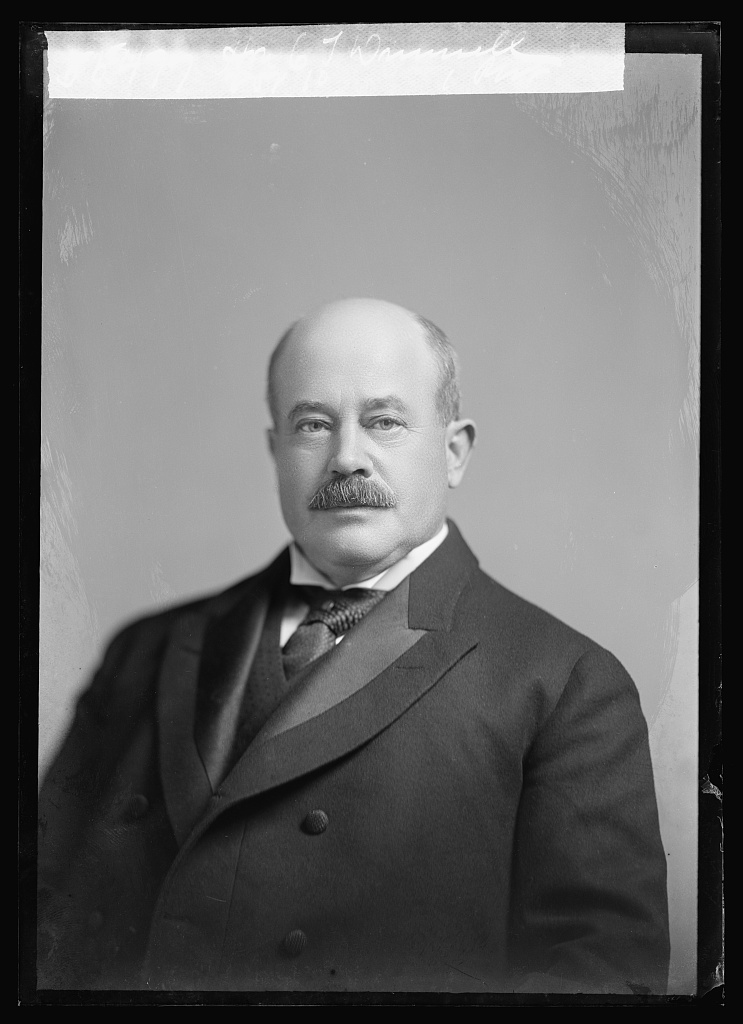
Historical · U.S. House · New York · District 3
Charles Dunwell
Former U.S. Representative · New York District 3 · 1903–1909 · Republican
Charles Dunwell represented New York's District 3 in the United States House of Representatives (1903–1909) for the Republican party. The page below collects sourced biographical facts, term history, committee roles, and provenance for Dunwell.
Bioguide ID: D000557
Key facts
- Full name
- Charles Dunwell
- State
- New York
- District
- District 3
- Party
- Republican
- House service
- 1903–1909
- First House term
- 1903
- Status
- Left office
- Current term ends
- —
- Born
- 1852
- Bioguide ID
- D000557
- Committee assignments
- —
- Dataset version
- 1.20260606
Biographical narrative
812 words · sourced from the Wikipedia REST extract
Charles Dunwell was a U.S. Representative from New York, serving as a member of the Republican Party. He represented New York's 3rd congressional district in the House of Representatives, with his tenure spanning from 1903 until his death in 1908. Dunwell's career in public service and law was marked by his commitment to his constituents and his involvement in various capacities within the political landscape of New York during the early 20th century.
Early life and career
Charles Dunwell was born on February 13, 1852, in Newark, New York. His family relocated to Lyons, a nearby town, in 1854, where he spent his formative years. Dunwell received his early education at the Lyons Union School, which laid the groundwork for his future academic pursuits. He demonstrated a strong inclination towards higher education, ultimately enrolling at Cornell University in Ithaca, New York. He was part of the class of 1873 and became a member of the Kappa Alpha Society, an organization that fostered academic and social engagement among its members.
After completing his junior year at Cornell, Dunwell transitioned to Columbia Law School in New York City, where he furthered his legal education. He graduated from Columbia in 1874 and was subsequently admitted to the bar the same year. Following his admission, he began practicing law in New York City, establishing a career that would serve as a foundation for his future political endeavors.
In 1889, Dunwell took on the role of general agent for the New York Life Insurance Company, a position that likely enhanced his understanding of financial and insurance matters, which would later inform his legislative priorities. His early political aspirations included an unsuccessful bid for the position of comptroller of the city of Brooklyn in 1890. Despite this setback, Dunwell remained active in politics, serving on the New York Republican State Committee from 1891 to 1892. His involvement in the Republican Party during this period helped to solidify his political connections and prepare him for future electoral success.
House tenure
Dunwell's congressional career began when he was elected to the Fifty-eighth Congress as a Republican representative for New York's 3rd congressional district. He took office on March 4, 1903, and was subsequently re-elected to the Fifty-ninth and Sixtieth Congresses. Throughout his time in the House of Representatives, Dunwell served until his death on June 12, 1908, in Brooklyn, New York. His tenure in Congress spanned a critical period in American history, characterized by significant social and political changes.
During his time in the House, Dunwell participated in various legislative activities and contributed to discussions on a range of issues pertinent to his constituents and the nation. His experience in law and insurance likely influenced his perspectives on economic and regulatory matters, although specific details regarding his legislative initiatives and voting record are not extensively documented.
Dunwell's service in Congress was marked by his commitment to the Republican Party and its platform during the early 20th century, a time when the party was focused on issues such as economic growth, infrastructure development, and regulatory reforms. His role as a representative allowed him to advocate for the interests of his district and engage with national policy discussions.
Legislative focus and committees
While specific details regarding the committees on which Dunwell served or the particular legislative issues he championed are not extensively recorded, it is reasonable to infer that his background in law and insurance would have informed his legislative focus. Representatives during this era often engaged with issues related to economic policy, public infrastructure, and social reforms, reflecting the broader concerns of their constituents.
Dunwell's legal expertise may have positioned him to contribute to discussions surrounding regulatory frameworks, particularly in areas related to commerce and finance. As a member of the Republican Party, he likely aligned with the party's emphasis on promoting business interests and fostering economic development. His tenure coincided with a time of significant growth in the United States, and representatives were often tasked with addressing the challenges and opportunities that arose from this expansion.
Although the specifics of Dunwell's legislative contributions are not detailed, his role as a U.S. Representative would have involved participation in debates, committee meetings, and the formulation of policy proposals aimed at addressing the needs of his constituents. The early 20th century was a time of transition in American society, and legislators like Dunwell were integral to shaping the legislative responses to these changes.
Dunwell's congressional career came to an end with his death in office, which marked the conclusion of his public service. He was interred in Evergreen Cemetery, leaving behind a legacy as a dedicated public servant who contributed to the political landscape of New York during a transformative period in American history. His life and career reflect the complexities of early 20th-century American politics and the role of representatives in addressing the needs and concerns of their constituents.
Notable legislation
Sponsored and co-sponsored legislation for Charles Dunwell is pending operator curation. The biographical narrative above carries the same provenance trail until per-bill rows are written.
Sources
- [1]https://en.wikipedia.org/wiki/Charles_T._DunwellWikipedia · retrieved 2026-06-06
Notable quotes
Sourced quotes for Charles Dunwell are pending operator curation. Narrative-scope provenance remains attached below.
Sources
- [1]https://en.wikipedia.org/wiki/Charles_T._DunwellWikipedia · retrieved 2026-06-06
Key positions
Curated policy positions for Charles Dunwell are pending operator review. The biographical narrative above carries the same provenance trail until per-topic positions are written.
Sources
- [1]https://en.wikipedia.org/wiki/Charles_T._DunwellWikipedia · retrieved 2026-06-06
Terms served
- 1903–1905U.S. House · Term 1 · Republican
- 1905–1907U.S. House · Term 2 · Republican
- 1907–1909U.S. House · Term 3 · Republican
Sources & provenance
Every attributable claim above carries a per-section [N] marker that resolves to the corresponding URL below. Each entry records the upstream provider, the canonical URL, and the timestamp at which the source was retrieved by the ingest pipeline.
Key facts
- https://bioguide.congress.gov/search/bio/D000557bioguide · retrieved 2026-06-06
- https://www.govtrack.us/congress/members/403664govtrack · retrieved 2026-06-06
Biographical narrative
- https://en.wikipedia.org/wiki/Charles_T._Dunwellwikipedia · retrieved 2026-06-06
Find your representative
Every U.S. state elects representatives by district. Browse New York’s delegation, the full former-representative roster, or explore the role and term length.
Related on The Candidate
- Preceded by Henry BristowEarlier holder of the New York District 3 House seat · Republican.Open
- Succeeded by Joseph FlynnLater holder of the New York District 3 House seat · Democratic.Open
- Abel HuntingtonFormer U.S. Representative · New York District 1 · JacksonOpen
- Alfred ChapinFormer U.S. Representative · New York District 1 · DemocraticOpen
- Cadwallader ColdenFormer U.S. Representative · New York District 1 · FederalistOpen
- Charles FloydFormer U.S. Representative · New York District 1 · DemocraticOpen