
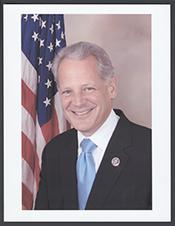
Historical · U.S. House · New York · District 3
Steve Israel
Former U.S. Representative · New York District 3 · 2001–2017 · Democratic
Steve Israel represented New York's District 3 in the United States House of Representatives (2001–2017) for the Democratic party. The page below collects sourced biographical facts, term history, committee roles, and provenance for Israel.
Bioguide ID: I000057
Key facts
- Full name
- Steve Israel
- State
- New York
- District
- District 3
- Party
- Democratic
- House service
- 2001–2017
- First House term
- 2001
- Status
- Left office
- Current term ends
- —
- Born
- 1958
- Bioguide ID
- I000057
- Committee assignments
- —
- Dataset version
- 1.20260605
Biographical narrative
869 words · sourced from the Wikipedia REST extract
Steven Jay Israel is a former U.S. Representative from New York, who served in the House of Representatives from 2001 until 2017. A member of the Democratic Party, he represented New York's 2nd congressional district until 2013 and subsequently New York's 3rd congressional district until his retirement. During his tenure, Israel held various leadership roles, including chairing the Democratic Congressional Campaign Committee and the Democratic Policy and Communications Committee. Following his departure from Congress, he transitioned into political commentary and academia.
Early life and career
Steve Israel was born on May 30, 1958, in Brooklyn, New York, and grew up in Levittown, a community on Long Island. His educational journey began at Nassau Community College, followed by a year at Syracuse University. He ultimately graduated from George Washington University in 1982 with a Bachelor of Arts degree.
After completing his education, Israel began his professional career as a staff member for U.S. Representative Richard Ottinger. This experience provided him with insights into the legislative process and the workings of Congress. In 1993, he entered local politics, securing a position on the Huntington Town Board, where he served until his election to the U.S. House of Representatives.
House tenure
Israel's congressional career commenced in 2001 when he was elected to represent New York's 2nd congressional district after the incumbent, Rick Lazio, vacated the seat to run for the U.S. Senate. Israel won the election with 48% of the vote, defeating Republican candidate Joan Johnson, who garnered 34%, along with several independent candidates. His ability to navigate the political landscape allowed him to be reelected seven times, often with relative ease, despite the district being characterized as a swing area.
During his time in the House, Israel announced on January 5, 2016, that he would not seek reelection in November 2016, marking the end of his eight terms in office. His tenure was marked by a commitment to various issues and a focus on representing the interests of his constituents in northern Nassau County, Suffolk County, and a small portion of Queens.
Legislative focus and committees
Throughout his time in Congress, Israel was involved in numerous legislative efforts and committee assignments. He served on the Committee on Appropriations, where he participated in subcommittees focused on Energy and Water Development, State, Foreign Operations, and Related Programs, as well as Military Construction, Veterans Affairs, and Related Agencies. His work on these committees allowed him to influence funding and policy decisions on critical issues affecting both his constituents and the nation.
In addition to his committee work, Israel was active in various caucuses. He was a co-chair and founder of the Congressional Center Aisle Caucus, which aimed to foster bipartisanship. He also co-chaired the House Cancer Caucus and the Long Island Sound Caucus, focusing on health and environmental issues, respectively. His leadership roles extended to the Democratic Party, where he served as an Assistant Democratic Whip and chaired the House Democratic Caucus Task Force on Defense and the Military. He also co-chaired the House Democratic Study Group on National Security Policy, reflecting his engagement with defense and military matters.
Israel's voting record included significant decisions, such as his support for the authorization of military force in Iraq, which was contrary to the stance of many of his Democratic colleagues. His leadership as Assistant Whip in his second term and as chair of the House Democratic Caucus Task Force on Defense and Military in his third term underscored his influence within the party and his commitment to military and defense issues.
His policy positions were diverse, reflecting a range of interests and concerns. On the topic of abortion, Israel supported legal access under specific circumstances, such as cases of rape, incest, and threats to the mother's life. He consistently received high ratings from pro-choice organizations, indicating his alignment with their advocacy.
In the realm of economics, Israel proposed legislation aimed at requiring U.S. national parks to sell merchandise made in the United States, highlighting his focus on domestic production and job creation. He also advocated for increased gun control measures, voting against legislation that would reduce federal regulations on firearms and supporting initiatives like the "No Fly, No Buy" Act, which aimed to prevent individuals on the no-fly list from purchasing guns.
Israel's engagement with social movements, such as his support for Occupy Wall Street, drew both attention and criticism. He defended his position by emphasizing his commitment to Israel and his Jewish heritage amidst accusations of anti-Semitism directed at the movement.
In leadership roles, Israel was recognized for his fundraising abilities and candidate recruitment efforts, which contributed to his selection as chair of the Democratic Congressional Campaign Committee from 2011 to 2015. His tenure in this role was marked by efforts to maintain Democratic competitiveness in a challenging electoral environment.
After leaving Congress in 2017, Israel transitioned to a career as a political commentator, joining CNN. In 2019, he was appointed as the inaugural director of the Institute of Politics and Global Affairs at Cornell University, furthering his engagement with political discourse and education. As of 2022, he also serves on the Board of Advisors for the lobbying firm Michael Best Strategies, continuing his involvement in political and public policy discussions.
Notable legislation
Sponsored and co-sponsored legislation for Steve Israel is pending operator curation. The biographical narrative above carries the same provenance trail until per-bill rows are written.
Sources
- [1]https://en.wikipedia.org/wiki/Steve_IsraelWikipedia · retrieved 2026-06-05
Notable quotes
Sourced quotes for Steve Israel are pending operator curation. Narrative-scope provenance remains attached below.
Sources
- [1]https://en.wikipedia.org/wiki/Steve_IsraelWikipedia · retrieved 2026-06-05
Key positions
Curated policy positions for Steve Israel are pending operator review. The biographical narrative above carries the same provenance trail until per-topic positions are written.
Sources
- [1]https://en.wikipedia.org/wiki/Steve_IsraelWikipedia · retrieved 2026-06-05
Terms served
- 2001–2003U.S. House · Term 1 · Democratic
- 2003–2005U.S. House · Term 2 · Democratic
- 2005–2007U.S. House · Term 3 · Democratic
- 2007–2009U.S. House · Term 4 · Democratic
- 2009–2011U.S. House · Term 5 · Democratic
- 2011–2013U.S. House · Term 6 · Democratic
- 2013–2015U.S. House · Term 7 · Democratic
- 2015–2017U.S. House · Term 8 · Democratic
Sources & provenance
Every attributable claim above carries a per-section [N] marker that resolves to the corresponding URL below. Each entry records the upstream provider, the canonical URL, and the timestamp at which the source was retrieved by the ingest pipeline.
Key facts
- https://bioguide.congress.gov/search/bio/I000057bioguide · retrieved 2026-06-05
- http://israel.house.govhouse.gov · retrieved 2026-06-05
Biographical narrative
- https://en.wikipedia.org/wiki/Steve_Israelwikipedia · retrieved 2026-06-05
Find your representative
Every U.S. state elects representatives by district. Browse New York’s delegation, the full former-representative roster, or explore the role and term length.
Related on The Candidate
- Preceded by Robert MrazekEarlier holder of the New York District 3 House seat · Democratic.Open
- Succeeded by George SantosLater holder of the New York District 3 House seat · Republican.Open
- Abel HuntingtonFormer U.S. Representative · New York District 1 · JacksonOpen
- Alfred ChapinFormer U.S. Representative · New York District 1 · DemocraticOpen
- Cadwallader ColdenFormer U.S. Representative · New York District 1 · FederalistOpen
- Charles FloydFormer U.S. Representative · New York District 1 · DemocraticOpen