
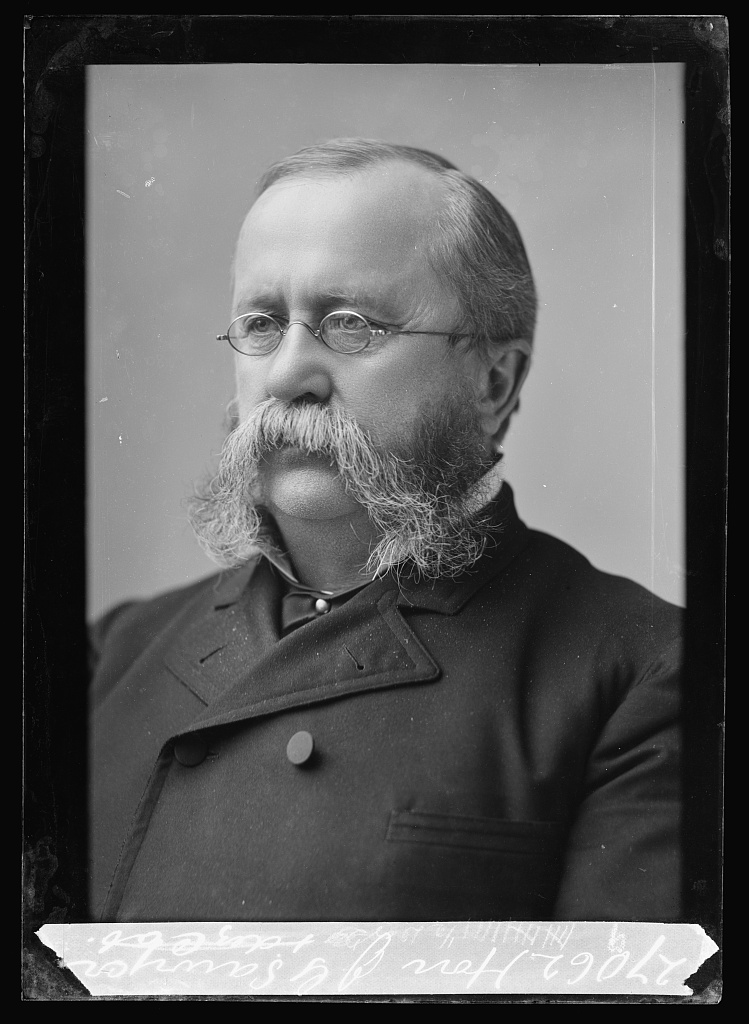
Historical · U.S. House · New York · District 31
John Sawyer
Former U.S. Representative · New York District 31 · 1885–1891 · Republican
John Sawyer represented New York's District 31 in the United States House of Representatives (1885–1891) for the Republican party. The page below collects sourced biographical facts, term history, committee roles, and provenance for Sawyer.
Bioguide ID: S000088
Key facts
- Full name
- John Sawyer
- State
- New York
- District
- District 31
- Party
- Republican
- House service
- 1885–1891
- First House term
- 1885
- Status
- Left office
- Current term ends
- —
- Born
- 1825
- Bioguide ID
- S000088
- Committee assignments
- —
- Dataset version
- 1.20260606
Biographical narrative
909 words · sourced from the Wikipedia REST extract
John Sawyer was a prominent U.S. Representative from New York, serving in the House of Representatives during the late 19th century. A member of the Republican Party, Sawyer's political career spanned three terms in Congress, where he was known for his commitment to education and public service. His tenure in the House began in 1885 and concluded in 1891, after which he returned to his legal practice until his death in 1898.
Early life and career
John Sawyer was born on June 5, 1825, in Brandon, Vermont, as the eldest of seven children in the family of John F. and Mary J. Sawyer. In 1831, the Sawyer family moved to Knowlesville, New York, where John received his early education at local common schools and later at Millville Academy. His pursuit of higher education led him to Kentucky and Arkansas, where he worked as a teacher in one-room schoolhouses. This experience allowed him to earn the necessary funds to continue his studies.
In 1846, Sawyer returned to Knowlesville and subsequently moved to Albion, New York, in 1847. There, he began studying law, initially with the firm of Curtis & Stone and later with Benjamin L. Bessac. His legal career began to take shape before he completed his formal education in law. In 1848, he was elected as the superintendent of public schools for Orleans County, New York, reflecting his strong commitment to education and community service.
Sawyer's political career began to flourish in the early 1850s. In 1851, he was elected as a justice of the peace, a position he held for nearly five years. This role provided him with valuable experience in the legal and political systems of his time. In 1855, he formed a partnership with Sanford E. Church, which further established his presence in the legal community. His political aspirations continued to grow, and in 1862, he was elected as the district attorney for Orleans County. The following year, he was elected as the county judge, solidifying his reputation as a dedicated public servant.
In addition to his legal and political roles, Sawyer was a strong advocate for education. In 1876, he was appointed to the original Board of Education for the Albion Union Free School, demonstrating his ongoing commitment to improving educational opportunities in his community.
House tenure
John Sawyer's congressional career began when he was elected to the U.S. House of Representatives as a Republican in 1884. He served three consecutive terms, representing New York's 31st congressional district during the Forty-ninth, Fiftieth, and Fifty-first Congresses from March 4, 1885, to March 3, 1891. His election to Congress marked a significant milestone in his political journey, as he transitioned from local and state-level positions to a national platform.
During his time in the House, Sawyer was known for his staunch Republican alignment and his commitment to the principles of the party, which had evolved from the Whig Party. He played a role in organizing the Republican Party in Orleans County, contributing to its growth and influence in the region. His experience as a lawyer and public servant informed his legislative priorities and actions while in office.
Sawyer's tenure in Congress coincided with a period of significant political and social change in the United States. The late 19th century was marked by industrialization, urbanization, and various reform movements. As a member of the House, Sawyer participated in discussions and debates that shaped the nation's policies during this transformative era. His background in law and education likely influenced his perspectives on issues related to governance, public welfare, and the role of education in society.
After completing his third term in Congress, Sawyer returned to Albion, New York, where he resumed his legal practice. His decision to step away from national politics did not diminish his commitment to public service, as he continued to engage with his community and contribute to local affairs.
Legislative focus and committees
While specific details regarding the legislation Sawyer sponsored or the committees he served on during his time in Congress are not extensively documented, his background suggests a strong focus on issues related to education and public welfare. Given his previous roles in local government and his advocacy for educational initiatives, it is likely that he prioritized legislation aimed at improving educational opportunities and supporting community development.
As a member of the Republican Party during a time of significant political activity, Sawyer would have been involved in discussions surrounding economic policies, infrastructure development, and social reforms. The late 19th century was characterized by debates over tariffs, labor rights, and the expansion of the federal government's role in various aspects of American life. Sawyer's legal expertise and experience in local governance would have provided him with valuable insights into these issues.
Following his departure from Congress in 1891, Sawyer continued to be recognized for his contributions to his community and the state of New York. He passed away on September 5, 1898, in Albion, where he was interred at Mount Albion Cemetery. His legacy includes the hamlet of Sawyer in Orleans County, which was named in his honor, reflecting the impact he had on his community and the region.
In summary, John Sawyer's life and career were marked by a dedication to public service, education, and the principles of the Republican Party. His journey from a local educator to a U.S. Representative illustrates the potential for individuals to influence their communities and the nation through commitment and active participation in governance.
Notable legislation
Sponsored and co-sponsored legislation for John Sawyer is pending operator curation. The biographical narrative above carries the same provenance trail until per-bill rows are written.
Sources
- [1]https://en.wikipedia.org/wiki/John_G._SawyerWikipedia · retrieved 2026-06-06
Notable quotes
Sourced quotes for John Sawyer are pending operator curation. Narrative-scope provenance remains attached below.
Sources
- [1]https://en.wikipedia.org/wiki/John_G._SawyerWikipedia · retrieved 2026-06-06
Key positions
Curated policy positions for John Sawyer are pending operator review. The biographical narrative above carries the same provenance trail until per-topic positions are written.
Sources
- [1]https://en.wikipedia.org/wiki/John_G._SawyerWikipedia · retrieved 2026-06-06
Terms served
- 1885–1887U.S. House · Term 1 · Republican
- 1887–1889U.S. House · Term 2 · Republican
- 1889–1891U.S. House · Term 3 · Republican
Sources & provenance
Every attributable claim above carries a per-section [N] marker that resolves to the corresponding URL below. Each entry records the upstream provider, the canonical URL, and the timestamp at which the source was retrieved by the ingest pipeline.
Key facts
- https://bioguide.congress.gov/search/bio/S000088bioguide · retrieved 2026-06-06
- https://www.govtrack.us/congress/members/409600govtrack · retrieved 2026-06-06
Biographical narrative
- https://en.wikipedia.org/wiki/John_G._Sawyerwikipedia · retrieved 2026-06-06
Find your representative
Every U.S. state elects representatives by district. Browse New York’s delegation, the full former-representative roster, or explore the role and term length.
Related on The Candidate
- Preceded by Robert StevensEarlier holder of the New York District 31 House seat · Democratic.Open
- Succeeded by Henry BrewsterLater holder of the New York District 31 House seat · Republican.Open
- Abel HuntingtonFormer U.S. Representative · New York District 1 · JacksonOpen
- Alfred ChapinFormer U.S. Representative · New York District 1 · DemocraticOpen
- Cadwallader ColdenFormer U.S. Representative · New York District 1 · FederalistOpen
- Charles FloydFormer U.S. Representative · New York District 1 · DemocraticOpen