
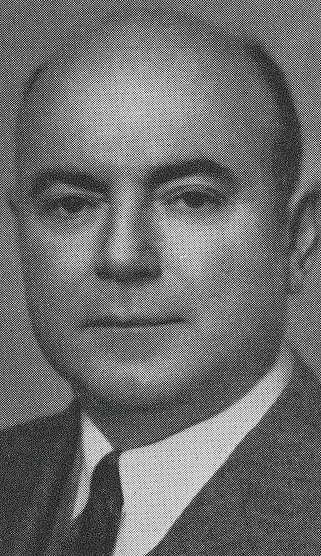
Historical · U.S. House · New York · District 32
Pat Kearney
Former U.S. Representative · New York District 32 · 1943–1959 · Republican
Pat Kearney represented New York's District 32 in the United States House of Representatives (1943–1959) for the Republican party. The page below collects sourced biographical facts, term history, committee roles, and provenance for Kearney.
Bioguide ID: K000030
Key facts
- Full name
- Pat Kearney
- State
- New York
- District
- District 32
- Party
- Republican
- House service
- 1943–1959
- First House term
- 1943
- Status
- Left office
- Current term ends
- —
- Born
- 1889
- Bioguide ID
- K000030
- Committee assignments
- —
- Dataset version
- 1.20260605
Biographical narrative
986 words · sourced from the Wikipedia REST extract
Bernard William "Pat" Kearney was a Republican politician who served as a member of the United States House of Representatives from New York's 32nd congressional district. His congressional career spanned from 1943 until 1959, during which he became known for his staunch anti-communist stance and his advocacy for veterans' affairs. Kearney played a significant role in the passage of the GI Bill, which provided benefits to returning World War II veterans, and he was actively involved in various military and veterans organizations throughout his life.
Early life and career
Pat Kearney was born on May 23, 1889, in Ithaca, New York, to Patrick B. Kearney, a clothier, and Josephine M. Kearney. He pursued higher education at Albany Law School, graduating in 1914, where he was a member of the Delta Chi fraternity. Following his graduation, Kearney began his legal career in Gloversville, New York, establishing himself as an attorney in Hamilton and Fulton Counties.
Kearney's military career began in 1909 when he enlisted in the New York National Guard. He initially served with Company G of the 2nd New York Infantry and later transferred to Troop B of the 1st New York Cavalry. His service included participation in the Pancho Villa Expedition in 1916, where he was involved in border patrol operations. In 1917, he attended Officer Training School at Fort Niagara, receiving his commission shortly thereafter.
During World War I, Kearney served in France as part of the 27th Division, where he saw combat in significant battles such as St. Mihiel and Meuse-Argonne. His contributions during the war earned him prestigious honors, including the French Legion of Honor (Officer) and the Croix de Guerre. After the war, he continued his service in the National Guard, eventually rising to the rank of brigadier general before retiring in 1940.
In addition to his military service, Kearney was active in local politics and held various legal positions. He served as the City Judge of Gloversville from 1920 to 1924 and later as the Assistant District Attorney for Hamilton County from 1924 to 1929 and for Fulton County from 1929 to 1931. He was appointed Fulton County District Attorney, a position he held from 1931 until 1942.
House tenure
Kearney's political career at the federal level began when he was elected to the United States House of Representatives in 1942. He officially took office on January 3, 1943, and served a total of eight consecutive terms, concluding his tenure on January 3, 1959. Throughout his time in Congress, Kearney was recognized for his commitment to veterans' issues and his strong anti-communist views, which were particularly prominent during the Cold War era.
In the House, Kearney rose to prominence as the ranking Republican member of the House Un-American Activities Committee (HUAC). This committee was instrumental in investigating alleged communist activities within the United States, and Kearney's involvement underscored his dedication to combating perceived threats to American democracy. His reputation as a staunch anti-communist was well-established during his time on the committee.
Kearney's legislative achievements included co-authoring the GI Bill, a landmark piece of legislation that provided a range of benefits to veterans returning from World War II. His efforts were crucial in shepherding the bill through Congress, and he is credited with suggesting the title of the legislation. The GI Bill significantly impacted the lives of millions of veterans, providing them with access to education, housing, and other essential services.
In addition to his work on veterans' affairs, Kearney also participated in discussions surrounding civil rights. He voted in favor of the Civil Rights Act of 1957, which aimed to address voting rights and discrimination issues affecting African Americans.
Kearney chose not to seek re-election in 1958, concluding his congressional career after serving for over 15 years. His decision to retire marked the end of a significant chapter in his life, during which he had made substantial contributions to both his constituents and the nation.
Legislative focus and committees
During his tenure in the U.S. House of Representatives, Kearney's legislative focus was primarily centered on veterans' affairs and anti-communism. As a member of the House Un-American Activities Committee, he played a vital role in investigating and addressing concerns related to communist influence in the United States. His work on the committee was reflective of the broader national sentiment during the Cold War, as fears of communism permeated American society and politics.
Kearney's advocacy for veterans was perhaps his most notable contribution to American legislation. The GI Bill, which he co-authored, became a cornerstone of post-war policy aimed at assisting returning servicemen and women. The bill provided a range of benefits, including education funding, low-interest home loans, and unemployment compensation, which collectively transformed the landscape for veterans reintegrating into civilian life. Kearney's involvement in this legislation demonstrated his commitment to ensuring that those who served in the military received the support they deserved.
In addition to his work on veterans' issues, Kearney's support for civil rights legislation indicated a willingness to engage with the pressing social issues of his time. His vote in favor of the Civil Rights Act of 1957 illustrated a recognition of the need for legislative action to address racial discrimination and promote equality.
Throughout his congressional career, Kearney's positions on various issues were influenced by his background as a veteran and his experiences in local and state government. His legal expertise and military service informed his approach to policy-making, allowing him to advocate effectively for the interests of his constituents and the nation as a whole.
After leaving Congress, Kearney continued to be active in various capacities, residing in Canandaigua, New York, and Venice, Florida, during his retirement. He passed away on June 3, 1976, in Venice and was laid to rest at Arlington National Cemetery, a testament to his service to the nation. His legacy as a dedicated public servant and advocate for veterans remains a notable aspect of his life and career.
Notable legislation
Sponsored and co-sponsored legislation for Pat Kearney is pending operator curation. The biographical narrative above carries the same provenance trail until per-bill rows are written.
Sources
- [1]https://en.wikipedia.org/wiki/Bernard_W._KearneyWikipedia · retrieved 2026-06-05
Notable quotes
Sourced quotes for Pat Kearney are pending operator curation. Narrative-scope provenance remains attached below.
Sources
- [1]https://en.wikipedia.org/wiki/Bernard_W._KearneyWikipedia · retrieved 2026-06-05
Key positions
Curated policy positions for Pat Kearney are pending operator review. The biographical narrative above carries the same provenance trail until per-topic positions are written.
Sources
- [1]https://en.wikipedia.org/wiki/Bernard_W._KearneyWikipedia · retrieved 2026-06-05
Terms served
- 1943–1945U.S. House · Term 1 · Republican
- 1945–1947U.S. House · Term 2 · Republican
- 1947–1949U.S. House · Term 3 · Republican
- 1949–1951U.S. House · Term 4 · Republican
- 1951–1953U.S. House · Term 5 · Republican
- 1953–1955U.S. House · Term 6 · Republican
- 1955–1957U.S. House · Term 7 · Republican
- 1957–1959U.S. House · Term 8 · Republican
Sources & provenance
Every attributable claim above carries a per-section [N] marker that resolves to the corresponding URL below. Each entry records the upstream provider, the canonical URL, and the timestamp at which the source was retrieved by the ingest pipeline.
Key facts
- https://bioguide.congress.gov/search/bio/K000030bioguide · retrieved 2026-06-05
- https://www.govtrack.us/congress/members/406201govtrack · retrieved 2026-06-05
Biographical narrative
- https://en.wikipedia.org/wiki/Bernard_W._Kearneywikipedia · retrieved 2026-06-05
Find your representative
Every U.S. state elects representatives by district. Browse New York’s delegation, the full former-representative roster, or explore the role and term length.
Related on The Candidate
- Preceded by Thaddeus SweetEarlier holder of the New York District 32 House seat · Republican.Open
- Succeeded by Alexander PirnieLater holder of the New York District 32 House seat · Republican.Open
- Abel HuntingtonFormer U.S. Representative · New York District 1 · JacksonOpen
- Alfred ChapinFormer U.S. Representative · New York District 1 · DemocraticOpen
- Cadwallader ColdenFormer U.S. Representative · New York District 1 · FederalistOpen
- Charles FloydFormer U.S. Representative · New York District 1 · DemocraticOpen