
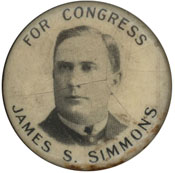
Historical · U.S. House · New York · District 34
James Simmons
Former U.S. Representative · New York District 34 · 1909–1913 · Republican
James Simmons represented New York's District 34 in the United States House of Representatives (1909–1913) for the Republican party. The page below collects sourced biographical facts, term history, committee roles, and provenance for Simmons.
Bioguide ID: S000418
Key facts
- Full name
- James Simmons
- State
- New York
- District
- District 34
- Party
- Republican
- House service
- 1909–1913
- First House term
- 1909
- Status
- Left office
- Current term ends
- —
- Born
- 1861
- Bioguide ID
- S000418
- Committee assignments
- —
- Dataset version
- 1.20260606
Biographical narrative
918 words · sourced from the Wikipedia REST extract
James Simmons was a U.S. Representative from New York, serving in the House of Representatives during the early 20th century. A member of the Republican Party, Simmons represented New York's 34th congressional district for two terms from 1909 until 1913. His career in public service was preceded by a successful venture in the real estate business, which he pursued both in New York and later in Florida. Simmons was also involved in local Republican politics, serving as chairman of the city committee in Niagara Falls. After his congressional tenure, he returned to his business pursuits until his death in 1935.
Early life and career
James Simmons was born on November 25, 1861, near Liberty, Maryland. His early education took place in the public schools of his hometown, where he laid the foundation for his future endeavors. He furthered his education by attending the local academy and graduated from Frederick College, an institution known for its commitment to liberal arts education. This academic background provided Simmons with the skills and knowledge that would later aid him in his professional and political career.
In 1880, Simmons relocated to Roanoke, Virginia, where he entered the real estate business. This move marked the beginning of his professional life, and he quickly established himself in the industry. Real estate would become a significant aspect of his career, as he demonstrated a keen understanding of the market and the needs of the community. In 1894, Simmons moved again, this time to Niagara Falls, New York. The burgeoning city, known for its natural beauty and tourism, offered ample opportunities for real estate development. Simmons continued his work in real estate in Niagara Falls, where he would eventually become a prominent figure in local business and politics.
Simmons's involvement in the Republican Party began to take shape during his time in Niagara Falls. He served as the chairman of the Republican city committee in both 1907 and 1908, indicating his growing influence within the party at the local level. His leadership in the committee likely helped him build a network of supporters and allies, which would prove beneficial when he decided to run for public office.
House tenure
Simmons's political career reached a significant milestone when he was elected to the United States House of Representatives. He was elected as a Republican to the Sixty-first Congress, beginning his first term on March 4, 1909. His election came during a period of significant political change in the United States, as the country was experiencing rapid industrialization and urbanization. Simmons's tenure in the House lasted until March 3, 1913, encompassing two full terms.
During his time in Congress, Simmons participated in various legislative activities and contributed to discussions on issues pertinent to his constituents and the nation. While specific details regarding the bills he supported or opposed during his tenure are not documented, his role as a congressman would have involved addressing the pressing concerns of the time, such as economic development, infrastructure, and social issues. As a representative from New York, a state that was central to many national discussions, Simmons would have had the opportunity to influence key legislative decisions.
Despite his efforts and contributions, Simmons faced challenges in his political career. He was an unsuccessful candidate for reelection in 1912, which marked the end of his time in the House. The political landscape was competitive, and the dynamics of voter preferences can often shift, leading to electoral challenges for incumbents. Following his defeat, Simmons continued to engage in political activities, including serving as a delegate to the Republican National Convention in 1912, where he would have had the opportunity to participate in shaping the party's platform and direction.
Legislative focus and committees
While specific details regarding Simmons's legislative focus and the committees on which he served during his congressional tenure are not provided, it can be inferred that, as a member of the Republican Party during the early 1900s, his legislative priorities likely aligned with the broader goals of the party at that time. The Republican Party was generally associated with promoting business interests, advocating for economic growth, and supporting infrastructure development, particularly in rapidly growing urban areas like those in New York.
Simmons's background in real estate may have influenced his perspective on urban development and housing issues. Given the significant population growth and urbanization occurring in the early 20th century, issues related to housing, land use, and urban planning would have been critical topics for a representative from a major city like Niagara Falls. His experiences in the real estate sector may have provided him with valuable insights into the needs of his constituents, particularly regarding economic opportunities and community development.
After leaving Congress, Simmons returned to his real estate business in Niagara Falls, where he continued to apply his expertise in the field. In 1927, he expanded his business ventures to St. Petersburg, Florida, reflecting a broader trend of migration and economic opportunity in the southern United States during that period. Simmons's ability to adapt to changing markets and environments speaks to his entrepreneurial spirit and commitment to his professional pursuits.
James Simmons passed away on November 28, 1935, just three days after his 74th birthday. His contributions to his community and his service in the U.S. House of Representatives remain part of the historical record of New York's political landscape. He was interred in Riverdale Cemetery in Lewiston, New York, where he is remembered as a figure who engaged in both business and public service throughout his life.
Notable legislation
Sponsored and co-sponsored legislation for James Simmons is pending operator curation. The biographical narrative above carries the same provenance trail until per-bill rows are written.
Sources
- [1]https://en.wikipedia.org/wiki/James_S._Simmons_(New_York_politician)Wikipedia · retrieved 2026-06-06
Notable quotes
Sourced quotes for James Simmons are pending operator curation. Narrative-scope provenance remains attached below.
Sources
- [1]https://en.wikipedia.org/wiki/James_S._Simmons_(New_York_politician)Wikipedia · retrieved 2026-06-06
Key positions
Curated policy positions for James Simmons are pending operator review. The biographical narrative above carries the same provenance trail until per-topic positions are written.
Sources
- [1]https://en.wikipedia.org/wiki/James_S._Simmons_(New_York_politician)Wikipedia · retrieved 2026-06-06
Terms served
- 1909–1911U.S. House · Term 1 · Republican
- 1911–1913U.S. House · Term 2 · Republican
Sources & provenance
Every attributable claim above carries a per-section [N] marker that resolves to the corresponding URL below. Each entry records the upstream provider, the canonical URL, and the timestamp at which the source was retrieved by the ingest pipeline.
Key facts
- https://bioguide.congress.gov/search/bio/S000418bioguide · retrieved 2026-06-06
- https://www.govtrack.us/congress/members/409912govtrack · retrieved 2026-06-06
Biographical narrative
- https://en.wikipedia.org/wiki/James_S._Simmons_(New_York_politician)wikipedia · retrieved 2026-06-06
Find your representative
Every U.S. state elects representatives by district. Browse New York’s delegation, the full former-representative roster, or explore the role and term length.
Related on The Candidate
- Preceded by Peter PorterEarlier holder of the New York District 34 House seat · Ind. Republican.Open
- Succeeded by William HillLater holder of the New York District 34 House seat · Republican.Open
- Abel HuntingtonFormer U.S. Representative · New York District 1 · JacksonOpen
- Alfred ChapinFormer U.S. Representative · New York District 1 · DemocraticOpen
- Cadwallader ColdenFormer U.S. Representative · New York District 1 · FederalistOpen
- Charles FloydFormer U.S. Representative · New York District 1 · DemocraticOpen