
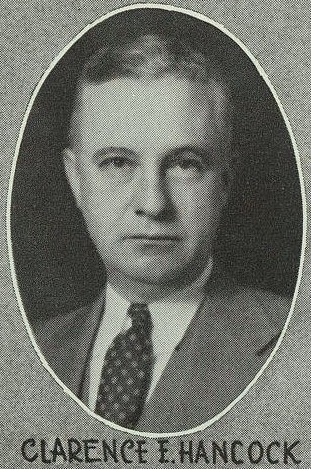
Historical · U.S. House · New York · District 36
Clarence Hancock
Former U.S. Representative · New York District 36 · 1927–1947 · Republican
Clarence Hancock represented New York's District 36 in the United States House of Representatives (1927–1947) for the Republican party. The page below collects sourced biographical facts, term history, committee roles, and provenance for Hancock.
Bioguide ID: H000146
Key facts
- Full name
- Clarence Hancock
- State
- New York
- District
- District 36
- Party
- Republican
- House service
- 1927–1947
- First House term
- 1927
- Status
- Left office
- Current term ends
- —
- Born
- 1885
- Bioguide ID
- H000146
- Committee assignments
- —
- Dataset version
- 1.20260605
Biographical narrative
1,034 words · sourced from the Wikipedia REST extract
Clarence Eugene Hancock was an American attorney and politician who served as a U.S. Representative for New York's 36th congressional district from 1927 until 1947. A member of the Republican Party, Hancock's political career spanned two decades during which he was involved in significant legislative activities and served on various congressional committees. His early life was marked by a strong educational background and military service, which shaped his professional and civic engagements.
Early life and career
Clarence Hancock was born on February 13, 1885, in Syracuse, New York. He was the son of Martha Connelly Hancock and Theodore E. Hancock, the latter being a notable attorney and political figure who held the position of New York Attorney General from 1894 to 1898. Growing up in Syracuse, Hancock attended Madison School and graduated from Syracuse Central High School. He pursued higher education at Wesleyan University, where he earned his degree in 1906, followed by his legal studies at New York Law School, from which he graduated with a Bachelor of Laws (LL.B.) in 1908.
After being admitted to the bar, Hancock began practicing law in Syracuse, establishing a legal career that would later complement his political ambitions. His early professional life included a significant role as Syracuse's corporation counsel from 1926 to 1927, where he contributed to the legal affairs of the city. In addition to his legal practice, Hancock was actively involved in various civic organizations and served as a director of the Syracuse Journal newspaper. His commitment to community service was evident through his participation in local organizations, including the Onondaga County Bar Association and the Syracuse Chamber of Commerce.
Hancock's military service began with his enlistment in the New York National Guard's 1st Cavalry Regiment, where he achieved the rank of sergeant. He participated in the Pancho Villa Expedition in 1916, which was a military operation aimed at capturing the Mexican revolutionary leader. During World War I, Hancock served with distinction in France as a captain in the 104th Machine Gun Battalion, part of the 27th Division. His leadership during combat earned him recognition for bravery, culminating in the receipt of the Citation Star, which was later upgraded to the Silver Star. His military experiences not only shaped his character but also influenced his later political career.
House tenure
Hancock's political career in the U.S. House of Representatives began with a successful campaign in a special election held in 1927. As a Republican, he won the election and subsequently was reelected every two years, serving a total of ten consecutive terms until January 3, 1947. His tenure in Congress was characterized by a commitment to his constituents in New York's 36th congressional district, where he focused on various legislative issues.
During his time in office, Hancock was known for his opposition to President Franklin D. Roosevelt's New Deal policies, which were designed to address the economic challenges of the Great Depression. His stance on these issues reflected the broader Republican perspective of the time, which often criticized the expansion of federal government intervention in the economy. Hancock's legislative activities included participation in key committees, notably the Judiciary Committee and the Naval Affairs Committee, where he contributed to discussions and decisions on important national issues.
In addition to his committee work, Hancock played a role in the Republican Congressional Campaign Committee, serving as the chair of its speaker's bureau. His involvement in this capacity highlighted his commitment to party organization and electoral strategy, particularly during the 1936 elections when he led the party's eastern speaker's bureau. Hancock's ability to navigate the political landscape of his time allowed him to maintain a significant presence in Congress for two decades.
Despite his long and impactful career, Hancock chose not to seek reelection in 1946 due to declining health. His decision marked the end of an era in which he had established himself as a prominent figure in New York politics. Following his departure from Congress, Hancock continued to engage in community and civic activities until his death.
Legislative focus and committees
Throughout his congressional career, Clarence Hancock was involved in a range of legislative issues and served on several important committees. His opposition to the New Deal was a defining aspect of his political identity, as he consistently advocated for limited government intervention and fiscal conservatism. This ideological stance resonated with many constituents in his district, contributing to his repeated electoral successes.
Hancock's service on the Judiciary Committee allowed him to engage with critical legal and constitutional issues, shaping legislation that impacted the judicial system and civil rights. His role on the Naval Affairs Committee was equally significant, particularly during a time when military readiness and national security were paramount concerns due to the ongoing global conflicts of the era. His contributions to discussions on naval policy and military appropriations reflected his commitment to ensuring the preparedness of the United States Armed Forces.
In addition to his committee responsibilities, Hancock's leadership within the Republican Party was evident through his involvement in campaign strategy and outreach efforts. His role as chair of the Republican Congressional Campaign Committee's speaker's bureau demonstrated his dedication to promoting Republican candidates and policies, particularly in the face of a challenging political landscape during the New Deal era.
Hancock's legislative focus and committee work were complemented by his extensive background in law and military service, which provided him with a unique perspective on the issues facing the nation. His ability to navigate complex legislative matters and advocate for his constituents contributed to his reputation as a dedicated public servant.
Clarence Hancock passed away on January 3, 1948, in Washington, D.C., shortly after concluding his congressional career. He was buried at Woodlawn Cemetery in Syracuse, New York. His legacy includes the impact he made during his time in Congress and the contributions he made to his community and country throughout his life. His family continued to honor his memory, with institutions such as Syracuse Hancock International Airport and Hancock Field Air National Guard Base named in his honor. After his death, his papers were donated to Syracuse University and later transferred to the State University of New York at Albany, preserving his contributions for future generations to study and understand.
Notable legislation
Sponsored and co-sponsored legislation for Clarence Hancock is pending operator curation. The biographical narrative above carries the same provenance trail until per-bill rows are written.
Sources
- [1]https://en.wikipedia.org/wiki/Clarence_E._HancockWikipedia · retrieved 2026-06-05
Notable quotes
Sourced quotes for Clarence Hancock are pending operator curation. Narrative-scope provenance remains attached below.
Sources
- [1]https://en.wikipedia.org/wiki/Clarence_E._HancockWikipedia · retrieved 2026-06-05
Key positions
Curated policy positions for Clarence Hancock are pending operator review. The biographical narrative above carries the same provenance trail until per-topic positions are written.
Sources
- [1]https://en.wikipedia.org/wiki/Clarence_E._HancockWikipedia · retrieved 2026-06-05
Terms served
- 1927–1929U.S. House · Term 1 · Republican
- 1929–1931U.S. House · Term 2 · Republican
- 1931–1933U.S. House · Term 3 · Republican
- 1933–1935U.S. House · Term 4 · Republican
- 1935–1937U.S. House · Term 5 · Republican
- 1937–1939U.S. House · Term 6 · Republican
- 1939–1941U.S. House · Term 7 · Republican
- 1941–1943U.S. House · Term 8 · Republican
- 1943–1945U.S. House · Term 9 · Republican
- 1945–1947U.S. House · Term 10 · Republican
Sources & provenance
Every attributable claim above carries a per-section [N] marker that resolves to the corresponding URL below. Each entry records the upstream provider, the canonical URL, and the timestamp at which the source was retrieved by the ingest pipeline.
Key facts
- https://bioguide.congress.gov/search/bio/H000146bioguide · retrieved 2026-06-05
- https://www.govtrack.us/congress/members/405028govtrack · retrieved 2026-06-05
Biographical narrative
- https://en.wikipedia.org/wiki/Clarence_E._Hancockwikipedia · retrieved 2026-06-05
Find your representative
Every U.S. state elects representatives by district. Browse New York’s delegation, the full former-representative roster, or explore the role and term length.
Related on The Candidate
- Preceded by Norman GouldEarlier holder of the New York District 36 House seat · Republican.Open
- Succeeded by Henry Smith IIILater holder of the New York District 36 House seat · Republican.Open
- Abel HuntingtonFormer U.S. Representative · New York District 1 · JacksonOpen
- Alfred ChapinFormer U.S. Representative · New York District 1 · DemocraticOpen
- Cadwallader ColdenFormer U.S. Representative · New York District 1 · FederalistOpen
- Charles FloydFormer U.S. Representative · New York District 1 · DemocraticOpen