
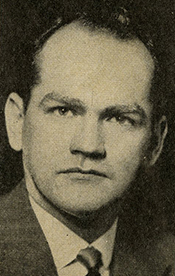
Historical · U.S. House · New York · District 4
Gregory McMahon
Former U.S. Representative · New York District 4 · 1947–1949 · Republican
Gregory McMahon represented New York's District 4 in the United States House of Representatives (1947–1949) for the Republican party. The page below collects sourced biographical facts, term history, committee roles, and provenance for McMahon.
Bioguide ID: M000560
Key facts
- Full name
- Gregory McMahon
- State
- New York
- District
- District 4
- Party
- Republican
- House service
- 1947–1949
- First House term
- 1947
- Status
- Left office
- Current term ends
- —
- Born
- 1915
- Bioguide ID
- M000560
- Committee assignments
- —
- Dataset version
- 1.20260605
Biographical narrative
947 words · sourced from the Wikipedia REST extract
Gregory McMahon was a U.S. Representative from New York, serving as a member of the Republican Party. He held office in the House of Representatives for a single term from 1947 to 1949, representing New York's 4th congressional district. McMahon's career in public service was preceded by a solid educational background and military service, which shaped his approach to politics and governance. After his time in Congress, he continued his professional career as an accountant and tax consultant.
Early life and career
Gregory McMahon was born on March 19, 1915, in New York City. His early education took place in a parochial school, which provided him with a foundation in both academic and moral teachings. He later graduated from St. John's Prep School in Brooklyn in 1933, an institution known for its rigorous academic standards and commitment to preparing students for higher education. Following his high school education, McMahon attended St. John's University, where he completed his undergraduate studies in 1938. His time at St. John's University was pivotal, as it not only equipped him with knowledge but also connected him with a network of peers that would influence his future endeavors.
In 1939, McMahon began his legal education at St. John's Law School, where he studied until 1941. During this period, he also became a certified public accountant, a designation he achieved in 1939. This professional qualification would later inform his work in Congress, particularly in matters related to finance and taxation. In addition to his studies, McMahon contributed to the academic community by teaching at St. John's College from 1939 to 1942. His role as an educator demonstrated his commitment to fostering knowledge and supporting the development of future generations.
With the onset of World War II, McMahon enlisted in the United States Navy, serving as an ensign from December 1941 until October 1945. His military service took place primarily in the Pacific theater, where he was involved in various operations that were critical to the war effort. This experience not only instilled in him a sense of duty and patriotism but also provided him with insights into the challenges faced by service members and their families. After the war, McMahon returned to civilian life, where he resumed his career in accounting and began to explore opportunities in public service.
House tenure
Gregory McMahon's political career began when he was elected to the House of Representatives as a Republican, representing New York's 4th congressional district. He took office on January 3, 1947, during the Eightieth Congress. His election came at a time when the Republican Party was regaining strength after the Democratic dominance that characterized the previous decade. McMahon's tenure in Congress was marked by the post-war era, a period of significant change and adjustment for the United States as it transitioned from wartime to peacetime.
During his time in office, McMahon participated in the legislative process, contributing to discussions and decisions that shaped national policy. His background as a certified public accountant likely influenced his focus on fiscal matters, taxation, and economic policy. However, specific details regarding the legislation he supported or opposed during his term are not extensively documented. McMahon served a single term in the House, concluding his time in office on January 3, 1949, when he was not reelected for the Eighty-first Congress. The reasons for his defeat in the 1948 election are not detailed, but it was common for many representatives to face challenges in securing reelection during this period, particularly as political dynamics shifted.
After leaving Congress, McMahon returned to his professional roots in accounting and tax consulting. His expertise in these areas allowed him to continue contributing to the financial well-being of individuals and businesses. He settled in Garden City, New York, where he lived until his passing in 1989. His post-congressional career reflects a commitment to public service, albeit in a different capacity, as he continued to engage with the community through his professional work.
Legislative focus and committees
While specific details about Gregory McMahon's legislative focus and committee assignments during his time in Congress are not extensively documented, it can be inferred that his background as a certified public accountant would have influenced his approach to fiscal policy and financial legislation. Representatives often draw upon their professional experiences to inform their legislative priorities, and McMahon's expertise in accounting would likely have positioned him to engage with issues related to taxation, budgeting, and economic development.
In the context of the late 1940s, Congress faced numerous challenges, including the need to address the economic adjustments following World War II, the management of returning veterans, and the beginning of the Cold War. These issues required thoughtful consideration and action, and McMahon's background may have provided him with a unique perspective on the financial implications of various policies. However, without specific records of his committee assignments or the legislation he championed, it is difficult to provide a detailed account of his contributions in these areas.
Overall, Gregory McMahon's tenure in the U.S. House of Representatives was characterized by a commitment to public service and a focus on financial matters, shaped by his educational background and professional experience. His time in office, though brief, was part of a larger narrative of post-war America, reflecting the complexities and challenges of a nation in transition. After leaving Congress, he continued to serve his community through his work as an accountant and tax consultant, maintaining a connection to the principles of service and responsibility that guided his earlier career in public office. McMahon's life and career illustrate the pathways through which individuals can engage in public service and contribute to the governance of their communities and the nation as a whole.
Notable legislation
Sponsored and co-sponsored legislation for Gregory McMahon is pending operator curation. The biographical narrative above carries the same provenance trail until per-bill rows are written.
Sources
- [1]https://en.wikipedia.org/wiki/Gregory_McMahonWikipedia · retrieved 2026-06-05
Notable quotes
Sourced quotes for Gregory McMahon are pending operator curation. Narrative-scope provenance remains attached below.
Sources
- [1]https://en.wikipedia.org/wiki/Gregory_McMahonWikipedia · retrieved 2026-06-05
Key positions
Curated policy positions for Gregory McMahon are pending operator review. The biographical narrative above carries the same provenance trail until per-topic positions are written.
Sources
- [1]https://en.wikipedia.org/wiki/Gregory_McMahonWikipedia · retrieved 2026-06-05
Terms served
- 1947–1949U.S. House · Term 1 · Republican
Sources & provenance
Every attributable claim above carries a per-section [N] marker that resolves to the corresponding URL below. Each entry records the upstream provider, the canonical URL, and the timestamp at which the source was retrieved by the ingest pipeline.
Key facts
- https://bioguide.congress.gov/search/bio/M000560bioguide · retrieved 2026-06-05
- https://www.govtrack.us/congress/members/407552govtrack · retrieved 2026-06-05
Biographical narrative
- https://en.wikipedia.org/wiki/Gregory_McMahonwikipedia · retrieved 2026-06-05
Find your representative
Every U.S. state elects representatives by district. Browse New York’s delegation, the full former-representative roster, or explore the role and term length.
Related on The Candidate
- Preceded by William BarryEarlier holder of the New York District 4 House seat · Democratic.Open
- Succeeded by Louis ClementeLater holder of the New York District 4 House seat · Democratic.Open
- Abel HuntingtonFormer U.S. Representative · New York District 1 · JacksonOpen
- Alfred ChapinFormer U.S. Representative · New York District 1 · DemocraticOpen
- Cadwallader ColdenFormer U.S. Representative · New York District 1 · FederalistOpen
- Charles FloydFormer U.S. Representative · New York District 1 · DemocraticOpen