
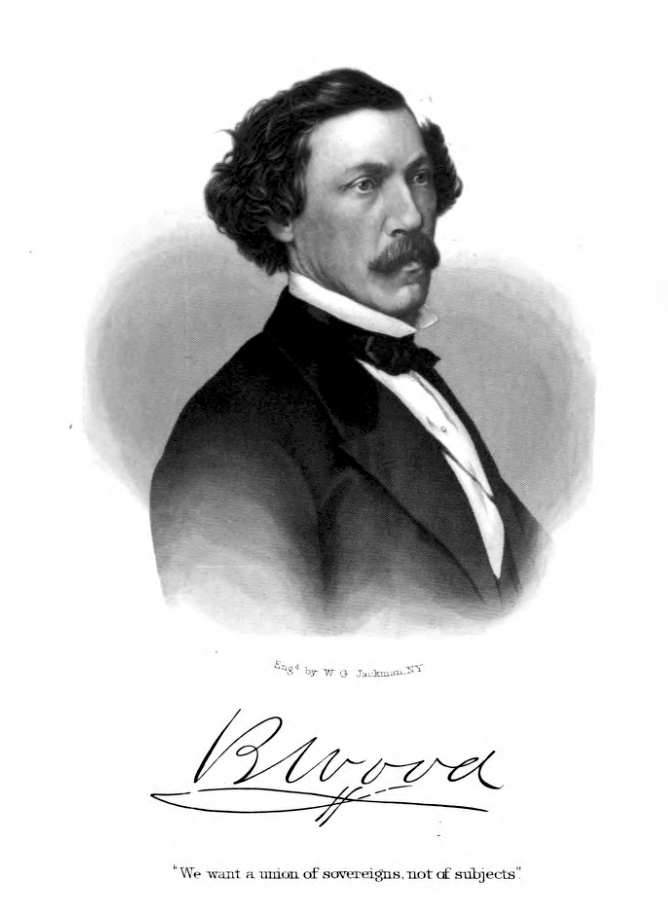
Historical · U.S. House · New York · District 5
Benjamin Wood
Former U.S. Representative · New York District 5 · 1861–1883 · Democratic
Benjamin Wood represented New York's District 5 in the United States House of Representatives (1861–1883) for the Democratic party. The page below collects sourced biographical facts, term history, committee roles, and provenance for Wood.
Bioguide ID: W000690
Key facts
- Full name
- Benjamin Wood
- State
- New York
- District
- District 5
- Party
- Democratic
- House service
- 1861–1883
- First House term
- 1861
- Status
- Left office
- Current term ends
- —
- Born
- 1820
- Bioguide ID
- W000690
- Committee assignments
- —
- Dataset version
- 1.20260606
Biographical narrative
884 words · sourced from the Wikipedia REST extract
Benjamin Wood was an American politician and publishing entrepreneur who served as a U.S. Representative from New York during a tumultuous period in American history, including the Civil War. A member of the Democratic Party, Wood's political career spanned three terms in the United States Congress, where he was known for his controversial stances and connections to the media. In addition to his political endeavors, he was also involved in the publishing industry, notably as the editor and publisher of a newspaper that faced significant challenges during the Civil War.
Early life and career
Benjamin Wood was born on October 13, 1820, in Shelbyville, Kentucky, to Benjamin and Rebecca (Lehman) Wood. He was part of a family that would have a notable impact on American politics, as he was the brother of Fernando Wood, who also served as a U.S. Representative and later became the mayor of New York City. The Wood family relocated from Kentucky to New York City during Benjamin's youth, where he received his education.
After completing his studies, Wood entered the mercantile and shipping business, which laid the groundwork for his future entrepreneurial ventures. In 1860, he acquired the New York Daily News, a publication distinct from the current newspaper of the same name, which was founded later in 1919. As the editor and publisher, Wood was responsible for the newspaper's content and direction, navigating the challenges posed by the political climate of the time.
The onset of the Civil War brought significant difficulties for Wood and his publication. In 1861, the federal government suspended the delivery of the New York Daily News through the postal service, citing its perceived sympathy for the Confederacy. This suspension forced Wood to halt operations temporarily, during which time he turned to writing a novel titled "Fort Lafayette or, Love and Secession," published in 1862. The novel reflects the tensions and divisions of the era, illustrating Wood's engagement with the political discourse of his time.
After approximately 18 months, Wood managed to resume publication of the New York Daily News. However, the newspaper continued to face scrutiny, particularly between 1863 and 1865, when it was alleged that personal columns published in the paper were being used by Confederate spies for coded communications. This controversy led to the arrest of the managing editor, William McKellar, who was summoned before a congressional investigative committee. As a result of these events, Wood's reputation suffered, and he was viewed as a traitor by many in the Northern states.
House tenure
Wood's political career began in earnest when he was elected as a Democrat to the 37th United States Congress, serving from March 4, 1861, to March 3, 1865. His tenure coincided with a critical period in American history, marked by the Civil War and its aftermath. Following his first term, he continued to engage in state politics, serving in the New York State Senate for the 4th District during the years 1866 and 1867.
After a brief hiatus from federal office, Wood returned to Congress, being elected to the 47th United States Congress, where he served from March 4, 1881, until March 3, 1883. Throughout his congressional career, Wood was involved in various legislative discussions and decisions that shaped the nation during a time of significant change. His political affiliations and actions were often scrutinized, particularly due to his connections to the media and the controversies surrounding his newspaper.
While serving in Congress, Wood's political activities were influenced by his background in publishing and his experiences during the Civil War. His dual roles as a politician and a media figure provided him with a unique perspective on the issues facing the nation, although they also contributed to the contentious nature of his public image.
Legislative focus and committees
During his time in the House of Representatives, Benjamin Wood's legislative focus was shaped by the political landscape of the era, including the challenges posed by the Civil War and the Reconstruction period that followed. As a member of the Democratic Party, he often aligned with the party's positions on various issues, although specific details regarding his legislative initiatives and committee assignments are not extensively documented.
Wood's involvement in Congress occurred during a time when the nation was grappling with the consequences of the Civil War, including debates over civil rights, economic recovery, and the reintegration of Southern states into the Union. His experiences as a publisher and his connections to the media likely informed his perspectives on these issues, although the specifics of his contributions to legislative discussions remain less clear.
In addition to his congressional duties, Wood's background in publishing may have influenced his approach to communication and public engagement. The controversies surrounding his newspaper during the Civil War, including allegations of espionage, may have shaped his views on freedom of the press and the role of media in political discourse.
After concluding his final term in the House in 1883, Wood continued to be recognized for his contributions to both politics and publishing. He remained a notable figure in New York until his death on February 21, 1900. Wood was interred at Calvary Cemetery in Queens, New York. His legacy is intertwined with the complex history of American politics during a transformative period, reflecting the challenges and controversies that characterized his life and career.
Notable legislation
Sponsored and co-sponsored legislation for Benjamin Wood is pending operator curation. The biographical narrative above carries the same provenance trail until per-bill rows are written.
Sources
- [1]https://en.wikipedia.org/wiki/Benjamin_Wood_(American_politician)Wikipedia · retrieved 2026-06-06
Notable quotes
Sourced quotes for Benjamin Wood are pending operator curation. Narrative-scope provenance remains attached below.
Sources
- [1]https://en.wikipedia.org/wiki/Benjamin_Wood_(American_politician)Wikipedia · retrieved 2026-06-06
Key positions
Curated policy positions for Benjamin Wood are pending operator review. The biographical narrative above carries the same provenance trail until per-topic positions are written.
Sources
- [1]https://en.wikipedia.org/wiki/Benjamin_Wood_(American_politician)Wikipedia · retrieved 2026-06-06
Terms served
- 1861–1863U.S. House · Term 1 · Democratic
- 1863–1865U.S. House · Term 2 · Democratic
- 1881–1883U.S. House · Term 3 · Democratic
Sources & provenance
Every attributable claim above carries a per-section [N] marker that resolves to the corresponding URL below. Each entry records the upstream provider, the canonical URL, and the timestamp at which the source was retrieved by the ingest pipeline.
Key facts
- https://bioguide.congress.gov/search/bio/W000690bioguide · retrieved 2026-06-06
- https://www.govtrack.us/congress/members/411842govtrack · retrieved 2026-06-06
Biographical narrative
- https://en.wikipedia.org/wiki/Benjamin_Wood_(American_politician)wikipedia · retrieved 2026-06-06
Find your representative
Every U.S. state elects representatives by district. Browse New York’s delegation, the full former-representative roster, or explore the role and term length.
Related on The Candidate
- Preceded by William MaclayEarlier holder of the New York District 5 House seat · Democratic.Open
- Succeeded by John GrahamLater holder of the New York District 5 House seat · Democratic.Open
- Abel HuntingtonFormer U.S. Representative · New York District 1 · JacksonOpen
- Alfred ChapinFormer U.S. Representative · New York District 1 · DemocraticOpen
- Cadwallader ColdenFormer U.S. Representative · New York District 1 · FederalistOpen
- Charles FloydFormer U.S. Representative · New York District 1 · DemocraticOpen