
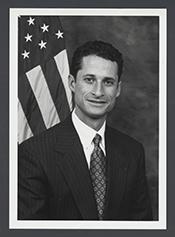
Historical · U.S. House · New York · District 9
Anthony Weiner
Former U.S. Representative · New York District 9 · 1999–2011 · Democratic
Anthony Weiner represented New York's District 9 in the United States House of Representatives (1999–2011) for the Democratic party. The page below collects sourced biographical facts, term history, committee roles, and provenance for Weiner.
Bioguide ID: W000792
Key facts
- Full name
- Anthony Weiner
- State
- New York
- District
- District 9
- Party
- Democratic
- House service
- 1999–2011
- First House term
- 1999
- Status
- Left office
- Current term ends
- —
- Born
- 1964
- Bioguide ID
- W000792
- Committee assignments
- —
- Dataset version
- 1.20260605
Biographical narrative
1,025 words · sourced from the Wikipedia REST extract
Anthony D. Weiner is a former American politician who served as a U.S. Representative for New York's 9th congressional district from 1999 until his resignation in 2011. A member of the Democratic Party, Weiner's political career began in local government before he transitioned to national politics. He is known for his controversial tenure, which included involvement in multiple scandals that ultimately led to his resignation from Congress and subsequent legal issues.
Early life and career
Anthony David Weiner was born on September 4, 1964, in Brooklyn, New York. He is the middle child of Mort Weiner, a lawyer, and Frances Weiner, a public high school math teacher. Weiner is of Jewish descent and spent part of his childhood in the Park Slope neighborhood of Brooklyn. His early education began at P.S. 39 The Henry Bristow School, where he laid the groundwork for his academic pursuits.
Weiner exhibited a strong interest in academics and was admitted to Brooklyn Technical High School, a specialized institution known for its rigorous curriculum, from which he graduated in 1981. He furthered his education at the State University of New York at Plattsburgh, where he earned a Bachelor of Arts degree in political science in 1985. During his college years, Weiner spent a junior year as an exchange student at the College of William & Mary, where he developed friendships with notable figures, including future comedian and political commentator Jon Stewart. His involvement in student government during this time highlighted his burgeoning interest in politics, and he was recognized as the most effective student senator.
After completing his degree, Weiner began his political career by joining the staff of then-U.S. Representative Chuck Schumer. He worked in Schumer's Washington, D.C., office for three years before transferring to the district office in Brooklyn in 1988. Schumer's mentorship played a significant role in Weiner's early political development, encouraging him to engage in local politics.
Weiner's first significant electoral success came in 1991 when he ran for a seat on the New York City Council. The council had recently expanded from 35 to 51 seats, and Weiner faced a competitive Democratic primary. Despite being considered a long-shot candidate, he won the primary by a narrow margin and subsequently prevailed in the general election, making history as the youngest city councilmember in New York City's history at the age of 27. He served on the City Council from 1992 until 1998, during which time he initiated various programs aimed at improving quality of life in his district. Notably, he implemented a program to employ at-risk youth in graffiti cleanup efforts and supported development initiatives that revitalized the Sheepshead Bay area.
House tenure
In 1998, Weiner sought higher office by running for the U.S. House of Representatives from New York's 9th congressional district, a seat previously held by his mentor Chuck Schumer, who was then campaigning for the U.S. Senate. Weiner won the Democratic primary election by a narrow margin and subsequently secured a significant victory in the general election. He officially began his tenure in the House of Representatives in January 1999.
During his time in Congress, Weiner served a total of seven terms, representing his constituents until June 2011. His legislative focus included a variety of domestic issues, and he was known for his outspoken nature on several topics. Weiner was particularly critical of the Stupak-Pitts Amendment to the Affordable Care Act, which restricted the use of federal funds for abortion services. He described the amendment as "unnecessary and divisive," arguing that it would hinder health insurers from providing abortion coverage, regardless of whether federal funds were used to purchase insurance.
In April 2008, Weiner established the bipartisan Congressional Middle Class Caucus, aimed at addressing issues affecting middle-class Americans. He also sponsored legislation to increase the number of O-visas available to foreign fashion models, reflecting his interest in supporting various industries and promoting economic opportunities.
Weiner's time in the House was marked by a blend of legislative activity and public engagement. He was known for his ability to communicate effectively with constituents and the media, often using social media platforms to connect with a broader audience. However, his career took a significant turn due to personal scandals that overshadowed his legislative work.
Legislative focus and committees
Throughout his congressional career, Weiner served on various committees that shaped his legislative priorities. His focus on domestic issues was evident in his participation in discussions surrounding healthcare, economic policy, and social issues. He was particularly active in advocating for the middle class and addressing concerns related to economic inequality.
Weiner's establishment of the Congressional Middle Class Caucus was a notable aspect of his legislative focus, as it aimed to bring attention to the challenges faced by middle-class families in America. This initiative sought to create a platform for bipartisan dialogue on policies that would benefit this demographic, emphasizing the importance of economic stability and access to essential services.
In addition to his work on the Middle Class Caucus, Weiner's criticism of the Stupak-Pitts Amendment highlighted his commitment to reproductive rights and healthcare access. His stance on this issue resonated with many constituents who valued his advocacy for women's rights and healthcare choices.
Despite his legislative accomplishments, Weiner's tenure was ultimately marred by personal controversies. In June 2011, he resigned from Congress amid revelations of his involvement in a sexting scandal, which had significant repercussions for his political career. Following his resignation, a special election was held to fill his seat, resulting in a Republican victory.
Weiner's political journey continued to be tumultuous, as he faced further legal challenges related to his actions, including a subsequent scandal that emerged during his 2013 campaign for mayor of New York City. His legal troubles culminated in a guilty plea for transferring obscene material to a minor, leading to a period of incarceration.
In summary, Anthony D. Weiner's career in politics was characterized by early success in local government, a significant tenure in the U.S. House of Representatives, and a series of controversies that ultimately defined his legacy. His work on behalf of middle-class Americans and his involvement in key legislative initiatives reflect a complex and multifaceted political career.
Notable legislation
Sponsored and co-sponsored legislation for Anthony Weiner is pending operator curation. The biographical narrative above carries the same provenance trail until per-bill rows are written.
Sources
- [1]https://en.wikipedia.org/wiki/Anthony_WeinerWikipedia · retrieved 2026-06-05
Notable quotes
Sourced quotes for Anthony Weiner are pending operator curation. Narrative-scope provenance remains attached below.
Sources
- [1]https://en.wikipedia.org/wiki/Anthony_WeinerWikipedia · retrieved 2026-06-05
Key positions
Curated policy positions for Anthony Weiner are pending operator review. The biographical narrative above carries the same provenance trail until per-topic positions are written.
Sources
- [1]https://en.wikipedia.org/wiki/Anthony_WeinerWikipedia · retrieved 2026-06-05
Terms served
- 1999–2001U.S. House · Term 1 · Democratic
- 2001–2003U.S. House · Term 2 · Democratic
- 2003–2005U.S. House · Term 3 · Democratic
- 2005–2007U.S. House · Term 4 · Democratic
- 2007–2009U.S. House · Term 5 · Democratic
- 2009–2011U.S. House · Term 6 · Democratic
- 2011–2011U.S. House · Term 7 · Democratic
Sources & provenance
Every attributable claim above carries a per-section [N] marker that resolves to the corresponding URL below. Each entry records the upstream provider, the canonical URL, and the timestamp at which the source was retrieved by the ingest pipeline.
Key facts
- https://bioguide.congress.gov/search/bio/W000792bioguide · retrieved 2026-06-05
- http://www.house.gov/weinerhouse.gov · retrieved 2026-06-05
Biographical narrative
- https://en.wikipedia.org/wiki/Anthony_Weinerwikipedia · retrieved 2026-06-05
Find your representative
Every U.S. state elects representatives by district. Browse New York’s delegation, the full former-representative roster, or explore the role and term length.
Related on The Candidate
- Preceded by Geraldine FerraroEarlier holder of the New York District 9 House seat · Democratic.Open
- Succeeded by Robert TurnerLater holder of the New York District 9 House seat · Republican.Open
- Abel HuntingtonFormer U.S. Representative · New York District 1 · JacksonOpen
- Alfred ChapinFormer U.S. Representative · New York District 1 · DemocraticOpen
- Cadwallader ColdenFormer U.S. Representative · New York District 1 · FederalistOpen
- Charles FloydFormer U.S. Representative · New York District 1 · DemocraticOpen