
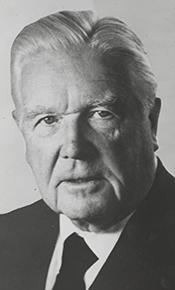
Historical · U.S. House · New York · District 9
James Delaney
Former U.S. Representative · New York District 9 · 1945–1979 · Democratic
James Delaney represented New York's District 9 in the United States House of Representatives (1945–1979) for the Democratic party. The page below collects sourced biographical facts, term history, committee roles, and provenance for Delaney.
Bioguide ID: D000211
Key facts
- Full name
- James Delaney
- State
- New York
- District
- District 9
- Party
- Democratic
- House service
- 1945–1979
- First House term
- 1945
- Status
- Left office
- Current term ends
- —
- Born
- 1901
- Bioguide ID
- D000211
- Committee assignments
- —
- Dataset version
- 1.20260605
Biographical narrative
862 words · sourced from the Wikipedia REST extract
James J. Delaney was an American politician who served as a U.S. Representative for New York's 9th congressional district from 1945 until 1979. A member of the Democratic Party, Delaney's lengthy tenure in the House of Representatives spanned 16 terms, during which he was involved in various legislative efforts and held significant positions within congressional committees. His career was marked by a blend of progressive and conservative stances, reflecting the changing political landscape of his constituents and the nation.
Early life and career
James Joseph Delaney was born on March 19, 1901, in New York City. He grew up in Long Island City, Queens, where he attended public school. Demonstrating an early interest in law, Delaney pursued higher education at St. John's College in Brooklyn, graduating from its law department with a Bachelor of Laws (LL.B.) degree in 1931. Following his graduation, he was admitted to the bar in 1933, beginning his legal career.
Delaney's professional journey included a significant role as an assistant district attorney for Queens County, a position he held from 1936 until his election to Congress in 1944. His legal background provided him with a foundation for his later legislative work, as he navigated the complexities of lawmaking and governance.
House tenure
Delaney entered the U.S. House of Representatives after being elected as a Democrat to the 79th Congress in 1944. His initial term began amidst significant political shifts, as the boundaries of congressional districts were redrawn, leading to the creation of an open seat in the 6th district. Delaney successfully defeated Republican candidate Otto Schuler to secure his position. However, his first term was interrupted by a defeat in 1946, attributed in part to the declining popularity of President Harry S. Truman, which allowed the Republican Party to gain several seats in Congress. Delaney's defeat came at the hands of Robert Nodar Jr., but he made a comeback in 1948, winning the seat back and subsequently securing re-election for 14 consecutive terms.
Throughout his time in Congress, Delaney was known for his active participation in legislative matters. He gained attention in the late 1950s for his role in addressing youth violence, particularly through the introduction of legislation aimed at banning automatic-opening or switchblade knives. This initiative was a response to rising concerns about crime and violence, particularly among youth, and culminated in the enactment of the Switchblade Knife Act of 1958. Delaney and his supporters believed that restricting access to such weapons would help mitigate gang violence, although later analyses indicated that the issue persisted, with gang members shifting to firearms.
In addition to his work on youth violence, Delaney served as the chairman of a Select Committee that investigated the use of chemicals and pesticides in food products during the 81st and 82nd Congresses. His efforts led to the inclusion of the Delaney clause in the Federal Food, Drug, and Cosmetic Act of 1938, which aimed to prohibit carcinogenic substances from being used as food additives.
Delaney's political career was characterized by a gradual shift in his views, aligning more closely with the conservative elements of his constituency over time. His alignment with conservative principles became evident when he opposed certain progressive initiatives, such as a 1961 education funding bill that excluded parochial schools. He also took a stance against busing for school integration and expressed support for the Vietnam War, which positioned him at odds with more liberal factions within the Democratic Party.
Legislative focus and committees
Delaney's legislative focus evolved throughout his lengthy career, reflecting both his personal beliefs and the interests of his constituents. His political base primarily consisted of working-class, socially conservative Catholic voters, many of whom had previously supported Democratic figures like Franklin D. Roosevelt and John F. Kennedy. However, during the 1972 election cycle, Delaney faced significant challenges from within his party, particularly from Councilman Thomas Manton, who was backed by influential local Democratic leaders. Despite this internal strife, Delaney secured renomination but faced a competitive election.
As he continued to serve, Delaney's relationships with conservative leaders and his political maneuvering played a crucial role in his legislative successes. He was instrumental in securing funding for New York City during financial crises, notably through the New York City Seasonal Financing Act of 1975, which provided a substantial loan to help the city avoid bankruptcy. His leadership as chairman of the House Committee on Rules facilitated the passage of critical legislation, including the New York City Loan Guarantee Act, which further supported the city's financial stability.
Delaney's tenure in Congress came to an end when he chose not to seek re-election in 1978. His decision paved the way for future political figures, including Geraldine Ferraro, who won the election to succeed him. Delaney officially resigned from Congress on December 31, 1978, concluding a distinguished career that spanned over three decades.
Following his retirement from public office, Delaney relocated to Key Biscayne, Florida, where he lived until his passing on May 24, 1987, in Tenafly, New Jersey. He was interred at Calvary Cemetery in Queens, New York, leaving behind a legacy marked by his long service in the U.S. House of Representatives and his contributions to various legislative initiatives.
Notable legislation
Sponsored and co-sponsored legislation for James Delaney is pending operator curation. The biographical narrative above carries the same provenance trail until per-bill rows are written.
Sources
- [1]https://en.wikipedia.org/wiki/James_J._DelaneyWikipedia · retrieved 2026-06-05
Notable quotes
Sourced quotes for James Delaney are pending operator curation. Narrative-scope provenance remains attached below.
Sources
- [1]https://en.wikipedia.org/wiki/James_J._DelaneyWikipedia · retrieved 2026-06-05
Key positions
Curated policy positions for James Delaney are pending operator review. The biographical narrative above carries the same provenance trail until per-topic positions are written.
Sources
- [1]https://en.wikipedia.org/wiki/James_J._DelaneyWikipedia · retrieved 2026-06-05
Terms served
- 1945–1947U.S. House · Term 1 · Democratic
- 1949–1951U.S. House · Term 2 · Democratic
- 1951–1953U.S. House · Term 3 · Democratic
- 1953–1955U.S. House · Term 4 · Democratic
- 1955–1957U.S. House · Term 5 · Democratic
- 1957–1959U.S. House · Term 6 · Democratic
- 1959–1961U.S. House · Term 7 · Democratic
- 1961–1963U.S. House · Term 8 · Democratic
- 1963–1965U.S. House · Term 9 · Democratic
- 1965–1967U.S. House · Term 10 · Democratic
- 1967–1969U.S. House · Term 11 · Democratic
- 1969–1971U.S. House · Term 12 · Democratic
- 1971–1973U.S. House · Term 13 · Democratic
- 1973–1975U.S. House · Term 14 · Democratic
- 1975–1977U.S. House · Term 15 · Democratic
- 1977–1979U.S. House · Term 16 · Democratic
Sources & provenance
Every attributable claim above carries a per-section [N] marker that resolves to the corresponding URL below. Each entry records the upstream provider, the canonical URL, and the timestamp at which the source was retrieved by the ingest pipeline.
Key facts
- https://bioguide.congress.gov/search/bio/D000211bioguide · retrieved 2026-06-05
- https://www.govtrack.us/congress/members/403355govtrack · retrieved 2026-06-05
Biographical narrative
- https://en.wikipedia.org/wiki/James_J._Delaneywikipedia · retrieved 2026-06-05
Find your representative
Every U.S. state elects representatives by district. Browse New York’s delegation, the full former-representative roster, or explore the role and term length.
Related on The Candidate
- Preceded by Stephen RuddEarlier holder of the New York District 9 House seat · Democratic.Open
- Succeeded by Geraldine FerraroLater holder of the New York District 9 House seat · Democratic.Open
- Abel HuntingtonFormer U.S. Representative · New York District 1 · JacksonOpen
- Alfred ChapinFormer U.S. Representative · New York District 1 · DemocraticOpen
- Cadwallader ColdenFormer U.S. Representative · New York District 1 · FederalistOpen
- Charles FloydFormer U.S. Representative · New York District 1 · DemocraticOpen