
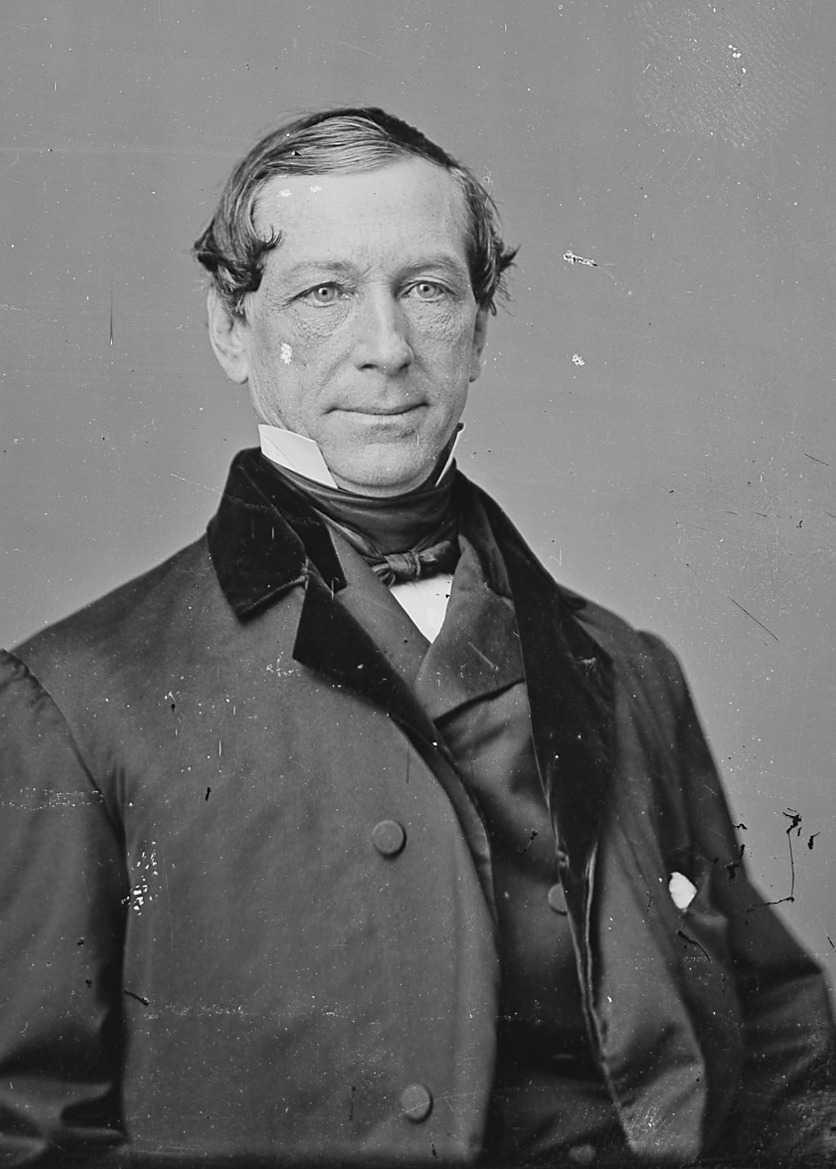
Historical · U.S. House · New York · At-Large
Fernando Wood
Former U.S. Representative · New York At-Large · 1841–1883 · Democratic
Fernando Wood represented New York's At-Large in the United States House of Representatives (1841–1883) for the Democratic party. The page below collects sourced biographical facts, term history, committee roles, and provenance for Wood.
Bioguide ID: W000694
Key facts
- Full name
- Fernando Wood
- State
- New York
- District
- At-Large
- Party
- Democratic
- House service
- 1841–1883
- First House term
- 1841
- Status
- Left office
- Current term ends
- —
- Born
- 1812
- Bioguide ID
- W000694
- Committee assignments
- —
- Dataset version
- 1.20260606
Biographical narrative
982 words · sourced from the Wikipedia REST extract
Fernando Wood was an American politician affiliated with the Democratic Party, who served as a U.S. Representative for New York and held the office of mayor of New York City on multiple occasions. His political career spanned several decades, during which he was involved in various aspects of local and national governance. Wood's tenure in the House of Representatives was marked by his alignment with the Southern sympathies during a tumultuous period in American history, including the Civil War. He was a significant figure in Tammany Hall, a powerful political organization in New York City, and his career was characterized by both political ambition and controversy.
Early life and career
Fernando Wood was born on June 14, 1812, in Philadelphia, Pennsylvania. His mother, who chose his Spanish forename from a gothic novel, raised him in a family that experienced financial instability. His father, Benjamin Wood, was a dry goods speculator who faced bankruptcy during the Panic of 1819. The family's financial difficulties led to frequent relocations, moving from Philadelphia to various locations, including Kentucky, New Orleans, Havana, and Charleston, before finally settling in New York City in 1821. In New York, Benjamin Wood opened a tobacconist store, which ultimately failed by 1829, leading to his departure for Charleston, where he died two years later.
Growing up in a challenging environment, Fernando Wood's education was initially provided at a private academy associated with Columbia College. However, he left school at the age of 13 to support his family, taking on various low-paying jobs, including a brief stint as a stage actor. In 1831, he married Anna W. Taylor, the daughter of a Philadelphia merchant. After returning to New York City in 1832, Wood struggled to find success in business, attempting various ventures, including a ship chandler firm that failed during the Panic of 1837. His early business endeavors were marked by hardship, including the closure of a bar that he had opened with his wife's dowry due to poor sales.
Despite his business failures, Wood found success in politics, joining the Jacksonian Democratic Party, likely motivated by his disdain for the Second Bank of the United States, which he blamed for his family's financial ruin. His political career began to take shape when he became a member of the Tammany Society, a fraternal-political organization that played a significant role in New York City's Democratic politics. Wood's rise within Tammany Hall was facilitated by his ability to navigate the factional divisions within the organization, particularly between moderates and the more radical Locofoco faction. His political acumen allowed him to gain important positions within Tammany, setting the stage for his future electoral successes.
House tenure
Fernando Wood's congressional career began when he was elected to the United States House of Representatives in 1841 at the age of 28. He served a total of ten terms in the House, with his initial term lasting until 1843. Wood's election was part of a broader trend in which New York City elected its congressional representatives on a single ticket, a practice that shaped the political landscape of the time. His campaign strategy included appealing to Irish voters by promoting Anglophobic sentiments, which resonated with constituents who were wary of British influence.
After his first term, Wood returned to private life for a period before re-entering politics. His subsequent terms in the House were characterized by his alignment with the Democratic Party's interests, particularly those sympathetic to the Southern states. During the Civil War, Wood became known for his opposition to President Abraham Lincoln and his advocacy for peace with the Confederacy. He was associated with the Copperhead faction, which sought an immediate end to hostilities and was critical of the war effort.
Wood's political career included significant leadership roles, particularly during his final terms in the House, when he served as the chairman of the House Committee on Ways and Means. This position placed him at the center of fiscal policy discussions and legislative initiatives. His tenure in the House concluded on March 3, 1883, after which he returned to private life once again.
Legislative focus and committees
Throughout his time in the House of Representatives, Fernando Wood's legislative focus reflected his political beliefs and the interests of his constituents. He was known for his strong opposition to the Thirteenth Amendment, which aimed to abolish slavery in the United States. Wood's stance on this issue was indicative of his broader political sympathies toward the Southern states, particularly during the Civil War. His advocacy for peace with the Confederacy led him to propose controversial ideas, such as suggesting that New York City declare itself an independent city-state to maintain its lucrative cotton trade with the South.
In addition to his opposition to the Thirteenth Amendment, Wood's legislative priorities included issues related to economic policy and governance. As chairman of the House Committee on Ways and Means, he played a crucial role in shaping fiscal legislation and addressing economic challenges facing the nation. His leadership in this committee allowed him to influence key decisions related to taxation, revenue generation, and budgetary matters.
Wood's political career was also marked by his involvement in local governance as mayor of New York City, where he served three non-consecutive terms. His mayoralty was characterized by a strong vision for the office, which often led to conflicts with the Republican-controlled state legislature. His attempts to consolidate power and implement reforms brought him into direct confrontation with political opponents, resulting in significant controversies during his time in office.
In summary, Fernando Wood's career as a U.S. Representative and mayor of New York City was shaped by his early life experiences, political affiliations, and the tumultuous historical context of his time. His legacy is intertwined with the political dynamics of the 19th century, particularly regarding issues of governance, civil rights, and the complex relationship between Northern and Southern states during the Civil War era.
Notable legislation
Sponsored and co-sponsored legislation for Fernando Wood is pending operator curation. The biographical narrative above carries the same provenance trail until per-bill rows are written.
Sources
- [1]https://en.wikipedia.org/wiki/Fernando_WoodWikipedia · retrieved 2026-06-06
Notable quotes
Sourced quotes for Fernando Wood are pending operator curation. Narrative-scope provenance remains attached below.
Sources
- [1]https://en.wikipedia.org/wiki/Fernando_WoodWikipedia · retrieved 2026-06-06
Key positions
Curated policy positions for Fernando Wood are pending operator review. The biographical narrative above carries the same provenance trail until per-topic positions are written.
Sources
- [1]https://en.wikipedia.org/wiki/Fernando_WoodWikipedia · retrieved 2026-06-06
Terms served
- 1841–1843U.S. House · Term 1 · Democratic
- 1863–1865U.S. House · Term 2 · Democratic
- 1867–1869U.S. House · Term 3 · Democratic
- 1869–1871U.S. House · Term 4 · Democratic
- 1871–1873U.S. House · Term 5 · Democratic
- 1873–1875U.S. House · Term 6 · Democratic
- 1875–1877U.S. House · Term 7 · Democratic
- 1877–1879U.S. House · Term 8 · Democratic
- 1879–1881U.S. House · Term 9 · Democratic
- 1881–1883U.S. House · Term 10 · Democratic
Sources & provenance
Every attributable claim above carries a per-section [N] marker that resolves to the corresponding URL below. Each entry records the upstream provider, the canonical URL, and the timestamp at which the source was retrieved by the ingest pipeline.
Key facts
- https://bioguide.congress.gov/search/bio/W000694bioguide · retrieved 2026-06-06
- https://www.govtrack.us/congress/members/411846govtrack · retrieved 2026-06-06
Biographical narrative
- https://en.wikipedia.org/wiki/Fernando_Woodwikipedia · retrieved 2026-06-06
Find your representative
Every U.S. state elects representatives by district. Browse New York’s delegation, the full former-representative roster, or explore the role and term length.
Related on The Candidate
- Preceded by Campbell WhiteEarlier holder of the New York At-Large House seat · Jacksonian.Open
- Succeeded by William CockranLater holder of the New York At-Large House seat · Democratic.Open
- Abel HuntingtonFormer U.S. Representative · New York District 1 · JacksonOpen
- Alfred ChapinFormer U.S. Representative · New York District 1 · DemocraticOpen
- Cadwallader ColdenFormer U.S. Representative · New York District 1 · FederalistOpen
- Charles FloydFormer U.S. Representative · New York District 1 · DemocraticOpen