
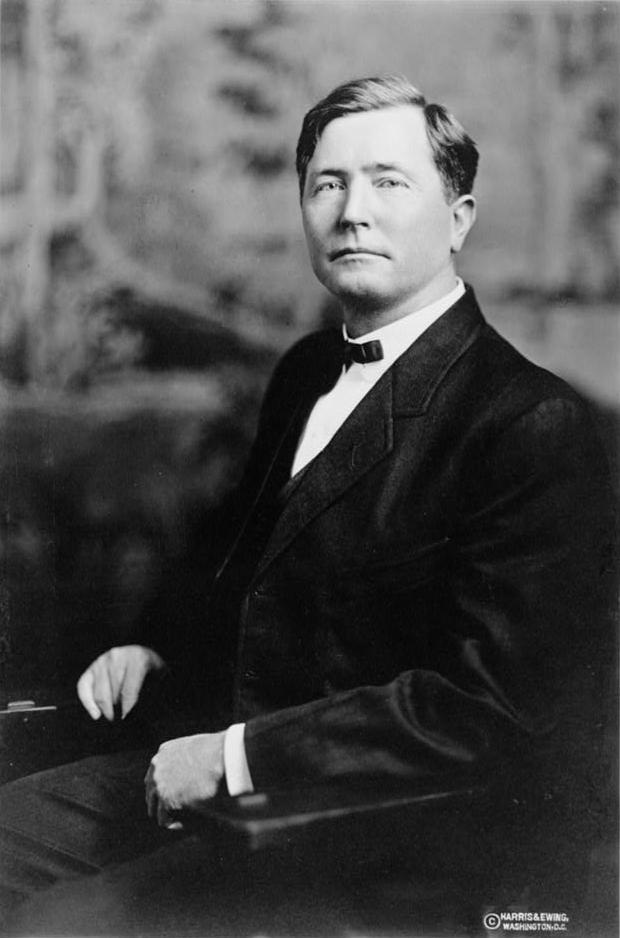
Historical · U.S. House · Texas · District 12
Oscar Callaway
Former U.S. Representative · Texas District 12 · 1911–1917 · Democratic
Oscar Callaway represented Texas's District 12 in the United States House of Representatives (1911–1917) for the Democratic party. The page below collects sourced biographical facts, term history, committee roles, and provenance for Callaway.
Bioguide ID: C000056
Key facts
- Full name
- Oscar Callaway
- State
- Texas
- District
- District 12
- Party
- Democratic
- House service
- 1911–1917
- First House term
- 1911
- Status
- Left office
- Current term ends
- —
- Born
- 1872
- Bioguide ID
- C000056
- Committee assignments
- —
- Dataset version
- 1.20260606
Biographical narrative
925 words · sourced from the Wikipedia REST extract
Oscar Callaway was a U.S. Representative from Texas, serving in the House of Representatives for three terms from 1911 to 1917. A member of the Democratic Party, Callaway represented Texas's twelfth congressional district during a period marked by significant national and international developments. His tenure was characterized by a strong stance on fiscal conservatism and a notable opposition to military preparedness during World War I.
Early life and career
Oscar Callaway was born on October 2, 1872, in Harmony Hill, located in Rusk County, Texas. In 1876, when Callaway was just four years old, his family relocated to Comanche County, Texas, where he would later establish his career. He pursued higher education at the University of Texas at Austin, attending from 1897 to 1899. Callaway graduated from the university's law department in 1900, marking the beginning of his professional journey in law.
After being admitted to the bar in the same year, Callaway began his legal career and was appointed as the prosecuting attorney for Comanche County, a position he held from 1900 to 1902. His involvement in local politics and law laid the groundwork for his future political aspirations. In addition to his legal work, Callaway was actively engaged in the Democratic Party, serving as a delegate to various state conventions from 1896 through the mid-1920s.
On December 29, 1904, Callaway married Stella Couch, further establishing his roots in the community. Following his early legal career and involvement in local governance, he transitioned into a more significant political role, ultimately leading to his election to the U.S. House of Representatives.
House tenure
Oscar Callaway's congressional career began when he was elected as a Democrat to the Sixty-second Congress, which convened on March 4, 1911. He was subsequently re-elected to serve in the Sixty-third and Sixty-fourth Congresses, concluding his service on March 3, 1917. Throughout his time in office, Callaway was known for his fiscal conservatism and his critical approach to federal expenditures.
During his tenure, Callaway served on several committees, including the Committee on Expenditures in the Treasury Department from 1912 to 1913, and the Committee on Expenditures in the Department of the Interior from 1914 to 1915. He later became a member of the Naval Affairs Committee, where he continued to express his views on military spending and preparedness.
Callaway's approach to fiscal matters was characterized by a rigorous examination of federal spending, particularly in relation to large appropriations for river and harbor projects. He was particularly vocal in his opposition to significant funding initiatives aimed at making the Trinity and Brazos rivers navigable, reflecting his belief that such expenditures were excessive.
In 1916, Callaway gained national attention for his outspoken opposition to a naval appropriation bill. He argued that the establishment of a civilian army would be sufficient to defend against invasions and contended that battleships had become obsolete due to the advent of submarines. His stance was part of a broader critique of the Preparedness Movement, which he believed disproportionately benefited munitions manufacturers at the expense of taxpayers.
Callaway's strong opposition to military preparedness and his criticism of fellow congressmen on this issue led to tensions within the House. Some of his remarks were deemed too controversial and were subsequently expunged from the Congressional Record. His criticism extended to accusations that influential business interests were manipulating public opinion through newspaper ownership to promote the preparedness agenda.
Despite his efforts to articulate his views, Callaway faced challenges in maintaining his congressional seat. In 1916, he was unsuccessful in his bid for renomination, losing to James Clifton Wilson. His defeat was attributed in part to his opposition to military preparedness, which resonated with a constituency that was increasingly supportive of military expansion in the context of global conflicts.
Legislative focus and committees
Throughout his time in Congress, Oscar Callaway's legislative focus was primarily on fiscal conservatism and scrutinizing federal expenditures. His membership on various committees allowed him to influence discussions on budgetary matters and government spending, particularly in relation to military appropriations and infrastructure projects.
Callaway's tenure on the Committee on Expenditures in the Treasury Department and the Committee on Expenditures in the Department of the Interior provided him with a platform to voice his concerns regarding government spending. His commitment to fiscal responsibility was evident in his opposition to large-scale appropriations, which he believed were often unnecessary and wasteful.
As a member of the Naval Affairs Committee, Callaway's views on military spending became increasingly prominent. His opposition to the naval appropriation bill in 1916 was a defining moment in his congressional career, highlighting his belief that the nation should not prioritize military expenditures over other pressing domestic needs. He argued for a reevaluation of military strategy, advocating for a focus on civilian defense rather than traditional military buildup.
Callaway's legislative efforts were shaped by the political climate of the time, particularly as the United States grappled with its role in global conflicts. His opposition to the Preparedness Movement placed him at odds with many of his contemporaries, who were advocating for increased military readiness in light of the growing tensions in Europe.
After concluding his congressional service on March 3, 1917, Callaway returned to his ranch near Comanche, Texas, where he engaged in agricultural pursuits and continued to practice law. He remained active in local affairs and continued to be involved in the Democratic Party. Oscar Callaway passed away on January 31, 1947, in Comanche, Texas, and was interred at Oakwood Cemetery in the same town, marking the end of a life dedicated to public service and legal practice.
Notable legislation
Sponsored and co-sponsored legislation for Oscar Callaway is pending operator curation. The biographical narrative above carries the same provenance trail until per-bill rows are written.
Sources
- [1]https://en.wikipedia.org/wiki/Oscar_CallawayWikipedia · retrieved 2026-06-06
Notable quotes
Sourced quotes for Oscar Callaway are pending operator curation. Narrative-scope provenance remains attached below.
Sources
- [1]https://en.wikipedia.org/wiki/Oscar_CallawayWikipedia · retrieved 2026-06-06
Key positions
Curated policy positions for Oscar Callaway are pending operator review. The biographical narrative above carries the same provenance trail until per-topic positions are written.
Sources
- [1]https://en.wikipedia.org/wiki/Oscar_CallawayWikipedia · retrieved 2026-06-06
Terms served
- 1911–1913U.S. House · Term 1 · Democratic
- 1913–1915U.S. House · Term 2 · Democratic
- 1915–1917U.S. House · Term 3 · Democratic
Sources & provenance
Every attributable claim above carries a per-section [N] marker that resolves to the corresponding URL below. Each entry records the upstream provider, the canonical URL, and the timestamp at which the source was retrieved by the ingest pipeline.
Key facts
- https://bioguide.congress.gov/search/bio/C000056bioguide · retrieved 2026-06-06
- https://www.govtrack.us/congress/members/402215govtrack · retrieved 2026-06-06
Biographical narrative
- https://en.wikipedia.org/wiki/Oscar_Callawaywikipedia · retrieved 2026-06-06
Find your representative
Every U.S. state elects representatives by district. Browse Texas’s delegation, the full former-representative roster, or explore the role and term length.
Related on The Candidate
- Preceded by Oscar GillespieEarlier holder of the Texas District 12 House seat · Democratic.Open
- Succeeded by James WilsonLater holder of the Texas District 12 House seat · Democratic.Open
- Charles StewartFormer U.S. Representative · Texas District 1 · DemocraticOpen
- David KaufmanFormer U.S. Representative · Texas District 1 · DemocraticOpen
- Eugene BlackFormer U.S. Representative · Texas District 1 · DemocraticOpen
- George SmythFormer U.S. Representative · Texas District 1 · DemocraticOpen