
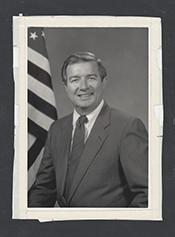
Historical · U.S. House · Texas · District 14
Gregory Laughlin
Former U.S. Representative · Texas District 14 · 1989–1997 · Republican
Gregory Laughlin represented Texas's District 14 in the United States House of Representatives (1989–1997) for the Republican party. The page below collects sourced biographical facts, term history, committee roles, and provenance for Laughlin.
Bioguide ID: L000119
Key facts
- Full name
- Gregory Laughlin
- State
- Texas
- District
- District 14
- Party
- Republican
- House service
- 1989–1997
- First House term
- 1989
- Status
- Left office
- Current term ends
- —
- Born
- 1942
- Bioguide ID
- L000119
- Committee assignments
- —
- Dataset version
- 1.20260605
Biographical narrative
839 words · sourced from the Wikipedia REST extract
Greg Laughlin is a former American politician who served as a U.S. Representative for Texas's 14th congressional district. A member of the Republican Party, Laughlin's congressional career spanned four terms from 1989 until 1997. His political journey included a notable transition from the Democratic Party to the Republican Party during a significant period of political change in the United States.
Early life and career
Gregory Haines Laughlin was born on January 21, 1942, in Bay City, Texas. He spent his formative years in West Columbia, Texas, where he continues to maintain a residence. Laughlin pursued higher education at Texas A&M University, graduating with a degree that laid the foundation for his subsequent career in law and politics. Following his education, he served in the United States Army from 1968 to 1970, a period during which he gained valuable experience that would later inform his public service. After his active duty, he continued his military commitment as a reservist.
Before entering politics, Laughlin practiced law in Texas. His legal career included a significant role as an assistant district attorney in Houston for four years, where he developed a strong understanding of the legal system and public service. After his tenure in the district attorney's office, he returned to private practice, further honing his legal expertise.
Laughlin's initial foray into politics came in 1986 when he ran for the United States House of Representatives as a conservative Democrat. He narrowly lost to Republican incumbent Mac Sweeney, who had previously served as an aide in the Reagan administration. Undeterred, Laughlin sought a rematch in 1988 and successfully won the election, marking the beginning of his congressional career.
House tenure
Greg Laughlin's tenure in the U.S. House of Representatives began in 1989. During his time in office, he was involved in various legislative activities and faced a number of challenges. In the early years of his congressional career, he survived a contentious re-election campaign, which included allegations of favoritism toward a specific firm. Despite these challenges, Laughlin maintained his position and continued to serve his constituents.
In 1991, Laughlin distinguished himself as the only member of Congress to see active duty during Operation Desert Storm, serving as a colonel in the U.S. Army Reserves. This experience not only highlighted his commitment to military service but also underscored his connection to national defense issues.
A significant turning point in Laughlin's political career occurred in 1995 when the Republican Party, having gained a majority in the House for the first time in four decades, offered him a seat on the influential Ways and Means Committee. This opportunity came with the condition that he switch his party affiliation from Democrat to Republican. Laughlin made this transition on June 26, 1995, citing the need to make difficult votes as a Democrat.
In the 1996 congressional election, Laughlin faced a challenging primary contest. Despite endorsements from prominent Republican figures, including then-Governor George W. Bush and Speaker of the House Newt Gingrich, he encountered stiff competition from former Congressman Ron Paul and Jim Deats. In a three-way primary election, Laughlin secured the most votes but did not achieve a majority, necessitating a runoff against Paul. Ultimately, Laughlin was defeated in the runoff election, losing by a margin that led to his departure from Congress.
Legislative focus and committees
During his time in the House, Greg Laughlin's legislative focus encompassed a range of issues, reflecting both his legal background and his constituents' interests. His role on the Ways and Means Committee, which is responsible for taxation and other significant economic policies, allowed him to influence key legislation during a transformative period in American politics.
Laughlin's transition from the Democratic Party to the Republican Party was emblematic of broader shifts within the political landscape of the time. His decision to switch parties was motivated by the changing dynamics in Congress and the need to align with a party that had gained a majority and was poised to implement its agenda.
After leaving Congress in 1997, Laughlin continued to engage in public policy and legal work. He practiced law in Washington, D.C., focusing on areas such as energy, international trade, and tax law. His post-congressional career included work with the law firm Patton Boggs, and later with Pillsbury, Winthrop, Shaw, Pittman. Notably, Laughlin was contracted to work with the NSO Group, a firm known for its controversial software that has been implicated in significant international incidents.
In addition to his legal practice, Laughlin was involved in international election monitoring. He formed a bipartisan group of former members of Congress to observe the 2004 presidential elections in Cameroon, highlighting his continued interest in democratic processes and governance.
Greg Laughlin's career reflects a complex interplay of legal expertise, military service, and political evolution, marking him as a notable figure in Texas politics during the late 20th century. His journey from a conservative Democrat to a Republican congressman illustrates the shifting political allegiances that characterized the era, as well as his commitment to public service through various roles in law and governance.
Notable legislation
Sponsored and co-sponsored legislation for Gregory Laughlin is pending operator curation. The biographical narrative above carries the same provenance trail until per-bill rows are written.
Sources
- [1]https://en.wikipedia.org/wiki/Greg_LaughlinWikipedia · retrieved 2026-06-05
Notable quotes
Sourced quotes for Gregory Laughlin are pending operator curation. Narrative-scope provenance remains attached below.
Sources
- [1]https://en.wikipedia.org/wiki/Greg_LaughlinWikipedia · retrieved 2026-06-05
Key positions
Curated policy positions for Gregory Laughlin are pending operator review. The biographical narrative above carries the same provenance trail until per-topic positions are written.
Sources
- [1]https://en.wikipedia.org/wiki/Greg_LaughlinWikipedia · retrieved 2026-06-05
Terms served
- 1989–1991U.S. House · Term 1 · Democratic
- 1991–1993U.S. House · Term 2 · Democratic
- 1993–1995U.S. House · Term 3 · Democratic
- 1995–1997U.S. House · Term 4 · Republican
Sources & provenance
Every attributable claim above carries a per-section [N] marker that resolves to the corresponding URL below. Each entry records the upstream provider, the canonical URL, and the timestamp at which the source was retrieved by the ingest pipeline.
Key facts
- https://bioguide.congress.gov/search/bio/L000119bioguide · retrieved 2026-06-05
- https://www.govtrack.us/congress/members/406625govtrack · retrieved 2026-06-05
Biographical narrative
- https://en.wikipedia.org/wiki/Greg_Laughlinwikipedia · retrieved 2026-06-05
Find your representative
Every U.S. state elects representatives by district. Browse Texas’s delegation, the full former-representative roster, or explore the role and term length.
Related on The Candidate
- Preceded by Mac SweeneyEarlier holder of the Texas District 14 House seat · Republican.Open
- Charles StewartFormer U.S. Representative · Texas District 1 · DemocraticOpen
- David KaufmanFormer U.S. Representative · Texas District 1 · DemocraticOpen
- Eugene BlackFormer U.S. Representative · Texas District 1 · DemocraticOpen
- George SmythFormer U.S. Representative · Texas District 1 · DemocraticOpen
- Republican PartyFederal candidates and office holders on the Republican line.Open