
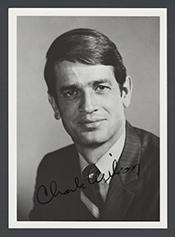
Historical · U.S. House · Texas · District 2
Charles Wilson
Former U.S. Representative · Texas District 2 · 1973–1997 · Democratic
Charles Wilson represented Texas's District 2 in the United States House of Representatives (1973–1997) for the Democratic party. The page below collects sourced biographical facts, term history, committee roles, and provenance for Wilson.
Bioguide ID: W000570
Key facts
- Full name
- Charles Wilson
- State
- Texas
- District
- District 2
- Party
- Democratic
- House service
- 1973–1997
- First House term
- 1973
- Status
- Left office
- Current term ends
- —
- Born
- 1933
- Bioguide ID
- W000570
- Committee assignments
- —
- Dataset version
- 1.20260605
Biographical narrative
1,024 words · sourced from the Wikipedia REST extract
Charles Wilson was a prominent American politician who served as a Democratic U.S. Representative for Texas's 2nd congressional district. His tenure in the House of Representatives spanned from 1973 until 1997, during which he became known for his influential role in foreign policy, particularly regarding U.S. support for the Afghan Mujahideen during the Soviet-Afghan War. Wilson's political career is marked by his ability to navigate complex legislative negotiations and his commitment to various social issues, including women's rights and social security.
Early life and career
Charles Wilson was born on June 1, 1933, in Trinity, Texas. He was the son of Charles Edwin Wilson, an accountant for a local timber company, and Wilmuth Wilson, who worked as a florist. Growing up in a small town, Wilson was influenced by his family's values and the historical context of World War II, which fostered his early interest in military history and international affairs. He had one sister, Sharon, who later became involved in social causes, including serving as a local chair for Planned Parenthood and as president of the International Planned Parenthood Federation.
Wilson completed his education in the public schools of Trinity and graduated from Trinity High School in 1951. He then attended Sam Houston State University before receiving an appointment to the United States Naval Academy in Annapolis, Maryland. His time at the Naval Academy was marked by a challenging academic experience, culminating in his graduation in 1956 with a Bachelor of Science degree in engineering, specializing in electronics. Wilson's military career began shortly thereafter, as he served in the United States Navy from 1956 to 1960, achieving the rank of Lieutenant. He served as a gunnery officer on the USS John W. Weeks and later worked at the Pentagon in an Office of Naval Intelligence unit focused on evaluating Soviet nuclear capabilities.
Wilson's political aspirations began at a young age. At 13, he campaigned against a local city councilman, Charles Hazard, whose actions had harmed Wilson's dog. This early experience in political campaigning laid the groundwork for his future endeavors in public service. In 1960, while still in the Navy, Wilson volunteered for John F. Kennedy's presidential campaign. He also ran for a seat in the Texas state legislature, which was a violation of Navy regulations, but he was nonetheless elected in 1961. Wilson served in the Texas legislature for 12 years, including six years in the Texas House of Representatives and six years in the Texas Senate. His legislative focus included advocating for increased regulations on utilities, Medicaid expansion, tax exemptions for the elderly, and the Equal Rights Amendment. He was known for his progressive stances, particularly regarding women's rights and pro-choice policies, earning him the nickname "the liberal from Lufkin."
House tenure
In 1972, Wilson was elected to the United States House of Representatives, representing Texas's 2nd congressional district. He officially took office in January 1973 and was subsequently reelected 11 times, serving a total of 12 terms until his departure from Congress in January 1997. During his time in the House, Wilson became recognized for his strong positions on defense and foreign policy, aligning with the Democratic National Committee's platform on various social issues.
One of Wilson's early accomplishments as a freshman representative was securing the designation of Big Thicket in Southeast Texas as a National Preserve, which garnered him respect among his colleagues. His political acumen led to an appointment on the influential Committee on Appropriations, where he became known for his negotiation skills and ability to build coalitions to advance his legislative agenda. Colleagues referred to him as the "best horse trader in Washington," highlighting his effectiveness in securing votes for his initiatives.
Throughout his congressional career, Wilson maintained a strong commitment to U.S.-Israel relations, advocating for increased military aid to Israel, particularly during the Yom Kippur War in 1973. His support for Israel was a defining aspect of his foreign policy stance, and he worked to secure substantial U.S. aid for the country, which increased to $3 billion annually during his tenure on the appropriations committee.
Wilson's legislative influence extended beyond foreign policy, as he also championed various domestic issues. He was an advocate for women's rights, social security, and healthcare reforms, aligning with the broader Democratic agenda of the time. His ability to navigate the complexities of Congress allowed him to play a significant role in shaping policies that affected a wide range of constituents.
Legislative focus and committees
During his time in Congress, Wilson's legislative focus was characterized by a blend of defense, foreign policy, and social issues. His work on the Committee on Appropriations positioned him at the center of budgetary decisions, allowing him to influence funding allocations for various programs and initiatives. His reputation as a skilled negotiator enabled him to effectively advocate for his priorities while also collaborating with colleagues across party lines.
Wilson's involvement in foreign affairs was particularly notable during the late 1970s and 1980s, as he played a crucial role in supporting Operation Cyclone, a covert CIA operation aimed at supplying military assistance to the Afghan Mujahideen during the Soviet-Afghan War. This initiative became one of the largest covert operations in U.S. history and was instrumental in shaping U.S. foreign policy in the region. Wilson's behind-the-scenes efforts to garner support for this operation were later chronicled in the book "Charlie Wilson's War" and adapted into a film, further cementing his legacy in American political history.
In addition to his foreign policy work, Wilson's domestic legislative efforts included advocating for social justice and civil rights. He supported measures aimed at improving healthcare access, raising the minimum wage, and expanding social security benefits. His progressive stance on issues such as abortion and women's rights positioned him as a leading voice for liberal policies within the Texas delegation.
Wilson's tenure in the House of Representatives concluded in 1997, after which he retired from public office. His long career in politics left a lasting impact on both his constituents and the broader legislative landscape. Wilson's ability to navigate complex political challenges and advocate for a diverse range of issues remains a significant aspect of his legacy as a U.S. Representative.
Notable legislation
Sponsored and co-sponsored legislation for Charles Wilson is pending operator curation. The biographical narrative above carries the same provenance trail until per-bill rows are written.
Sources
- [1]https://en.wikipedia.org/wiki/Charlie_Wilson_(Texas_politician)Wikipedia · retrieved 2026-06-05
Notable quotes
Sourced quotes for Charles Wilson are pending operator curation. Narrative-scope provenance remains attached below.
Sources
- [1]https://en.wikipedia.org/wiki/Charlie_Wilson_(Texas_politician)Wikipedia · retrieved 2026-06-05
Key positions
Curated policy positions for Charles Wilson are pending operator review. The biographical narrative above carries the same provenance trail until per-topic positions are written.
Sources
- [1]https://en.wikipedia.org/wiki/Charlie_Wilson_(Texas_politician)Wikipedia · retrieved 2026-06-05
Terms served
- 1973–1975U.S. House · Term 1 · Democratic
- 1975–1977U.S. House · Term 2 · Democratic
- 1977–1979U.S. House · Term 3 · Democratic
- 1979–1981U.S. House · Term 4 · Democratic
- 1981–1983U.S. House · Term 5 · Democratic
- 1983–1985U.S. House · Term 6 · Democratic
- 1985–1987U.S. House · Term 7 · Democratic
- 1987–1989U.S. House · Term 8 · Democratic
- 1989–1991U.S. House · Term 9 · Democratic
- 1991–1993U.S. House · Term 10 · Democratic
- 1993–1995U.S. House · Term 11 · Democratic
- 1995–1997U.S. House · Term 12 · Democratic
Sources & provenance
Every attributable claim above carries a per-section [N] marker that resolves to the corresponding URL below. Each entry records the upstream provider, the canonical URL, and the timestamp at which the source was retrieved by the ingest pipeline.
Key facts
- https://bioguide.congress.gov/search/bio/W000570bioguide · retrieved 2026-06-05
- https://www.govtrack.us/congress/members/411725govtrack · retrieved 2026-06-05
Biographical narrative
- https://en.wikipedia.org/wiki/Charlie_Wilson_(Texas_politician)wikipedia · retrieved 2026-06-05
Find your representative
Every U.S. state elects representatives by district. Browse Texas’s delegation, the full former-representative roster, or explore the role and term length.
Related on The Candidate
- Preceded by John DowdyEarlier holder of the Texas District 2 House seat · Democratic.Open
- Succeeded by Jim TurnerLater holder of the Texas District 2 House seat · Democratic.Open
- Charles StewartFormer U.S. Representative · Texas District 1 · DemocraticOpen
- David KaufmanFormer U.S. Representative · Texas District 1 · DemocraticOpen
- Eugene BlackFormer U.S. Representative · Texas District 1 · DemocraticOpen
- George SmythFormer U.S. Representative · Texas District 1 · DemocraticOpen