
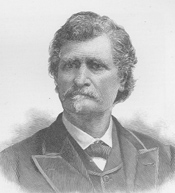
Historical · U.S. House · Texas · District 2
William Martin
Former U.S. Representative · Texas District 2 · 1887–1891 · Democratic
William Martin represented Texas's District 2 in the United States House of Representatives (1887–1891) for the Democratic party. The page below collects sourced biographical facts, term history, committee roles, and provenance for Martin.
Bioguide ID: M000203
Key facts
- Full name
- William Martin
- State
- Texas
- District
- District 2
- Party
- Democratic
- House service
- 1887–1891
- First House term
- 1887
- Status
- Left office
- Current term ends
- —
- Born
- 1823
- Bioguide ID
- M000203
- Committee assignments
- —
- Dataset version
- 1.20260606
Biographical narrative
1,062 words · sourced from the Wikipedia REST extract
William Martin was a U.S. Representative from Texas, affiliated with the Democratic Party. He served in the U.S. House of Representatives during the late 19th century, holding office from 1887 until 1891. Martin's political career followed a diverse background that included military service in the Confederate Army, legal practice, and a tenure in the Texas State Senate. His life spanned significant periods in American history, including the Civil War and the post-war Reconstruction era.
Early life and career
William Martin was born on May 23, 1823, in Twiggs County, Georgia, to Robert and Charlotte Martin. His early education took place in Alabama, where he attended common schools. He pursued higher education in law at Troy State College, which equipped him with the skills necessary to practice law. After being admitted to the bar, he relocated to Texas in 1850, where he began his legal career in Henderson County. This move marked the beginning of his long-standing connection to Texas, a state that would become central to his identity and political career.
In addition to his legal practice, Martin's early career included public service as a member of the Texas State Senate from 1853 to 1857. During this time, he represented several counties, including Freestone, Limestone, Henderson, and Navarro. His involvement in state politics laid the groundwork for his later ascension to national office. Martin's legal and political experiences in Texas during the mid-19th century provided him with a deep understanding of the issues facing his constituents, which would inform his legislative priorities in Congress.
Martin's life took a significant turn when the Civil War broke out. He enlisted in the Confederate States Army in 1861, joining Company K of the 4th Infantry, Hood's Texas Brigade. His regiment was active in the Eastern Theater of the war, serving under prominent Confederate generals such as Robert E. Lee and James Longstreet. Martin's military service was marked by a promotion to the rank of Major in April 1864, reflecting his leadership capabilities and commitment to the Confederate cause. The experiences he gained during the war would later influence his perspectives on issues of national importance.
Following the conclusion of the Civil War, Martin returned to Texas, where he resumed his law practice in Athens. His legal expertise and connections in the community facilitated his continued involvement in public service. He was elected as the district attorney for Kaufman, Smith, Henderson, and Anderson counties, further solidifying his reputation as a dedicated public servant.
House tenure
William Martin's congressional career began when he was elected as a Democrat to the 50th United States Congress on February 12, 1887. He filled the vacancy left by John H. Reagan, who had been chosen to serve in the United States Senate. Martin's election marked a significant step in his political journey, as he transitioned from state-level politics to the national stage. His first term in the House of Representatives commenced on November 4, 1887, and he was subsequently reelected to the 51st United States Congress, serving until March 3, 1891.
During his time in Congress, Martin participated in various legislative activities and discussions that shaped the policies of the era. His tenure coincided with a period of significant change in the United States, as the nation grappled with the aftermath of the Civil War and the challenges of Reconstruction. Martin's background as a veteran and his experiences in Texas likely informed his views on issues related to veterans, civil rights, and economic development.
Despite the challenges of the political landscape, Martin remained engaged with his constituents and worked to address their needs. His legislative efforts were reflective of the Democratic Party's priorities during the late 19th century, which often emphasized agrarian interests, states' rights, and opposition to certain federal policies. Martin's commitment to his constituents was evident in his approach to governance, as he sought to represent the interests of the people of Texas.
One notable incident during Martin's congressional career occurred in 1888 when he took offense to articles written about him by George Herbert Harries in The Washington Star. In a moment of conflict, Martin confronted Harries in the United States Capitol, leading to charges of assault. He ultimately pleaded guilty and was fined, an event that highlighted the sometimes contentious nature of political life in Washington, D.C.
After completing his second term in the House, Martin returned to Texas, where he resumed his law practice. His departure from Congress marked the end of a significant chapter in his political career, but his influence in Texas continued through his legal work and community involvement.
Legislative focus and committees
While specific details regarding the committees Martin served on during his time in Congress are not provided, it can be inferred that his background in law and public service would have influenced his legislative focus. As a representative from Texas, he likely prioritized issues pertinent to his constituents, including agricultural policies, veterans' affairs, and local economic development.
The late 19th century was a time of considerable change in the United States, with rapid industrialization and shifts in the economy. Martin's experiences as a lawyer and a former military officer may have shaped his perspectives on the evolving landscape of American society. His legislative efforts would have been informed by the needs and concerns of the people he represented, particularly in a state like Texas, which was experiencing significant growth and transformation.
In addition to his legislative work, Martin's military service and legal background may have positioned him as an advocate for veterans and their rights. The post-Civil War era saw many veterans seeking assistance and support, and representatives like Martin were often at the forefront of addressing these issues. His commitment to public service and his understanding of the challenges faced by veterans would have been critical in shaping his approach to legislation.
Overall, Martin's tenure in the U.S. House of Representatives was characterized by a dedication to his constituents and an engagement with the pressing issues of his time. His experiences in law, military service, and state politics provided him with a unique perspective that informed his legislative priorities and actions. After leaving Congress, Martin continued to contribute to his community through his law practice until his death on February 5, 1898, at his home near Hillsboro, Texas. His life and career reflect the complexities of American politics during a transformative era in the nation's history.
Notable legislation
Sponsored and co-sponsored legislation for William Martin is pending operator curation. The biographical narrative above carries the same provenance trail until per-bill rows are written.
Sources
- [1]https://en.wikipedia.org/wiki/William_Harrison_MartinWikipedia · retrieved 2026-06-06
Notable quotes
Sourced quotes for William Martin are pending operator curation. Narrative-scope provenance remains attached below.
Sources
- [1]https://en.wikipedia.org/wiki/William_Harrison_MartinWikipedia · retrieved 2026-06-06
Key positions
Curated policy positions for William Martin are pending operator review. The biographical narrative above carries the same provenance trail until per-topic positions are written.
Sources
- [1]https://en.wikipedia.org/wiki/William_Harrison_MartinWikipedia · retrieved 2026-06-06
Terms served
- 1887–1889U.S. House · Term 1 · Democratic
- 1889–1891U.S. House · Term 2 · Democratic
Sources & provenance
Every attributable claim above carries a per-section [N] marker that resolves to the corresponding URL below. Each entry records the upstream provider, the canonical URL, and the timestamp at which the source was retrieved by the ingest pipeline.
Key facts
- https://bioguide.congress.gov/search/bio/M000203bioguide · retrieved 2026-06-06
- https://www.govtrack.us/congress/members/407223govtrack · retrieved 2026-06-06
Biographical narrative
- https://en.wikipedia.org/wiki/William_Harrison_Martinwikipedia · retrieved 2026-06-06
Find your representative
Every U.S. state elects representatives by district. Browse Texas’s delegation, the full former-representative roster, or explore the role and term length.
Related on The Candidate
- Preceded by William McLeanEarlier holder of the Texas District 2 House seat · Democratic.Open
- Succeeded by John LongLater holder of the Texas District 2 House seat · Democratic.Open
- Charles StewartFormer U.S. Representative · Texas District 1 · DemocraticOpen
- David KaufmanFormer U.S. Representative · Texas District 1 · DemocraticOpen
- Eugene BlackFormer U.S. Representative · Texas District 1 · DemocraticOpen
- George SmythFormer U.S. Representative · Texas District 1 · DemocraticOpen