
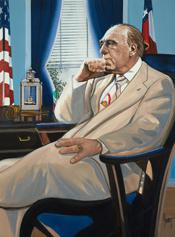
Historical · U.S. House · Texas · District 20
Henry González
Former U.S. Representative · Texas District 20 · 1961–1999 · Democratic
Henry González represented Texas's District 20 in the United States House of Representatives (1961–1999) for the Democratic party. The page below collects sourced biographical facts, term history, committee roles, and provenance for González.
Bioguide ID: G000272
Key facts
- Full name
- Henry González
- State
- Texas
- District
- District 20
- Party
- Democratic
- House service
- 1961–1999
- First House term
- 1961
- Status
- Left office
- Current term ends
- —
- Born
- 1916
- Bioguide ID
- G000272
- Committee assignments
- —
- Dataset version
- 1.20260605
Biographical narrative
1,019 words · sourced from the Wikipedia REST extract
Henry B. Gonzalez was a prominent American politician who served as a U.S. Representative for Texas's 20th congressional district from 1961 until 1999. A member of the Democratic Party, he was known for his long tenure in Congress, making him the longest-serving Hispanic member in the history of the U.S. Congress. Throughout his career, Gonzalez was recognized for his liberal stance on various issues and was a founding member of the Congressional Hispanic Caucus, advocating for the rights and representation of Hispanic Americans.
Early life and career
Born on May 3, 1916, in San Antonio, Texas, Henry Barbosa Gonzalez was the son of Mexican immigrants, Genoveva and Leonides Gonzalez, who arrived in the United States during the Mexican Revolution. Growing up in a culturally rich environment, Gonzalez was influenced by his heritage and the challenges faced by immigrant communities. He pursued higher education, first earning an associate's degree from San Antonio College, followed by a bachelor's degree from the University of Texas at Austin. He later obtained a Juris Doctor from St. Mary's University School of Law in San Antonio.
Gonzalez's early career began in the field of law and public service. He initially worked as a probation officer and quickly rose to the position of chief probation officer for Bexar County, Texas. His tenure in this role was marked by a commitment to social justice, but he resigned in 1945 after a conflict regarding the hiring of an African-American probation officer, highlighting the racial tensions of the time.
In addition to his legal career, Gonzalez became involved in local politics. He served on the San Antonio City Council from 1953 to 1956, where he played a significant role in desegregating public facilities, including swimming pools. His political aspirations continued to grow, and in 1956, he successfully ran for a seat in the Texas Senate, defeating Republican candidate Jesse Oppenheimer. He was re-elected in 1960, and during his time in the Senate, he set a record for the longest filibuster in the chamber's history, speaking for thirty-six consecutive hours against segregation-related bills.
Gonzalez's political ambitions extended to the gubernatorial level when he ran for governor of Texas in 1958, finishing second in the Democratic primary. In 1961, he sought a seat in the U.S. House of Representatives following the appointment of Paul J. Kilday to the Court of Military Appeals. Gonzalez entered the special election for Texas's 20th congressional district and won against a strong Republican opponent, marking the beginning of his lengthy congressional career.
House tenure
Henry Gonzalez was elected to the U.S. House of Representatives in November 1961 and began his first full term in 1962. Over the course of his 19 terms in office, he became a well-known figure in Congress, representing a district that was heavily Democratic. His electoral success was notable; he faced little serious opposition throughout his career, often running unopposed in several elections. Gonzalez's ability to secure re-election was attributed to the strong Democratic leanings of his district and his established reputation among constituents.
During his time in the House, Gonzalez was involved in numerous significant events and legislative efforts. He was present in Dallas during the assassination of President John F. Kennedy on November 22, 1963, and witnessed the aftermath of the tragedy. This experience had a profound impact on him and influenced his later work in Congress, particularly regarding issues of violence and civil rights.
Gonzalez was known for his outspoken support of civil rights legislation, voting in favor of landmark laws such as the Civil Rights Acts of 1964 and 1968, as well as the Voting Rights Act of 1965. His advocacy for civil rights distinguished him from many of his contemporaries in the South, who were often resistant to such reforms. Gonzalez's commitment to social justice extended beyond civil rights; he was also vocal on issues related to immigration and the rights of Hispanic Americans, reflecting his own background and the needs of his constituents.
Throughout his tenure, Gonzalez faced various challenges and controversies. He was labeled a "communist" by political opponents, which he addressed directly. In one notable incident, he physically confronted an individual who made such accusations in a restaurant, resulting in a legal case that ended with the charges being dropped. This incident illustrated the contentious political climate of the time and Gonzalez's willingness to stand up for his beliefs.
Legislative focus and committees
Gonzalez's legislative focus was characterized by a commitment to progressive policies and social justice. He was a founding member of the Congressional Hispanic Caucus, which aimed to increase the representation and influence of Hispanic Americans in Congress. His work in this area was instrumental in advocating for policies that addressed the unique challenges faced by Hispanic communities.
In addition to his advocacy for civil rights, Gonzalez was active in investigating political assassinations. He played a key role in the establishment of the United States House Select Committee on Assassinations in 1976, which aimed to investigate the deaths of President Kennedy and civil rights leader Martin Luther King Jr. Although he faced challenges in leading the committee, including internal conflicts, his involvement underscored his concern for accountability and justice in the political sphere.
Gonzalez was also known for his critical stance on U.S. foreign policy. Following the invasion of Grenada in 1983, he suggested the impeachment of President Ronald Reagan and introduced articles of impeachment related to the Iran-Contra scandal. His calls for impeachment reflected his belief in the importance of congressional oversight and adherence to constitutional principles. He continued to advocate for accountability during the presidencies of George H. W. Bush and Bill Clinton, demonstrating his commitment to maintaining checks on executive power.
Throughout his lengthy career, Gonzalez's contributions to the U.S. House of Representatives were marked by his dedication to civil rights, social justice, and the representation of Hispanic Americans. His legacy includes a significant impact on the legislative landscape and an enduring influence on the Democratic Party's approach to issues affecting minority communities. After serving for nearly four decades, Gonzalez's tenure concluded on January 3, 1999, leaving behind a complex and multifaceted legacy in American politics.
Notable legislation
Sponsored and co-sponsored legislation for Henry González is pending operator curation. The biographical narrative above carries the same provenance trail until per-bill rows are written.
Sources
- [1]https://en.wikipedia.org/wiki/Henry_B._Gonz%C3%A1lezWikipedia · retrieved 2026-06-05
Notable quotes
Sourced quotes for Henry González are pending operator curation. Narrative-scope provenance remains attached below.
Sources
- [1]https://en.wikipedia.org/wiki/Henry_B._Gonz%C3%A1lezWikipedia · retrieved 2026-06-05
Key positions
Curated policy positions for Henry González are pending operator review. The biographical narrative above carries the same provenance trail until per-topic positions are written.
Sources
- [1]https://en.wikipedia.org/wiki/Henry_B._Gonz%C3%A1lezWikipedia · retrieved 2026-06-05
Terms served
- 1961–1963U.S. House · Term 1 · Democratic
- 1963–1965U.S. House · Term 2 · Democratic
- 1965–1967U.S. House · Term 3 · Democratic
- 1967–1969U.S. House · Term 4 · Democratic
- 1969–1971U.S. House · Term 5 · Democratic
- 1971–1973U.S. House · Term 6 · Democratic
- 1973–1975U.S. House · Term 7 · Democratic
- 1975–1977U.S. House · Term 8 · Democratic
- 1977–1979U.S. House · Term 9 · Democratic
- 1979–1981U.S. House · Term 10 · Democratic
- 1981–1983U.S. House · Term 11 · Democratic
- 1983–1985U.S. House · Term 12 · Democratic
- 1985–1987U.S. House · Term 13 · Democratic
- 1987–1989U.S. House · Term 14 · Democratic
- 1989–1991U.S. House · Term 15 · Democratic
- 1991–1993U.S. House · Term 16 · Democratic
- 1993–1995U.S. House · Term 17 · Democratic
- 1995–1997U.S. House · Term 18 · Democratic
- 1997–1999U.S. House · Term 19 · Democratic
Sources & provenance
Every attributable claim above carries a per-section [N] marker that resolves to the corresponding URL below. Each entry records the upstream provider, the canonical URL, and the timestamp at which the source was retrieved by the ingest pipeline.
Key facts
- https://bioguide.congress.gov/search/bio/G000272bioguide · retrieved 2026-06-05
- https://www.govtrack.us/congress/members/404634govtrack · retrieved 2026-06-05
Biographical narrative
- https://en.wikipedia.org/wiki/Henry_B._Gonz%C3%A1lezwikipedia · retrieved 2026-06-05
Find your representative
Every U.S. state elects representatives by district. Browse Texas’s delegation, the full former-representative roster, or explore the role and term length.
Related on The Candidate
- Preceded by Fontaine MaverickEarlier holder of the Texas District 20 House seat · Democratic.Open
- Succeeded by Charlie GonzalezLater holder of the Texas District 20 House seat · Democratic.Open
- Charles StewartFormer U.S. Representative · Texas District 1 · DemocraticOpen
- David KaufmanFormer U.S. Representative · Texas District 1 · DemocraticOpen
- Eugene BlackFormer U.S. Representative · Texas District 1 · DemocraticOpen
- George SmythFormer U.S. Representative · Texas District 1 · DemocraticOpen