
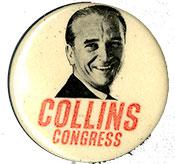
Historical · U.S. House · Texas · District 3
James Collins
Former U.S. Representative · Texas District 3 · 1967–1983 · Republican
James Collins represented Texas's District 3 in the United States House of Representatives (1967–1983) for the Republican party. The page below collects sourced biographical facts, term history, committee roles, and provenance for Collins.
Bioguide ID: C000638
Key facts
- Full name
- James Collins
- State
- Texas
- District
- District 3
- Party
- Republican
- House service
- 1967–1983
- First House term
- 1967
- Status
- Left office
- Current term ends
- —
- Born
- 1916
- Bioguide ID
- C000638
- Committee assignments
- —
- Dataset version
- 1.20260605
Biographical narrative
857 words · sourced from the Wikipedia REST extract
James M. Collins was a prominent American businessman and Republican politician who served as a U.S. Representative for Texas's Third Congressional District from 1968 until 1983. His political career began in the late 1960s, during a period of significant political change in the Dallas area. Collins's tenure in the House of Representatives was marked by a strong electoral record, reflecting the shifting political landscape of North Texas, which transitioned to a Republican stronghold during his time in office.
Early life and career
James Mitchell Collins was born on April 29, 1916, in Hallsville, located in Harrison County, East Texas. He was raised in a family with a strong business background; his father, Carr Collins Sr., was the founder of the Fidelity Union Life Insurance Company. This familial connection to the business world likely influenced Collins's later career as both a businessman and a politician. He had a sister, Ruth Sharp Altshuler, who also made notable contributions to the community.
Collins completed his secondary education at Woodrow Wilson High School in Dallas, where he would later be recognized for his achievements. In 1989, he was inducted into the Woodrow Wilson High School Hall of Fame, an honor that coincided with the sixtieth anniversary of the school's establishment. Following high school, Collins pursued higher education at Southern Methodist University, where he further developed his skills and knowledge, laying the groundwork for his future endeavors.
Before entering politics, Collins had a successful career in business, which provided him with valuable experience in leadership and public service. His business background may have contributed to his understanding of economic issues and the needs of his constituents when he later took office.
House tenure
Collins's political career began in earnest when he ran for the U.S. House of Representatives in 1966, seeking to represent the newly created Third Congressional District of Texas, which encompassed parts of North Dallas. In this initial campaign, he faced off against the incumbent Democrat Joe R. Pool. The election was competitive, with Collins securing 46 percent of the vote compared to Pool's 53 percent. Although he did not win, this close race demonstrated his potential as a candidate.
Tragedy struck in July 1968 when Joe R. Pool passed away. Following his death, a special election was held to fill the vacancy, and Collins seized the opportunity to run again. He won the special election decisively, defeating Pool's widow, Elizabeth, with over 60 percent of the vote. This victory marked the beginning of his long tenure in Congress, as he subsequently won a full term later that year, receiving 59.4 percent of the vote against Democrat Robert H. Hughes.
Throughout his eight terms in office, Collins established a reputation as a reliable Republican representative. His electoral success was notable; he consistently received a significant majority of the votes in subsequent elections, never dropping below 64 percent. In fact, in 1978, he ran unopposed, reflecting his strong standing within the district and the broader political environment in North Dallas, which had shifted toward the Republican Party during his tenure.
Collins's time in the House was not without controversy. In 1972, he became implicated in a salary kickback scheme involving his staff, which raised questions about his conduct. Despite this incident, he maintained a solid electoral base and continued to serve in Congress until the end of his last term in January 1983.
Legislative focus and committees
During his time in the U.S. House of Representatives, Collins focused on various legislative issues that were pertinent to his constituents and aligned with his party's platform. His opposition to desegregation busing was a notable aspect of his political stance, reflecting the sentiments of many constituents in his district during that era. This position was part of a broader national debate on civil rights and education policy, which was particularly contentious in the late 20th century.
Collins's legislative work involved participation in several committees, although specific committee assignments are not detailed in the available records. Typically, members of Congress serve on committees that align with their interests and the needs of their constituents, allowing them to influence legislation in areas such as education, transportation, and economic development. Given his background in business and his focus on local issues, it is likely that Collins engaged with committees that addressed economic and community development matters.
Throughout his eight terms, Collins contributed to the legislative process in ways that reflected the priorities of his district and the Republican Party. His ability to secure a strong electoral mandate allowed him to pursue his policy goals and advocate for the interests of his constituents effectively.
After leaving office in January 1983, Collins's legacy continued to influence the political landscape of North Texas. His tenure in Congress coincided with a significant transformation in the region's political dynamics, as the Republican Party solidified its presence in areas that had previously leaned Democratic. Collins passed away on July 21, 1989, leaving behind a record of public service that spanned nearly two decades in the U.S. House of Representatives. His contributions to Texas politics and his role in shaping the Third Congressional District remain a part of the region's history.
Notable legislation
Sponsored and co-sponsored legislation for James Collins is pending operator curation. The biographical narrative above carries the same provenance trail until per-bill rows are written.
Sources
- [1]https://en.wikipedia.org/wiki/James_M._CollinsWikipedia · retrieved 2026-06-05
Notable quotes
Sourced quotes for James Collins are pending operator curation. Narrative-scope provenance remains attached below.
Sources
- [1]https://en.wikipedia.org/wiki/James_M._CollinsWikipedia · retrieved 2026-06-05
Key positions
Curated policy positions for James Collins are pending operator review. The biographical narrative above carries the same provenance trail until per-topic positions are written.
Sources
- [1]https://en.wikipedia.org/wiki/James_M._CollinsWikipedia · retrieved 2026-06-05
Terms served
- 1967–1969U.S. House · Term 1 · Republican
- 1969–1971U.S. House · Term 2 · Republican
- 1971–1973U.S. House · Term 3 · Republican
- 1973–1975U.S. House · Term 4 · Republican
- 1975–1977U.S. House · Term 5 · Republican
- 1977–1979U.S. House · Term 6 · Republican
- 1979–1981U.S. House · Term 7 · Republican
- 1981–1983U.S. House · Term 8 · Republican
Sources & provenance
Every attributable claim above carries a per-section [N] marker that resolves to the corresponding URL below. Each entry records the upstream provider, the canonical URL, and the timestamp at which the source was retrieved by the ingest pipeline.
Key facts
- https://bioguide.congress.gov/search/bio/C000638bioguide · retrieved 2026-06-05
- https://www.govtrack.us/congress/members/402767govtrack · retrieved 2026-06-05
Biographical narrative
- https://en.wikipedia.org/wiki/James_M._Collinswikipedia · retrieved 2026-06-05
Find your representative
Every U.S. state elects representatives by district. Browse Texas’s delegation, the full former-representative roster, or explore the role and term length.
Related on The Candidate
- Preceded by Lindley Beckworth Sr.Earlier holder of the Texas District 3 House seat · Democratic.Open
- Succeeded by Steve BartlettLater holder of the Texas District 3 House seat · Republican.Open
- Charles StewartFormer U.S. Representative · Texas District 1 · DemocraticOpen
- David KaufmanFormer U.S. Representative · Texas District 1 · DemocraticOpen
- Eugene BlackFormer U.S. Representative · Texas District 1 · DemocraticOpen
- George SmythFormer U.S. Representative · Texas District 1 · DemocraticOpen