
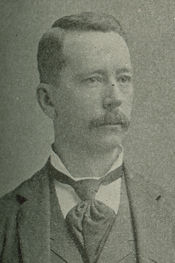
Historical · U.S. House · Texas · District 8
Charles Bell
Former U.S. Representative · Texas District 8 · 1893–1897 · Democratic
Charles Bell represented Texas's District 8 in the United States House of Representatives (1893–1897) for the Democratic party. The page below collects sourced biographical facts, term history, committee roles, and provenance for Bell.
Bioguide ID: B000333
Key facts
- Full name
- Charles Bell
- State
- Texas
- District
- District 8
- Party
- Democratic
- House service
- 1893–1897
- First House term
- 1893
- Status
- Left office
- Current term ends
- —
- Born
- 1853
- Bioguide ID
- B000333
- Committee assignments
- —
- Dataset version
- 1.20260606
Biographical narrative
942 words · sourced from the Wikipedia REST extract
Charles Bell was an American politician who served as a U.S. Representative for Texas's 8th congressional district from 1893 to 1897. A member of the Democratic Party, he had a diverse career that included roles as a lawyer, district attorney, and state senator. His political journey began in Tennessee, where he was born, and ultimately led him to Texas, where he became an influential figure in state and national politics during the late 19th century. After his tenure in Congress, he continued to engage in legal practice and held the position of Attorney General of Texas.
Early life and career
Charles Bell was born on April 18, 1853, in Chattanooga, Tennessee. His early education took place in public schools, where he laid the groundwork for his future academic pursuits. He later attended Sewanee College, which is known for its rigorous academic programs and its role in the education of many prominent Southern leaders. In 1871, at the age of 18, Bell moved to Texas, a decision that would significantly shape his career and political trajectory.
Upon arriving in Texas, Bell began to study law, demonstrating an early interest in the legal profession. He was admitted to the bar in 1874, marking the beginning of his legal career. Bell commenced his practice in Hamilton, Texas, where he quickly established himself in the local legal community. His skills and dedication led to his appointment as the prosecuting attorney for Hamilton County in 1876. This role allowed him to gain valuable experience in the legal system and to build a reputation as a competent attorney.
Bell's legal career continued to flourish, and from 1880 to 1882, he served as the district attorney for the same county. His work in these positions provided him with insights into both the legal and political landscapes of Texas, preparing him for future roles in public service. In addition to his legal work, Bell was politically active and participated in the Democratic National Convention in 1884 as a delegate, further solidifying his commitment to the Democratic Party.
In 1884, Bell was elected to the Texas Senate, where he served until 1888. His tenure in the state legislature allowed him to influence state policy and legislation, and he gained experience in governance that would be beneficial in his later congressional career. Following his time in the Senate, he was appointed as the judge of the twenty-ninth judicial district of Texas, a position he held from 1888 to 1890. This role further enhanced his legal credentials and provided him with a broader understanding of judicial processes.
House tenure
Charles Bell's congressional career began when he was elected to the United States House of Representatives as a Democrat, representing Texas's 8th congressional district. His first term commenced on March 4, 1893, during a period marked by significant political and economic changes in the United States. Bell served in the Fifty-third Congress and was subsequently re-elected to the Fifty-fourth Congress, which lasted until March 3, 1897.
During his time in Congress, Bell participated in various legislative activities and contributed to discussions on issues pertinent to his constituents and the nation. His experience in the Texas Senate and as a district judge likely informed his approach to legislation and governance. However, specific details regarding the bills he supported or the committees he served on during his congressional tenure are not extensively documented.
Bell chose not to seek renomination in 1896, concluding his time in the House after two terms. His decision to step away from Congress may have been influenced by various factors, including the political climate of the time and his personal aspirations. After leaving office, Bell returned to Texas, where he resumed his legal practice in Fort Worth, continuing to be active in the legal community.
Legislative focus and committees
While specific records of Charles Bell's legislative focus during his time in Congress are limited, it is clear that his background in law and his experience in state politics would have shaped his priorities as a representative. As a member of the Democratic Party, he would have aligned with the party's platform, which during the 1890s included issues such as economic reform, civil rights, and labor rights, reflecting the concerns of many Americans at the time.
Bell's legal expertise likely influenced his perspective on various legislative matters, particularly those related to the judiciary and law enforcement. His previous roles as a prosecuting attorney and district attorney would have provided him with a unique understanding of the legal system, which could have informed his contributions to discussions on criminal justice and legal reform.
In addition to his legislative work, Bell's participation in the Democratic National Convention in 1884 indicates his engagement with broader party dynamics and national issues. This involvement may have also influenced his legislative priorities and the issues he championed while in Congress.
After his congressional tenure, Bell continued to play a significant role in Texas politics. He was appointed as the Attorney General of Texas from 1901 to 1904, a position that allowed him to further influence state law and policy. Following his service as Attorney General, he resumed his legal practice in Fort Worth, where he remained active until his death on April 22, 1913.
Charles Bell's life and career reflect the complexities of American politics in the late 19th century, characterized by rapid change and the evolving role of government. His contributions to Texas politics, both as a legislator and as a legal professional, left a lasting impact on the state's legal and political landscape. He was laid to rest in East Oakwood Cemetery, leaving behind a legacy of public service and commitment to the law.
Notable legislation
Sponsored and co-sponsored legislation for Charles Bell is pending operator curation. The biographical narrative above carries the same provenance trail until per-bill rows are written.
Sources
- [1]https://en.wikipedia.org/wiki/Charles_K._BellWikipedia · retrieved 2026-06-06
Notable quotes
Sourced quotes for Charles Bell are pending operator curation. Narrative-scope provenance remains attached below.
Sources
- [1]https://en.wikipedia.org/wiki/Charles_K._BellWikipedia · retrieved 2026-06-06
Key positions
Curated policy positions for Charles Bell are pending operator review. The biographical narrative above carries the same provenance trail until per-topic positions are written.
Sources
- [1]https://en.wikipedia.org/wiki/Charles_K._BellWikipedia · retrieved 2026-06-06
Terms served
- 1893–1895U.S. House · Term 1 · Democratic
- 1895–1897U.S. House · Term 2 · Democratic
Sources & provenance
Every attributable claim above carries a per-section [N] marker that resolves to the corresponding URL below. Each entry records the upstream provider, the canonical URL, and the timestamp at which the source was retrieved by the ingest pipeline.
Key facts
- https://bioguide.congress.gov/search/bio/B000333bioguide · retrieved 2026-06-06
- https://www.govtrack.us/congress/members/401325govtrack · retrieved 2026-06-06
Biographical narrative
- https://en.wikipedia.org/wiki/Charles_K._Bellwikipedia · retrieved 2026-06-06
Find your representative
Every U.S. state elects representatives by district. Browse Texas’s delegation, the full former-representative roster, or explore the role and term length.
Related on The Candidate
- Preceded by Littleton MooreEarlier holder of the Texas District 8 House seat · Democratic.Open
- Succeeded by Thomas BallLater holder of the Texas District 8 House seat · Democratic.Open
- Charles StewartFormer U.S. Representative · Texas District 1 · DemocraticOpen
- David KaufmanFormer U.S. Representative · Texas District 1 · DemocraticOpen
- Eugene BlackFormer U.S. Representative · Texas District 1 · DemocraticOpen
- George SmythFormer U.S. Representative · Texas District 1 · DemocraticOpen