
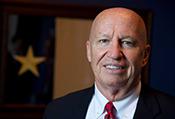
Historical · U.S. House · Texas · District 8
Kevin Brady
Former U.S. Representative · Texas District 8 · 1997–2023 · Republican
Kevin Brady represented Texas's District 8 in the United States House of Representatives (1997–2023) for the Republican party. The page below collects sourced biographical facts, term history, committee roles, and provenance for Brady.
Bioguide ID: B000755
Key facts
- Full name
- Kevin Brady
- State
- Texas
- District
- District 8
- Party
- Republican
- House service
- 1997–2023
- First House term
- 1997
- Status
- Left office
- Current term ends
- —
- Born
- 1955
- Bioguide ID
- B000755
- Committee assignments
- —
- Dataset version
- 1.20260603
Biographical narrative
947 words · sourced from the Wikipedia REST extract
Kevin Brady is a former U.S. Representative who served Texas's 8th congressional district from 1997 until January 3, 2023. A member of the Republican Party, Brady's political career spanned over two decades, during which he was involved in various legislative initiatives and held significant positions within the House of Representatives. His district included northern Houston, including The Woodlands, and he was known for his focus on economic policies, trade agreements, and fiscal responsibility.
Early life and career
Kevin Patrick Brady was born on April 11, 1955, in Vermillion, South Dakota. He was the second of five children born to William F. Brady, a lawyer, and Nancy A. Brady. Tragically, his father was killed in a courtroom shooting when Brady was just 12 years old, an event that profoundly impacted his early life. Following his high school graduation from Central High School in 1973, Brady pursued higher education at the University of South Dakota in Vermillion, where he earned a degree in mass communications.
Brady's early career included work for the Rapid City Chamber of Commerce, where he gained experience in local governance and community engagement. At the age of 26, he was elected to the Rapid City common council, marking the beginning of his political involvement. In 1982, he relocated to Texas to work for the Beaumont Chamber of Commerce, and three years later, he joined the South Montgomery County Woodlands Chamber of Commerce, further solidifying his ties to the region.
His political career in Texas began in earnest when he was elected to the Texas House of Representatives in 1990, representing the 15th district. This district included The Woodlands and parts of Montgomery County, as well as several other counties to the west and north of Houston. Brady succeeded Mike McKinney in this role, beginning his tenure on January 10, 1991. His experience in state politics laid the groundwork for his subsequent campaign for the U.S. House of Representatives.
House tenure
Brady's journey to the U.S. House of Representatives began in 1996 when incumbent Jack Fields announced his retirement from Texas's 8th congressional district. Brady entered the Republican primary, where he initially placed second with 22% of the vote in a competitive six-candidate field. The leading candidate, Gene Fontenot, received 36% but did not achieve the necessary majority. In a runoff election, Brady secured his position by defeating Fontenot with a narrow margin.
The election process was complicated by a Supreme Court ruling that declared several Texas congressional districts unconstitutional, leading to a unique "jungle primary" format in the general election. Brady emerged as the frontrunner with 41% of the vote and subsequently won the runoff with a decisive 59% against Fontenot.
Following this initial victory, Brady was re-elected multiple times, consistently receiving a significant majority of the votes in subsequent elections. Between 1998 and 2008, he never garnered less than 67% of the vote in his re-elections. In 2010, he faced his first primary challenge since 1998, winning with 79% of the vote. His electoral success continued in 2012, 2014, 2016, 2018, and 2020, with Brady often defeating his opponents by substantial margins.
Brady's tenure in the House was marked by a range of legislative actions and positions on key issues. He voted for the Authorization for the Use of Military Force Against Iraq in 2002 but later voted to impeach President George W. Bush in 2008 for misleading Congress regarding the war. He was a strong advocate for free trade, supporting agreements such as the Dominican Republic-Central America Free Trade Agreement (DR-CAFTA) and various trade agreements with South Korea, Colombia, and Panama.
Brady's political career culminated in his election as the 65th chair of the Committee on Ways and Means in November 2015, a position he held until 2019. His leadership on this committee allowed him to influence significant economic and fiscal policies during his time in office.
Legislative focus and committees
Throughout his congressional career, Brady focused on a variety of legislative issues, particularly those related to economic policy, trade, and fiscal responsibility. He was known for advocating free trade agreements, believing they would benefit the U.S. economy by opening markets and fostering international commerce. His support for the DR-CAFTA and other trade agreements reflected his commitment to enhancing trade relations and economic growth.
Brady was also a proponent of fiscal accountability and transparency in government spending. He authored a federal "sunset law," which aimed to require federal programs not explicitly mandated by the Constitution to justify their existence to taxpayers every twelve years or face elimination. This initiative was part of his broader effort to promote responsible governance and ensure that taxpayer dollars were used effectively.
In addition to his work on trade and fiscal policy, Brady introduced the Sound Dollar Act in March 2012, which sought to reform the Federal Reserve's mandate. This legislation aimed to shift the Federal Reserve's focus from a dual mandate of controlling unemployment and inflation to a single mandate centered on maintaining the stability of the U.S. dollar.
Brady's involvement in health care reform was also notable. In March 2017, he introduced an amendment to the American Health Care Act, which was the House Republican proposal to repeal the Affordable Care Act. His amendment sought to allow health insurance providers to fully deduct all forms of compensation for their highest-paid executives, reflecting his focus on deregulation and business interests.
Brady's legislative career concluded with his retirement in 2022, after serving a total of 13 terms in the U.S. House of Representatives. His long tenure and active participation in key committees, particularly the Committee on Ways and Means, positioned him as a significant figure in shaping U.S. economic policy during his time in office.
Notable legislation
Sponsored and co-sponsored legislation for Kevin Brady is pending operator curation. The biographical narrative above carries the same provenance trail until per-bill rows are written.
Sources
- [1]https://en.wikipedia.org/wiki/Kevin_BradyWikipedia · retrieved 2026-06-03
Notable quotes
Sourced quotes for Kevin Brady are pending operator curation. Narrative-scope provenance remains attached below.
Sources
- [1]https://en.wikipedia.org/wiki/Kevin_BradyWikipedia · retrieved 2026-06-03
Key positions
Curated policy positions for Kevin Brady are pending operator review. The biographical narrative above carries the same provenance trail until per-topic positions are written.
Sources
- [1]https://en.wikipedia.org/wiki/Kevin_BradyWikipedia · retrieved 2026-06-03
Terms served
- 1997–1999U.S. House · Term 1 · Republican
- 1999–2001U.S. House · Term 2 · Republican
- 2001–2003U.S. House · Term 3 · Republican
- 2003–2005U.S. House · Term 4 · Republican
- 2005–2007U.S. House · Term 5 · Republican
- 2007–2009U.S. House · Term 6 · Republican
- 2009–2011U.S. House · Term 7 · Republican
- 2011–2013U.S. House · Term 8 · Republican
- 2013–2015U.S. House · Term 9 · Republican
- 2015–2017U.S. House · Term 10 · Republican
- 2017–2019U.S. House · Term 11 · Republican
- 2019–2021U.S. House · Term 12 · Republican
- 2021–2023U.S. House · Term 13 · Republican
Sources & provenance
Every attributable claim above carries a per-section [N] marker that resolves to the corresponding URL below. Each entry records the upstream provider, the canonical URL, and the timestamp at which the source was retrieved by the ingest pipeline.
Key facts
- https://bioguide.congress.gov/search/bio/B000755bioguide · retrieved 2026-06-03
- https://kevinbrady.house.govhouse.gov · retrieved 2026-06-03
Biographical narrative
- https://en.wikipedia.org/wiki/Kevin_Bradywikipedia · retrieved 2026-06-03
Find your representative
Every U.S. state elects representatives by district. Browse Texas’s delegation, the full former-representative roster, or explore the role and term length.
Related on The Candidate
- Preceded by Jack Fields Jr.Earlier holder of the Texas District 8 House seat · Republican.Open
- Charles StewartFormer U.S. Representative · Texas District 1 · DemocraticOpen
- David KaufmanFormer U.S. Representative · Texas District 1 · DemocraticOpen
- Eugene BlackFormer U.S. Representative · Texas District 1 · DemocraticOpen
- George SmythFormer U.S. Representative · Texas District 1 · DemocraticOpen
- Republican PartyFederal candidates and office holders on the Republican line.Open