
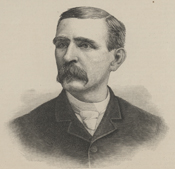
Historical · U.S. House · Virginia · District 1
Thomas Browne
Former U.S. Representative · Virginia District 1 · 1887–1891 · Republican
Thomas Browne represented Virginia's District 1 in the United States House of Representatives (1887–1891) for the Republican party. The page below collects sourced biographical facts, term history, committee roles, and provenance for Browne.
Bioguide ID: B000957
Key facts
- Full name
- Thomas Browne
- State
- Virginia
- District
- District 1
- Party
- Republican
- House service
- 1887–1891
- First House term
- 1887
- Status
- Left office
- Current term ends
- —
- Born
- 1844
- Bioguide ID
- B000957
- Committee assignments
- —
- Dataset version
- 1.20260606
Biographical narrative
1,069 words · sourced from the Wikipedia REST extract
Thomas Browne was a prominent figure in Virginia's political landscape during the late 19th century. He served as a Republican U.S. Representative for Virginia's 1st congressional district from 1887 until 1891. A veteran of the Civil War, Browne's career was marked by his legal practice and his service in Congress, where he represented his constituents during a time of significant change in the United States. His life spanned from February 8, 1844, to August 27, 1892, and he is remembered for his contributions to both his local community and the national legislature.
Early life and career
Thomas Browne was born in Drummondtown, which is now known as Accomac, located in Accomack County on Virginia's Eastern Shore. He was born into a family with deep roots in the region; his father, Dr. Peter Fielding Browne, was a physician, and his mother, Sally Cropper Bayly, came from a well-established planter family. Browne had one elder brother, Orris Applethwaite Browne, and a sister who died in infancy. His early education was conducted through private tutors, which was common for children of affluent families during that period. He later attended Hanover Academy and Bloomfield Academy, both educational institutions in Virginia that provided a classical education.
The American Civil War had a profound impact on Browne's life. He enlisted as a private in Company F of the 39th Virginia Infantry, where his father served as a surgeon. Browne's military service included time with Chew's Battalion of Stuart Horse Artillery, and he was part of the Army of Northern Virginia during its surrender at Appomattox Court House on April 9, 1865. This experience as a soldier shaped his character and influenced his later political career. After the war, he pursued a legal education, graduating from the law department of the University of Virginia in 1867, which enabled him to practice law upon his admission to the Virginia bar in 1868.
Following his legal training, Browne returned to his hometown to establish a law practice. His brother, Orris, also returned to the area and became involved in agricultural reform and the regulation of the oyster industry, reflecting the family's commitment to public service and community improvement. In 1873, Browne was elected as the Commonwealth attorney for Accomack County, a role in which he was responsible for prosecuting criminal cases. His work in this position earned him a reputation in the legal community, and he was subsequently re-elected, indicating his popularity and effectiveness as a prosecutor.
In 1886, Browne's political career took a significant turn when he was elected to the U.S. House of Representatives. He won a competitive race against the incumbent Democrat, Thomas Croxton, marking the beginning of his congressional tenure. His election was indicative of the shifting political dynamics in Virginia during this period, as the Republican Party sought to regain influence in a state that had been deeply affected by the Civil War and Reconstruction.
House tenure
Browne's first term in the House of Representatives began in 1887, during the 50th Congress. His election was part of a broader Republican strategy to reclaim power in the South, where the party had struggled following the end of Reconstruction. Browne's victory over Croxton, who had served in Congress prior to Browne's election, demonstrated his ability to connect with voters in his district, which included a diverse population with varying interests and concerns.
During his time in office, Browne served on various committees and participated in legislative discussions that were crucial to the interests of his constituents. His re-election in 1888 to the 51st Congress further solidified his position as a key representative for Virginia's 1st congressional district. He won this election with a narrow margin, securing 50.71% of the vote against Democrat Gilmer S. Kendall. This re-election underscored his ongoing support among voters, who valued his representation in Congress.
Browne's legislative focus during his tenure was shaped by the needs of his district and the broader political context of the time. The late 19th century was a period marked by economic growth, industrialization, and significant social change in the United States. As a member of the Republican Party, Browne aligned himself with policies that promoted economic development and infrastructure improvements, which were essential for the growth of Virginia's economy.
Despite his initial successes, Browne's political career faced challenges. In 1890, he sought re-election but was defeated by Democrat William A. Jones, receiving only 45.4% of the vote. This loss marked the end of his congressional career, and he returned to his law practice in Drummondtown. The political landscape in Virginia was shifting, and Browne's defeat reflected the changing dynamics of party support and voter preferences in the region.
Legislative focus and committees
During his time in the House of Representatives, Browne was involved in various legislative initiatives that reflected the priorities of his constituents and the Republican Party. While specific details of the bills he sponsored or supported are not documented, it is understood that his legislative agenda would have included issues pertinent to the economic and social conditions of Virginia in the late 19th century. This era was characterized by a focus on infrastructure development, including transportation and communication improvements, which were vital for the economic advancement of rural areas like those in his district.
Browne's participation in congressional committees would have provided him with a platform to advocate for the interests of his constituents. Committees in the House play a crucial role in shaping legislation, and members often focus on specific areas such as finance, agriculture, or military affairs. Browne's background as a lawyer and his experience as a Commonwealth attorney likely informed his contributions to discussions on legal and regulatory matters.
The late 19th century was also a time of significant social change, including debates over civil rights and labor issues. As a Republican, Browne would have been part of a party that, during this period, was grappling with the legacy of the Civil War and the ongoing challenges of Reconstruction. His legislative focus may have included support for policies that aimed to promote economic opportunity and social stability in a region still recovering from the war's aftermath.
Following his departure from Congress, Browne returned to his law practice, where he continued to serve his community until his death in 1892. His legacy as a two-term U.S. Representative and a dedicated public servant is remembered in the context of Virginia's political history during a transformative era in American society.
Notable legislation
Sponsored and co-sponsored legislation for Thomas Browne is pending operator curation. The biographical narrative above carries the same provenance trail until per-bill rows are written.
Sources
- [1]https://en.wikipedia.org/wiki/Thomas_H._B._BrowneWikipedia · retrieved 2026-06-06
Notable quotes
Sourced quotes for Thomas Browne are pending operator curation. Narrative-scope provenance remains attached below.
Sources
- [1]https://en.wikipedia.org/wiki/Thomas_H._B._BrowneWikipedia · retrieved 2026-06-06
Key positions
Curated policy positions for Thomas Browne are pending operator review. The biographical narrative above carries the same provenance trail until per-topic positions are written.
Sources
- [1]https://en.wikipedia.org/wiki/Thomas_H._B._BrowneWikipedia · retrieved 2026-06-06
Terms served
- 1887–1889U.S. House · Term 1 · Republican
- 1889–1891U.S. House · Term 2 · Republican
Sources & provenance
Every attributable claim above carries a per-section [N] marker that resolves to the corresponding URL below. Each entry records the upstream provider, the canonical URL, and the timestamp at which the source was retrieved by the ingest pipeline.
Key facts
- https://bioguide.congress.gov/search/bio/B000957bioguide · retrieved 2026-06-06
- https://www.govtrack.us/congress/members/401909govtrack · retrieved 2026-06-06
Biographical narrative
- https://en.wikipedia.org/wiki/Thomas_H._B._Brownewikipedia · retrieved 2026-06-06
Find your representative
Every U.S. state elects representatives by district. Browse Virginia’s delegation, the full former-representative roster, or explore the role and term length.
Related on The Candidate
- Preceded by Thomas CroxtonEarlier holder of the Virginia District 1 House seat · Democratic.Open
- Succeeded by William JonesLater holder of the Virginia District 1 House seat · Democratic.Open
- Alexander WhiteFormer U.S. Representative · Virginia District 1Open
- Archibald AtkinsonFormer U.S. Representative · Virginia District 1 · DemocraticOpen
- Beverly DouglasFormer U.S. Representative · Virginia District 1 · DemocraticOpen
- Daniel MorganFormer U.S. Representative · Virginia District 1 · FederalistOpen