
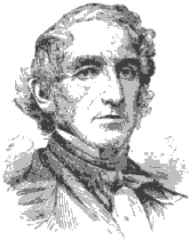
Historical · U.S. House · Virginia · District 13
George Hopkins
Former U.S. Representative · Virginia District 13 · 1835–1859 · Democratic
George Hopkins represented Virginia's District 13 in the United States House of Representatives (1835–1859) for the Democratic party. The page below collects sourced biographical facts, term history, committee roles, and provenance for Hopkins.
Bioguide ID: H000774
Key facts
- Full name
- George Hopkins
- State
- Virginia
- District
- District 13
- Party
- Democratic
- House service
- 1835–1859
- First House term
- 1835
- Status
- Left office
- Current term ends
- —
- Born
- 1804
- Bioguide ID
- H000774
- Committee assignments
- —
- Dataset version
- 1.20260606
Biographical narrative
896 words · sourced from the Wikipedia REST extract
George Hopkins was a prominent American politician and lawyer who served as a U.S. Representative from Virginia's 13th congressional district during the mid-19th century. A member of the Democratic Party, he had a significant political career that included multiple terms in the U.S. House of Representatives, as well as roles in state government and diplomatic service. His tenure in Congress was marked by leadership positions on key committees, and he was involved in various legislative activities that reflected the political climate of his time.
Early life and career
George Washington Hopkins was born on February 22, 1804, in Goochland County, Virginia, near Goochland Court House. He was the son of Charles Hopkins, an Episcopal minister, which likely influenced his early education and values. Hopkins attended local common schools, where he received a foundational education that would serve him well in his future endeavors. Following his schooling, he took on the role of a teacher, which provided him with valuable experience in public service and community engagement.
In pursuit of a legal career, Hopkins studied law and was admitted to the bar in 1834. He began practicing law in Lebanon, Virginia, where he established himself as a competent attorney. His legal career coincided with his growing interest in politics, leading him to enter public service. Before his election to the U.S. House of Representatives, Hopkins served in the Virginia House of Delegates from 1833 to 1835. This experience in state government helped him build a political network and gain insight into legislative processes.
In 1834, Hopkins was elected as a Jacksonian Democrat and Conservative to the United States House of Representatives. His election marked the beginning of a lengthy congressional career that would span several terms and various leadership roles.
House tenure
Hopkins's first term in the U.S. House of Representatives began in 1835, and he served continuously until 1847. During this period, he was involved in numerous legislative initiatives and discussions that were pivotal to the nation during a time of significant change. His political alignment with the Jacksonian Democrats positioned him within a party that was focused on issues such as states' rights, agrarian interests, and the expansion of democracy.
Throughout his congressional career, Hopkins held several important positions, including serving as the chairman of the Committee on Post Office and Post Roads from 1843 to 1847. In this role, he was responsible for overseeing legislation related to postal services and infrastructure, which were critical to communication and commerce in the expanding nation. His leadership on this committee demonstrated his ability to navigate complex legislative matters and advocate for the interests of his constituents.
In 1847, President James Knox Polk appointed Hopkins as Chargé d'affaires to Portugal, a diplomatic role that required him to represent U.S. interests abroad. He served in this capacity until 1849, after which he returned to Virginia and re-entered state politics. He was elected as Speaker of the Virginia House of Delegates, succeeding his brother Henry L. Hopkins, and held this position from 1850 to 1852. His time as Speaker further solidified his influence in Virginia politics and showcased his leadership abilities.
After a brief hiatus from national politics, Hopkins returned to the U.S. House of Representatives in 1856, serving again from 1857 to 1859. During this second stint, he was appointed chairman of the Committee on Foreign Affairs, where he dealt with matters related to international relations and diplomacy. His experience in both legislative and diplomatic roles contributed to his understanding of the complexities of governance during a tumultuous period in American history.
Legislative focus and committees
Throughout his time in Congress, Hopkins was involved in a range of legislative issues that reflected the priorities of his party and the interests of his constituents. His work on the Committee on Post Office and Post Roads highlighted his focus on improving communication and transportation infrastructure, which were essential for the economic development of the nation. The expansion of postal services was particularly important during this era, as it facilitated commerce and connected communities across vast distances.
As chairman of the Committee on Foreign Affairs during his later term, Hopkins engaged with issues that were increasingly relevant as the United States navigated its role on the global stage. This committee was responsible for overseeing foreign policy and international relations, areas that were becoming more complex due to growing tensions both domestically and internationally. His leadership in this capacity allowed him to influence U.S. foreign policy during a critical time in the nation's history.
Despite his significant contributions, Hopkins did not seek re-election in 1858, choosing instead to return to his legal practice in Abingdon, Virginia. However, his political career was not yet over, as he returned to the Virginia House of Delegates for a third time in 1859. He continued to serve in this capacity until his death on March 1, 1861, in Richmond, Virginia. His interment took place at Sinking Spring Cemetery in Abingdon, marking the end of a notable career in public service.
In summary, George Hopkins's career spanned various roles in law, state government, and the U.S. Congress. His legislative focus and leadership in key committees reflect a commitment to public service and a deep engagement with the political issues of his time. His legacy is characterized by his contributions to both state and national governance during a period of significant change in the United States.
Notable legislation
Sponsored and co-sponsored legislation for George Hopkins is pending operator curation. The biographical narrative above carries the same provenance trail until per-bill rows are written.
Sources
- [1]https://en.wikipedia.org/wiki/George_Washington_HopkinsWikipedia · retrieved 2026-06-06
Notable quotes
Sourced quotes for George Hopkins are pending operator curation. Narrative-scope provenance remains attached below.
Sources
- [1]https://en.wikipedia.org/wiki/George_Washington_HopkinsWikipedia · retrieved 2026-06-06
Key positions
Curated policy positions for George Hopkins are pending operator review. The biographical narrative above carries the same provenance trail until per-topic positions are written.
Sources
- [1]https://en.wikipedia.org/wiki/George_Washington_HopkinsWikipedia · retrieved 2026-06-06
Terms served
- 1835–1837U.S. House · Term 1 · Jackson
- 1837–1839U.S. House · Term 2 · Democratic
- 1839–1841U.S. House · Term 3 · Conservative
- 1841–1843U.S. House · Term 4 · Democratic
- 1843–1845U.S. House · Term 5 · Democratic
- 1845–1847U.S. House · Term 6 · Democratic
- 1857–1859U.S. House · Term 7 · Democratic
Sources & provenance
Every attributable claim above carries a per-section [N] marker that resolves to the corresponding URL below. Each entry records the upstream provider, the canonical URL, and the timestamp at which the source was retrieved by the ingest pipeline.
Key facts
- https://bioguide.congress.gov/search/bio/H000774bioguide · retrieved 2026-06-06
- https://www.govtrack.us/congress/members/405624govtrack · retrieved 2026-06-06
Biographical narrative
- https://en.wikipedia.org/wiki/George_Washington_Hopkinswikipedia · retrieved 2026-06-06
Find your representative
Every U.S. state elects representatives by district. Browse Virginia’s delegation, the full former-representative roster, or explore the role and term length.
Related on The Candidate
- Preceded by William BallEarlier holder of the Virginia District 13 House seat · Republican.Open
- Succeeded by Elbert MartinLater holder of the Virginia District 13 House seat · Ind. Democrat.Open
- Alexander WhiteFormer U.S. Representative · Virginia District 1Open
- Archibald AtkinsonFormer U.S. Representative · Virginia District 1 · DemocraticOpen
- Beverly DouglasFormer U.S. Representative · Virginia District 1 · DemocraticOpen
- Daniel MorganFormer U.S. Representative · Virginia District 1 · FederalistOpen