
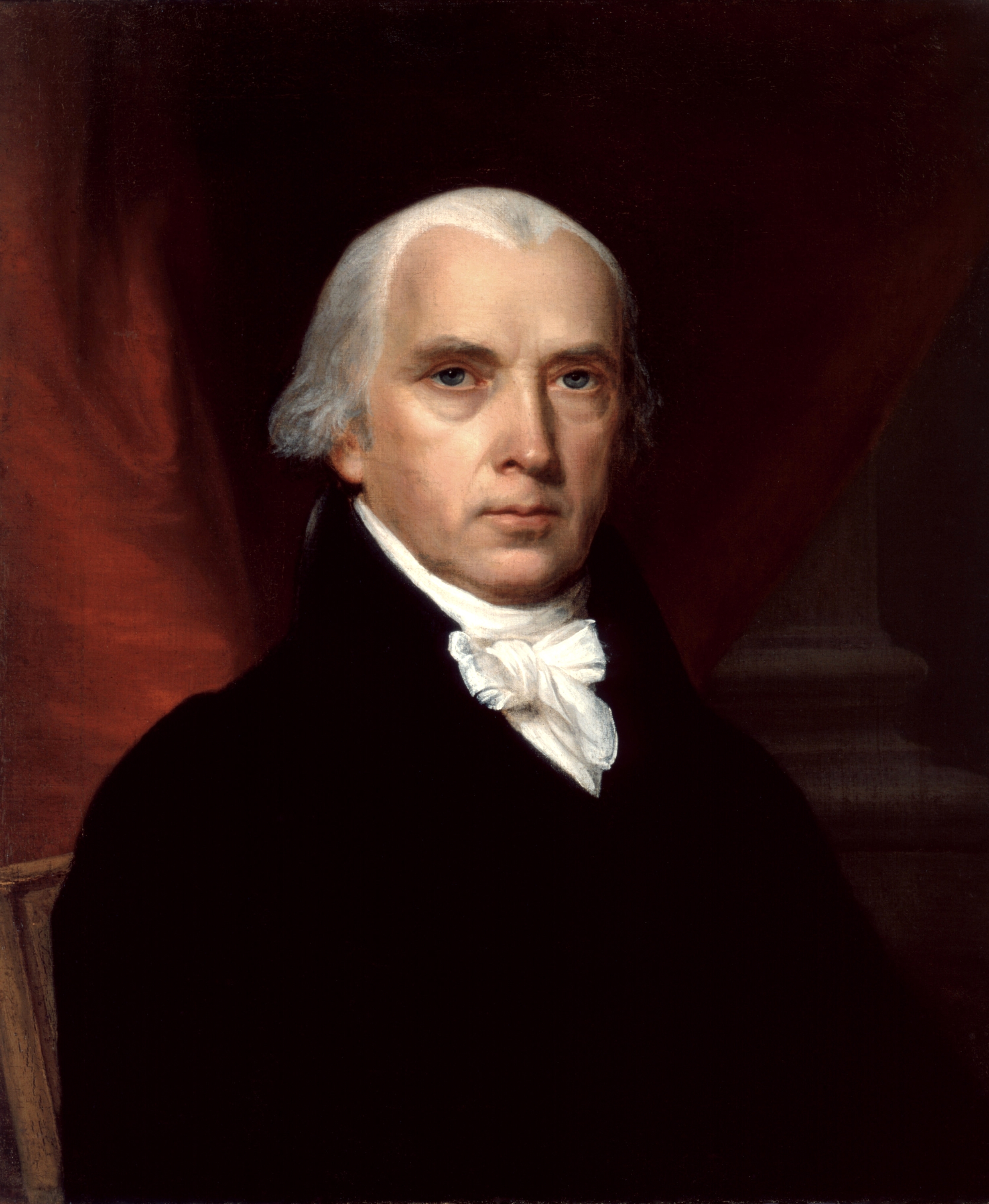
Historical · U.S. House · Virginia · District 15
James Madison
Former U.S. Representative · Virginia District 15 · 1789–1797 · Republican
James Madison represented Virginia's District 15 in the United States House of Representatives (1789–1797) for the Republican party. The page below collects sourced biographical facts, term history, committee roles, and provenance for Madison.
Bioguide ID: M000043
Key facts
- Full name
- James Madison
- State
- Virginia
- District
- District 15
- Party
- Republican
- House service
- 1789–1797
- First House term
- 1789
- Status
- Left office
- Current term ends
- —
- Born
- 1751
- Bioguide ID
- M000043
- Committee assignments
- —
- Dataset version
- 1.20260606
Biographical narrative
1,064 words · sourced from the Wikipedia REST extract
James Madison was a prominent American statesman and a key figure in the early history of the United States. He served as a U.S. Representative for Virginia's 15th congressional district and was a member of the Republican Party. His congressional career spanned from 1789 until 1797, during which he played a significant role in shaping the legislative framework of the nascent nation. Madison is widely recognized for his contributions to the Constitution and the Bill of Rights, earning him the title of "Father of the Constitution." His political career continued beyond his time in the House, culminating in his presidency from 1809 to 1817.
Early life and career
James Madison was born on March 16, 1751, in the Colony of Virginia, specifically at the Belle Grove plantation near Port Conway. He was born into a prominent family of slave-owning planters; his father, James Madison Sr., was a significant landowner with a plantation known as Mount Pleasant. The Madison family had deep roots in Virginia, with connections to influential figures in the region's history. Madison was the oldest of twelve children, although only six survived to adulthood. His upbringing in a large family and a wealthy plantation environment shaped his early views on governance and society.
Madison's education began at an early age. He was tutored by Donald Robertson, who educated him in various subjects, including mathematics, geography, and languages. He demonstrated exceptional proficiency in Latin, which would later aid him in his political career. At the age of 16, Madison returned home to study under Reverend Thomas Martin in preparation for college. Unlike many of his contemporaries, he chose not to attend the College of William and Mary due to health concerns related to the local climate. Instead, he enrolled at the College of New Jersey, now known as Princeton University, in 1769.
At Princeton, Madison's academic pursuits included Latin, Greek, theology, and Enlightenment philosophy. He became an active member of the American Whig–Cliosophic Society, where he honed his skills in debate and public speaking. He graduated in 1771, completing his degree in just two years alongside notable classmates such as Aaron Burr. Following his graduation, Madison remained at Princeton to further his studies in Hebrew and political philosophy under the guidance of the college's president, John Witherspoon.
Madison's early political engagement began during the American Revolutionary War. He was a member of the Virginia House of Delegates and participated in the Continental Congress, where he became increasingly aware of the limitations of the Articles of Confederation. His dissatisfaction with the weak national government prompted him to advocate for a stronger federal structure, leading to his involvement in the Constitutional Convention of 1787.
House tenure
Madison's tenure in the U.S. House of Representatives began in 1789, shortly after the ratification of the Constitution. He was elected to represent Virginia's 15th congressional district and quickly established himself as a leading figure in the new legislative body. Over the course of his four terms in the House, Madison was instrumental in shaping key legislation and addressing the pressing issues of the time.
One of Madison's significant contributions during his time in the House was his advocacy for the Bill of Rights. Recognizing the concerns of many citizens regarding the potential for government overreach, he worked diligently to draft and promote a series of amendments that would protect individual liberties. His efforts culminated in the adoption of the first ten amendments to the Constitution, which collectively form the Bill of Rights.
Madison's role in the House was not limited to constitutional matters. He was also involved in debates surrounding economic policies and the establishment of a national bank. His opposition to the financial strategies proposed by Secretary of the Treasury Alexander Hamilton highlighted the ideological divide between Madison and the Federalist Party. Alongside Thomas Jefferson, he helped form the Democratic-Republican Party, which sought to counterbalance the Federalists' influence.
Throughout his congressional career, Madison maintained a close relationship with President George Washington, serving as a trusted adviser. His insights and recommendations were valued during the formative years of the federal government, and he played a crucial role in shaping the legislative agenda.
Madison's final term in the House ended on March 3, 1797. After leaving Congress, he continued to be active in public life, eventually serving as Secretary of State under President Thomas Jefferson before being elected as the fourth president of the United States in 1808.
Legislative focus and committees
During his time in the House of Representatives, Madison focused on several key areas of legislation that reflected the needs and challenges of the early United States. His work on the Bill of Rights is perhaps the most notable aspect of his legislative focus. Understanding the importance of safeguarding individual liberties, Madison championed the inclusion of amendments that would ensure protections for freedom of speech, religion, and the right to bear arms, among others. This foundational work has had a lasting impact on American law and civil rights.
In addition to his work on the Bill of Rights, Madison was deeply involved in discussions regarding the structure and powers of the federal government. He advocated for a balanced approach that would prevent any single branch from becoming too powerful, a principle that remains central to the American political system today. His contributions to the Federalist Papers, alongside Hamilton and Jay, further articulated the rationale for a strong federal government and the necessity of checks and balances.
Madison's legislative focus also extended to economic issues. He was an advocate for policies that would promote economic stability and growth, although he often found himself at odds with Hamilton's vision of a centralized financial system. His opposition to Hamilton's proposals reflected a broader concern about the concentration of power in the federal government, a theme that would continue to resonate throughout his political career.
In terms of committee work, Madison was involved in various committees that addressed critical issues of governance and policy. His participation in these committees allowed him to influence the direction of legislation and engage with other lawmakers on matters of national importance.
Overall, Madison's tenure in the House of Representatives was marked by his commitment to the principles of republican government, individual rights, and a balanced approach to federal power. His legislative achievements laid the groundwork for the future of American governance and continue to be studied and referenced in contemporary political discourse.
Notable legislation
Sponsored and co-sponsored legislation for James Madison is pending operator curation. The biographical narrative above carries the same provenance trail until per-bill rows are written.
Sources
- [1]https://en.wikipedia.org/wiki/James_MadisonWikipedia · retrieved 2026-06-06
Notable quotes
Sourced quotes for James Madison are pending operator curation. Narrative-scope provenance remains attached below.
Sources
- [1]https://en.wikipedia.org/wiki/James_MadisonWikipedia · retrieved 2026-06-06
Key positions
Curated policy positions for James Madison are pending operator review. The biographical narrative above carries the same provenance trail until per-topic positions are written.
Sources
- [1]https://en.wikipedia.org/wiki/James_MadisonWikipedia · retrieved 2026-06-06
Terms served
- 1789–1791U.S. House · Term 1 · Republican
- 1791–1793U.S. House · Term 2 · Republican
- 1793–1795U.S. House · Term 3 · Republican
- 1795–1797U.S. House · Term 4 · Republican
Sources & provenance
Every attributable claim above carries a per-section [N] marker that resolves to the corresponding URL below. Each entry records the upstream provider, the canonical URL, and the timestamp at which the source was retrieved by the ingest pipeline.
Key facts
- https://bioguide.congress.gov/search/bio/M000043bioguide · retrieved 2026-06-06
- https://www.govtrack.us/congress/members/407071govtrack · retrieved 2026-06-06
Biographical narrative
- https://en.wikipedia.org/wiki/James_Madisonwikipedia · retrieved 2026-06-06
Find your representative
Every U.S. state elects representatives by district. Browse Virginia’s delegation, the full former-representative roster, or explore the role and term length.
Related on The Candidate
- Succeeded by John KerrLater holder of the Virginia District 15 House seat · Republican.Open
- Alexander WhiteFormer U.S. Representative · Virginia District 1Open
- Archibald AtkinsonFormer U.S. Representative · Virginia District 1 · DemocraticOpen
- Beverly DouglasFormer U.S. Representative · Virginia District 1 · DemocraticOpen
- Daniel MorganFormer U.S. Representative · Virginia District 1 · FederalistOpen
- Republican PartyFederal candidates and office holders on the Republican line.Open