
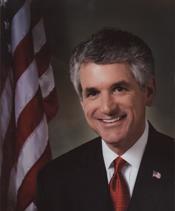
Historical · U.S. House · Virginia · District 2
Scott Rigell
Former U.S. Representative · Virginia District 2 · 2011–2017 · Republican
Scott Rigell represented Virginia's District 2 in the United States House of Representatives (2011–2017) for the Republican party. The page below collects sourced biographical facts, term history, committee roles, and provenance for Rigell.
Bioguide ID: R000589
Key facts
- Full name
- Scott Rigell
- State
- Virginia
- District
- District 2
- Party
- Republican
- House service
- 2011–2017
- First House term
- 2011
- Status
- Left office
- Current term ends
- —
- Born
- 1960
- Bioguide ID
- R000589
- Committee assignments
- —
- Dataset version
- 1.20260605
Biographical narrative
979 words · sourced from the Wikipedia REST extract
Edward Scott Rigell is a former U.S. Representative who served Virginia's 2nd congressional district from 2011 until 2017. A member of the Republican Party, Rigell's political career was marked by his business background and a focus on fiscal conservatism. He gained attention for his break with party norms during the 2016 presidential election, when he withdrew his support for the Republican nominee and endorsed a Libertarian candidate. Rigell's tenure in Congress was characterized by his positions on military and foreign policy, social issues, and economic reform.
Early life and career
E. Scott Rigell was born on May 28, 1960, in Titusville, Florida. He was raised in a family with a military background; his father served in the United States Marine Corps during World War II, landing on Iwo Jima, and his son later followed in the family tradition by also serving as a Marine. Rigell himself joined the United States Marine Corps Reserve, where he served from 1978 to 1984 and attained the rank of Sergeant. This military service likely influenced his later political positions, particularly regarding veterans and military affairs.
Rigell pursued higher education, earning an Associate of Arts degree from Brevard Community College. He continued his studies at Mercer University, where he obtained a Bachelor of Business Administration (BBA). Rigell later earned a Master of Business Administration (MBA) from Regent University. His educational background laid a foundation for his later career in business and politics.
Before entering Congress, Rigell had a successful career in the automotive industry. He and his former wife, Teri, established two car dealerships under the name Freedom Automotive, located in Norfolk and Chesapeake/Virginia Beach. This entrepreneurial experience provided him with insights into economic issues, which would later inform his legislative priorities.
House tenure
Rigell's political career began in earnest when he ran for the U.S. House of Representatives in 2010. He won the Republican nomination in a competitive six-way primary, defeating Bert Mizusawa. His candidacy was bolstered by endorsements from prominent figures, including Virginia Governor Bob McDonnell and support from the National Republican Congressional Committee. The primary race was noted for its intensity and was rated as one of the top Congressional primaries of that election cycle.
During the campaign, Rigell faced scrutiny from opponents regarding his business practices, particularly his dealerships' participation in the Cash for Clunkers program. He defended his actions by emphasizing that the program's subsidies were directed to consumers rather than dealers. Additionally, Rigell's past campaign contributions to Democratic candidates, including Barack Obama during the 2008 primaries, were highlighted by his opponents. Rigell explained his political decisions by stating that he believed certain Democratic candidates posed a greater threat than others.
Rigell successfully defeated the Democratic incumbent, Glenn Nye, in the general election, marking the beginning of his first term in Congress in January 2011. He was part of a significant Republican majority in the House, the largest since the 1940s. Rigell was re-elected in subsequent elections, facing challenges from Democratic candidates Paul Hirschbiel in 2012 and Suzanne Patrick in 2014. Throughout his tenure, he emphasized economic issues, stating that his focus was on job creation and fiscal responsibility rather than social issues.
In January 2016, Rigell announced that he would not seek re-election, ultimately leaving office on January 3, 2017. His decision not to run again was notable, especially given the political climate of the time.
Legislative focus and committees
During his time in Congress, Rigell served on several committees, where he was able to influence legislation on a variety of issues. He was known for his commitment to reducing government spending and promoting market-based reforms in healthcare. Rigell's fiscal conservatism was a central theme of his political identity, and he often advocated for policies aimed at decreasing the national debt.
Rigell's voting record included notable instances of bipartisanship and independence from party lines. For example, in June 2012, he was one of only two Republicans to vote against a motion to hold Attorney General Eric Holder in contempt of Congress over the handling of the ATF gunwalking scandal. This vote illustrated his willingness to break with party leadership when he felt it was warranted.
On social issues, Rigell identified as "proudly pro-life" and opposed same-sex marriage. He also opposed the repeal of "Don't Ask, Don't Tell," reflecting his conservative stance on military and social policies. Throughout his tenure, he co-sponsored legislation aimed at restricting abortion funding and supported the reauthorization of the Violence Against Women Act, indicating a nuanced approach to social issues.
Given that Rigell's district included a significant population of active duty and retired military personnel, he prioritized military and foreign policy matters. He supported legislation to increase compensation for disabled veterans and advocated for continued military engagement in Afghanistan. Rigell opposed calls to withdraw troops from Afghanistan and expressed concerns about military interventions in other regions, such as Libya and Syria. He criticized the President's military actions in Libya as unconstitutional, arguing that Congress had not been adequately consulted, and he sought to ensure that any military action would adhere to the War Powers Resolution.
Rigell's approach to foreign policy was characterized by a cautious stance on military intervention, as he joined bipartisan efforts to resist calls for rapid military action in Iraq and other conflict zones. His advocacy for consulting Congress before military engagements underscored his commitment to legislative oversight in matters of war and peace.
In summary, E. Scott Rigell's tenure in the U.S. House of Representatives was marked by a blend of fiscal conservatism, a focus on military and veterans' issues, and a willingness to engage in bipartisan dialogue. His background as a businessman and military veteran informed his legislative priorities, while his decision to break with party norms during the 2016 election highlighted the complexities of his political identity. Rigell's contributions to Congress reflect a commitment to his constituents and the principles he championed throughout his career.
Notable legislation
Sponsored and co-sponsored legislation for Scott Rigell is pending operator curation. The biographical narrative above carries the same provenance trail until per-bill rows are written.
Sources
- [1]https://en.wikipedia.org/wiki/Scott_RigellWikipedia · retrieved 2026-06-05
Notable quotes
Sourced quotes for Scott Rigell are pending operator curation. Narrative-scope provenance remains attached below.
Sources
- [1]https://en.wikipedia.org/wiki/Scott_RigellWikipedia · retrieved 2026-06-05
Key positions
Curated policy positions for Scott Rigell are pending operator review. The biographical narrative above carries the same provenance trail until per-topic positions are written.
Sources
- [1]https://en.wikipedia.org/wiki/Scott_RigellWikipedia · retrieved 2026-06-05
Terms served
- 2011–2013U.S. House · Term 1 · Republican
- 2013–2015U.S. House · Term 2 · Republican
- 2015–2017U.S. House · Term 3 · Republican
Sources & provenance
Every attributable claim above carries a per-section [N] marker that resolves to the corresponding URL below. Each entry records the upstream provider, the canonical URL, and the timestamp at which the source was retrieved by the ingest pipeline.
Key facts
- https://bioguide.congress.gov/search/bio/R000589bioguide · retrieved 2026-06-05
- http://rigell.house.govhouse.gov · retrieved 2026-06-05
Biographical narrative
- https://en.wikipedia.org/wiki/Scott_Rigellwikipedia · retrieved 2026-06-05
Find your representative
Every U.S. state elects representatives by district. Browse Virginia’s delegation, the full former-representative roster, or explore the role and term length.
Related on The Candidate
- Preceded by Glenn NyeEarlier holder of the Virginia District 2 House seat · Democratic.Open
- Succeeded by Scott TaylorLater holder of the Virginia District 2 House seat · Republican.Open
- Alexander WhiteFormer U.S. Representative · Virginia District 1Open
- Archibald AtkinsonFormer U.S. Representative · Virginia District 1 · DemocraticOpen
- Beverly DouglasFormer U.S. Representative · Virginia District 1 · DemocraticOpen
- Daniel MorganFormer U.S. Representative · Virginia District 1 · FederalistOpen