
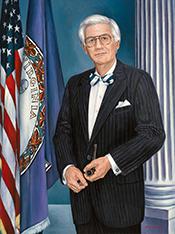
Historical · U.S. House · Virginia · District 7
Tom Bliley
Former U.S. Representative · Virginia District 7 · 1981–2001 · Republican
Tom Bliley represented Virginia's District 7 in the United States House of Representatives (1981–2001) for the Republican party. The page below collects sourced biographical facts, term history, committee roles, and provenance for Bliley.
Bioguide ID: B000556
Key facts
- Full name
- Tom Bliley
- State
- Virginia
- District
- District 7
- Party
- Republican
- House service
- 1981–2001
- First House term
- 1981
- Status
- Left office
- Current term ends
- —
- Born
- 1932
- Bioguide ID
- B000556
- Committee assignments
- —
- Dataset version
- 1.20260605
Biographical narrative
994 words · sourced from the Wikipedia REST extract
Thomas Jerome Bliley Jr. was an American businessman, Navy veteran, and politician who served as a U.S. Representative for Virginia's 7th congressional district from 1981 until 2001. A member of the Republican Party, Bliley was notable for his long tenure in Congress, during which he held significant leadership roles, including six years as chairman of the House Energy and Commerce Committee. His legislative contributions included pivotal laws that shaped telecommunications, healthcare, and financial services in the United States.
Early life and career
Thomas Jerome Bliley Jr. was born on January 28, 1932, in Chesterfield County, Virginia. He was the son of Carolyn and Thomas J. Bliley. His early education took place in Catholic schools, culminating in his graduation from Benedictine High School in 1948 at the age of 16. Following high school, Bliley pursued higher education at Georgetown University in Washington, D.C., where he earned a Bachelor of Arts degree in Political Science in 1952.
After completing his education, Bliley served in the U.S. Navy as a lieutenant from 1952 to 1955. Upon his return to civilian life, he became involved in the family business, Joseph W. Bliley Co. Funeral Home, where he worked as a funeral director and eventually rose to the position of President. His background in business and public service laid the groundwork for his later political career.
Bliley's political journey began in local government. In 1968, he was elected vice-mayor of Richmond, Virginia, serving in that capacity until 1970. He then successfully ran for mayor, a position he held until 1977. Initially aligned with the conservative Byrd Democrats, Bliley transitioned to the Republican Party after his tenure as mayor, reflecting a broader shift in the political landscape of Virginia.
House tenure
In 1980, Bliley sought a seat in the U.S. House of Representatives, winning the Republican nomination for Virginia's 3rd congressional district after the retirement of eight-term incumbent David Satterfield. He won the election with 52 percent of the vote, marking a significant political shift as he became the first Republican to secure an undisputed victory in the district since the Reconstruction Era. The 3rd district had been trending Republican, as it had not supported a Democratic presidential candidate since 1948, although local offices were still predominantly held by conservative Democrats.
Bliley's initial election was closely contested, but he subsequently faced little opposition in his re-elections. He was re-elected five times with increasing margins, only facing an independent candidate in 1984 and running unopposed in 1988. Following the 1990 census, the Virginia General Assembly undertook redistricting, which resulted in the renumbering of Bliley's district to the 7th. This new district retained many affluent and predominantly white areas of Richmond and its suburbs, solidifying its status as one of the most Republican districts in Virginia. Bliley continued to win re-election, facing a Democrat only once after the redistricting.
In 1995, after the Republican Party regained control of Congress, Bliley was elected Chairman of the House Commerce Committee, a position he held for six years. His leadership in this role allowed him to influence significant legislation, including the Telecommunications Act of 1996, which aimed to promote competition and reduce regulation in the telecommunications industry. He also played a key role in the Food and Drug Administration Modernization Act of 1997, which sought to streamline the approval process for new drugs and medical devices. Additionally, Bliley was involved in the Private Securities Litigation Reform Act and the Financial Services Modernization Act of 1999, commonly known as the Gramm-Leach-Bliley Act, which repealed parts of the Glass-Steagall Act and allowed commercial banks, investment banks, and insurance companies to consolidate.
Bliley's congressional career spanned a total of ten terms, concluding with his retirement on January 3, 2001. His tenure was marked by a focus on issues related to commerce, healthcare, and telecommunications, reflecting the priorities of his constituents and the Republican Party during that era.
Legislative focus and committees
Throughout his time in Congress, Bliley's legislative focus was primarily centered on issues pertaining to commerce, telecommunications, and healthcare. As Chairman of the House Commerce Committee, he was instrumental in shaping policies that influenced a wide range of sectors, from telecommunications to consumer protection. His role allowed him to advocate for legislation that aimed to foster economic growth and enhance the efficiency of regulatory processes.
The Telecommunications Act of 1996, one of his most notable contributions, was designed to promote competition in the telecommunications industry, leading to significant changes in how services were provided and regulated. This act was pivotal in the transition from a regulated monopoly system to a more competitive marketplace, impacting consumers and businesses alike.
Bliley's involvement in the Food and Drug Administration Modernization Act of 1997 highlighted his commitment to improving public health and safety. This legislation aimed to expedite the approval process for new drugs and medical devices, reflecting a broader trend toward deregulation in the healthcare sector during the 1990s.
In addition to his work on telecommunications and healthcare, Bliley was also a key figure in financial services reform. The Gramm-Leach-Bliley Act of 1999 represented a significant shift in the financial landscape, allowing for the consolidation of financial institutions and the elimination of barriers that had previously separated banking, securities, and insurance industries.
Bliley's legislative efforts were characterized by a focus on reducing regulatory burdens and promoting market-driven solutions to economic challenges. His leadership in the House Commerce Committee positioned him as a significant player in shaping the legislative agenda during a period of substantial change in American economic policy.
Following his retirement from Congress, Bliley remained active in civic affairs, including efforts to reform local governance in Richmond. He was involved in initiatives aimed at facilitating the direct election of the city's mayor, reflecting his ongoing commitment to public service and community engagement.
Bliley passed away on November 16, 2023, at the age of 91, leaving behind a legacy marked by his contributions to American politics and public policy during a transformative era in the nation's history.
Notable legislation
Sponsored and co-sponsored legislation for Tom Bliley is pending operator curation. The biographical narrative above carries the same provenance trail until per-bill rows are written.
Sources
- [1]https://en.wikipedia.org/wiki/Thomas_J._Bliley_Jr.Wikipedia · retrieved 2026-06-05
Notable quotes
Sourced quotes for Tom Bliley are pending operator curation. Narrative-scope provenance remains attached below.
Sources
- [1]https://en.wikipedia.org/wiki/Thomas_J._Bliley_Jr.Wikipedia · retrieved 2026-06-05
Key positions
Curated policy positions for Tom Bliley are pending operator review. The biographical narrative above carries the same provenance trail until per-topic positions are written.
Sources
- [1]https://en.wikipedia.org/wiki/Thomas_J._Bliley_Jr.Wikipedia · retrieved 2026-06-05
Terms served
- 1981–1983U.S. House · Term 1 · Republican
- 1983–1985U.S. House · Term 2 · Republican
- 1985–1987U.S. House · Term 3 · Republican
- 1987–1989U.S. House · Term 4 · Republican
- 1989–1991U.S. House · Term 5 · Republican
- 1991–1993U.S. House · Term 6 · Republican
- 1993–1995U.S. House · Term 7 · Republican
- 1995–1997U.S. House · Term 8 · Republican
- 1997–1999U.S. House · Term 9 · Republican
- 1999–2001U.S. House · Term 10 · Republican
Sources & provenance
Every attributable claim above carries a per-section [N] marker that resolves to the corresponding URL below. Each entry records the upstream provider, the canonical URL, and the timestamp at which the source was retrieved by the ingest pipeline.
Key facts
- https://bioguide.congress.gov/search/bio/B000556bioguide · retrieved 2026-06-05
- https://www.govtrack.us/congress/members/400571govtrack · retrieved 2026-06-05
Biographical narrative
- https://en.wikipedia.org/wiki/Thomas_J._Bliley_Jr.wikipedia · retrieved 2026-06-05
Find your representative
Every U.S. state elects representatives by district. Browse Virginia’s delegation, the full former-representative roster, or explore the role and term length.
Related on The Candidate
- Preceded by John Marsh Jr.Earlier holder of the Virginia District 7 House seat · Democratic.Open
- Succeeded by Eric CantorLater holder of the Virginia District 7 House seat · Republican.Open
- Alexander WhiteFormer U.S. Representative · Virginia District 1Open
- Archibald AtkinsonFormer U.S. Representative · Virginia District 1 · DemocraticOpen
- Beverly DouglasFormer U.S. Representative · Virginia District 1 · DemocraticOpen
- Daniel MorganFormer U.S. Representative · Virginia District 1 · FederalistOpen