
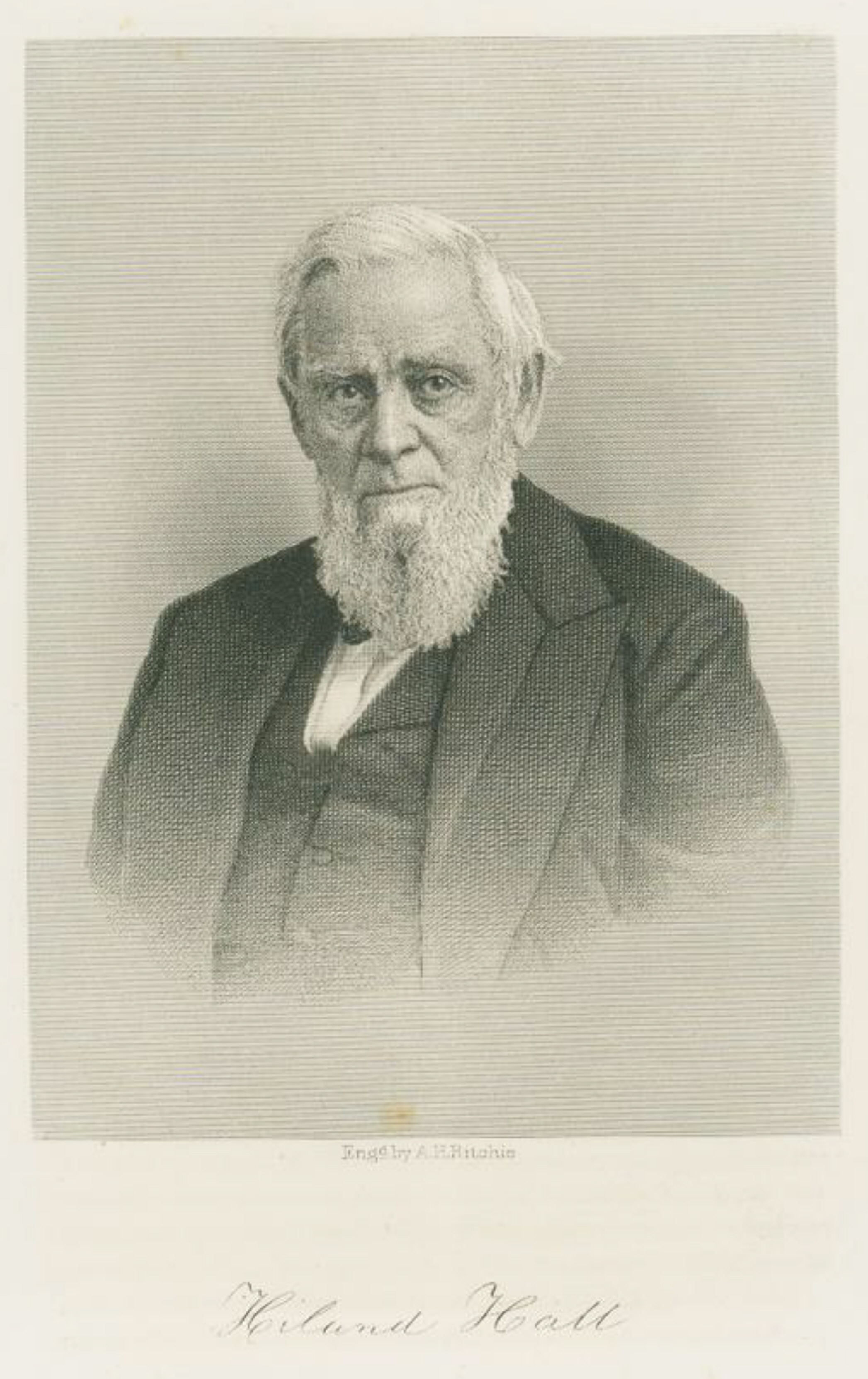
Historical · U.S. House · Vermont · District 1
Hiland Hall
Former U.S. Representative · Vermont District 1 · 1831–1843 · Whig
Hiland Hall represented Vermont's District 1 in the United States House of Representatives (1831–1843) for the Whig party. The page below collects sourced biographical facts, term history, committee roles, and provenance for Hall.
Bioguide ID: H000052
Key facts
- Full name
- Hiland Hall
- State
- Vermont
- District
- District 1
- Party
- Whig
- House service
- 1831–1843
- First House term
- 1831
- Status
- Left office
- Current term ends
- —
- Born
- 1795
- Bioguide ID
- H000052
- Committee assignments
- —
- Dataset version
- 1.20260606
Biographical narrative
853 words · sourced from the Wikipedia REST extract
Hiland Hall was an American lawyer and politician who served as a U.S. Representative for Vermont's 1st congressional district and later became the 25th governor of Vermont. His political career spanned several decades, during which he was affiliated with the Anti-Jacksonian movement and the Whig Party. Hall's tenure in the U.S. House of Representatives lasted from 1833 to 1843, and he played a significant role in state politics, including serving as a state bank commissioner and a judge on the Vermont Supreme Court. His contributions to public service extended beyond the legislature, as he was involved in various political appointments and efforts to address national issues during his lifetime.
Early life and career
Hiland Hall was born on July 20, 1795, in Bennington, Vermont. He received his early education in local common schools before pursuing a legal career. Hall studied law under the guidance of Marshall Carter, a prominent attorney in Bennington, and was admitted to the bar in 1819. Following his admission, he began practicing law in his hometown, establishing himself as a respected legal professional.
In addition to his legal career, Hall was active in local politics. He served as a member of the Vermont House of Representatives in 1827, which marked the beginning of his involvement in public service. His political engagements continued as he took on the role of clerk for Bennington County in 1828 and 1829. He further advanced his legal career by serving as the county state's attorney from 1828 until 1831, where he was responsible for prosecuting criminal cases and representing the county in legal matters.
On October 27, 1818, Hall married Dolly Tuttle Davis, and together they had seven children. His family connections extended into the political sphere, as his daughter Laura became the wife of Trenor W. Park, a businessman and lawyer. The Hall family had a lasting impact on the region, with the Park-McCullough Historic House, which Hall originally owned, later becoming a notable landmark and added to the National Register of Historic Places in 1972.
House tenure
Hiland Hall's congressional career began when he was elected as an Anti-Jacksonian to the Twenty-second Congress to fill a vacancy caused by the death of Jonathan Hunt. He took office on January 1, 1833, and was subsequently re-elected to the Twenty-third and Twenty-fourth Congresses. His affiliation with the Whig Party began during his tenure, as he was elected to the Twenty-fifth, Twenty-sixth, and Twenty-seventh Congresses as a member of that party.
During his time in the House of Representatives, Hall served for a total of six terms, concluding his congressional service on March 3, 1843. His legislative work included chairing the Committee on Revolutionary Claims during the Twenty-seventh Congress, where he oversaw matters related to claims arising from the Revolutionary War. Hall chose not to seek renomination in 1842, marking the end of his direct involvement in the U.S. Congress.
Legislative focus and committees
Throughout his congressional tenure, Hiland Hall was involved in various legislative matters, reflecting the political climate of the time. His affiliation with the Anti-Jacksonian movement and later the Whig Party positioned him within a political landscape that was characterized by significant debates over issues such as states' rights, economic policy, and the expansion of the United States.
As chairman of the Committee on Revolutionary Claims, Hall played a role in addressing claims made by individuals seeking compensation for losses incurred during the Revolutionary War. This committee's work was essential in ensuring that veterans and their families received recognition and financial support for their sacrifices. Hall's leadership in this capacity demonstrated his commitment to addressing historical grievances and supporting those who had served the nation.
In addition to his legislative responsibilities, Hall's political career included various appointments that showcased his expertise and leadership. After leaving Congress, he served as the State Bank Commissioner from 1843 to 1846, overseeing the operations and regulations of state banks. He later became a judge on the Vermont Supreme Court from 1846 to 1850, where he contributed to the judicial system of the state.
Hall's career continued with his appointment as the Second Comptroller of the Treasury from late 1850 to September 1851. He also served as the United States land commissioner for California from 1851 to 1854, a role that involved managing land distribution and addressing land-related issues in the rapidly growing state.
In 1858, Hall was elected as the 25th governor of Vermont, serving until 1860. His governorship coincided with a tumultuous period in American history, as the nation faced increasing tensions leading up to the Civil War. Hall was also a participant in the Peace Conference of 1861, which aimed to find a resolution to the conflicts that were threatening to divide the country.
Hiland Hall passed away on December 18, 1885, in Springfield, Massachusetts. He was interred in the Old Bennington Cemetery, leaving behind a legacy of public service and commitment to the state of Vermont. His contributions to both state and national politics continue to be recognized, and the Hiland Hall School in Shaftsbury is named in his honor, reflecting his enduring impact on the community and the state.
Notable legislation
Sponsored and co-sponsored legislation for Hiland Hall is pending operator curation. The biographical narrative above carries the same provenance trail until per-bill rows are written.
Sources
- [1]https://en.wikipedia.org/wiki/Hiland_HallWikipedia · retrieved 2026-06-06
Notable quotes
Sourced quotes for Hiland Hall are pending operator curation. Narrative-scope provenance remains attached below.
Sources
- [1]https://en.wikipedia.org/wiki/Hiland_HallWikipedia · retrieved 2026-06-06
Key positions
Curated policy positions for Hiland Hall are pending operator review. The biographical narrative above carries the same provenance trail until per-topic positions are written.
Sources
- [1]https://en.wikipedia.org/wiki/Hiland_HallWikipedia · retrieved 2026-06-06
Terms served
- 1831–1833U.S. House · Term 1 · Anti Jacksonian
- 1833–1835U.S. House · Term 2 · Whig
- 1835–1837U.S. House · Term 3 · Whig
- 1837–1839U.S. House · Term 4 · Whig
- 1839–1841U.S. House · Term 5 · Whig
- 1841–1843U.S. House · Term 6 · Whig
Sources & provenance
Every attributable claim above carries a per-section [N] marker that resolves to the corresponding URL below. Each entry records the upstream provider, the canonical URL, and the timestamp at which the source was retrieved by the ingest pipeline.
Key facts
- https://bioguide.congress.gov/search/bio/H000052bioguide · retrieved 2026-06-06
- https://www.govtrack.us/congress/members/404937govtrack · retrieved 2026-06-06
Biographical narrative
- https://en.wikipedia.org/wiki/Hiland_Hallwikipedia · retrieved 2026-06-06
Find your representative
Every U.S. state elects representatives by district. Browse Vermont’s delegation, the full former-representative roster, or explore the role and term length.
Related on The Candidate
- Preceded by William BradleyEarlier holder of the Vermont District 1 House seat · Adams.Open
- Succeeded by William HenryLater holder of the Vermont District 1 House seat · Whig.Open
- Ahiman MinerFormer U.S. Representative · Vermont District 1 · WhigOpen
- Charles JoyceFormer U.S. Representative · Vermont District 1 · RepublicanOpen
- Charles WillardFormer U.S. Representative · Vermont District 1 · RepublicanOpen
- David FosterFormer U.S. Representative · Vermont District 1 · RepublicanOpen