
Historical · U.S. House · Wisconsin · District 1
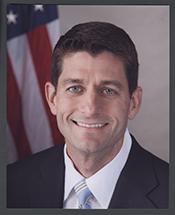
Paul Ryan
Former U.S. Representative · Wisconsin District 1 · 1999–2019 · Republican
Paul Ryan represented Wisconsin's District 1 in the United States House of Representatives (1999–2019) for the Republican party. The page below collects sourced biographical facts, term history, committee roles, and provenance for Ryan.
Bioguide ID: R000570
Key facts
- Full name
- Paul Ryan
- State
- Wisconsin
- District
- District 1
- Party
- Republican
- House service
- 1999–2019
- First House term
- 1999
- Status
- Left office
- Current term ends
- —
- Born
- 1970
- Bioguide ID
- R000570
- Committee assignments
- —
- Dataset version
- 1.20260605
Biographical narrative
1,140 words · sourced from the Wikipedia REST extract
Paul D. Ryan is an American politician who served as a U.S. Representative for Wisconsin's 1st congressional district from 1999 until 2019. A member of the Republican Party, he held the position of the 54th Speaker of the House of Representatives from 2015 to 2019. Ryan gained national prominence as the party's vice presidential nominee in the 2012 presidential election, running alongside Mitt Romney. His legislative career was marked by a focus on fiscal policy, including efforts to reform entitlement programs and tax legislation. Ryan's tenure in Congress concluded when he chose not to seek re-election in 2018, after which he was succeeded by Nancy Pelosi as Speaker.
Early life and career
Paul Davis Ryan was born on January 29, 1970, in Janesville, Wisconsin. He was the youngest of four children in his family, born to Elizabeth "Betty" Ann, an interior designer, and Paul Murray Ryan, a lawyer. Ryan's family has deep roots in Wisconsin, with his ancestry tracing back five generations in the state. His father had Irish heritage, while his mother was of German and English descent. Ryan's great-grandfather, Patrick William Ryan, established an earthmoving company in 1884, which evolved into Ryan Incorporated Central. Additionally, his grandfather served as the United States attorney for the Western District of Wisconsin.
Ryan's early education began at St. Mary's Catholic School in Janesville, followed by Joseph A. Craig High School. During his time in high school, he was active in various extracurricular activities, including sports such as skiing, track, and soccer, and he was elected president of his junior class. His leadership role extended to representing the student body on the school board. Ryan also worked part-time at McDonald's during his high school years. His family often engaged in outdoor activities, including hiking and skiing trips to the Rocky Mountains.
Ryan faced personal challenges during his adolescence, particularly with his father's struggle with alcoholism. His father passed away from a heart attack when Ryan was 16 years old, an event that deeply impacted him. Following this loss, Ryan's family dynamics changed, with his grandmother moving in due to her Alzheimer's disease, and Ryan took on caregiving responsibilities while his mother pursued her education. During this period, Ryan received Social Security survivors benefits, which were saved for his college education.
He attended Miami University in Oxford, Ohio, where he earned a bachelor's degree in economics and political science in 1992. His academic interests were shaped by the writings of influential economists such as Friedrich Hayek, Ludwig von Mises, and Milton Friedman. Ryan's engagement with these ideas led him to intern in the Washington, D.C. office of U.S. Senator Bob Kasten, where he began his political career. He also participated in the Washington Semester program at American University and worked various jobs, including as a salesman for Oscar Mayer.
After graduating, Ryan accepted a position as a legislative aide in Senator Kasten's office, where he began to build his political career. He later worked as a speechwriter for Empower America, a conservative advocacy group, which allowed him to further develop his political views and communication skills.
House tenure
Ryan was elected to the U.S. House of Representatives in 1998, succeeding Mark Neumann, who had vacated the seat to run for the U.S. Senate. He officially took office in January 1999 and went on to serve ten consecutive terms in the House. Throughout his time in Congress, Ryan became known for his focus on fiscal policy and budgetary issues. He was appointed as the chairman of the House Budget Committee in 2011, a role that allowed him to influence national budgetary policy significantly.
During his chairmanship, Ryan was a prominent advocate for reducing the federal deficit and reforming entitlement programs. He introduced several budget proposals, including "The Path to Prosperity," which aimed to reshape Medicare and Medicaid and reduce government spending. His budget plans often sparked debate and were central to discussions about the future of social safety nets in the United States.
In 2015, Ryan was elected as Speaker of the House following the resignation of John Boehner. His speakership was characterized by efforts to unify the Republican Party and advance a conservative legislative agenda. Under his leadership, the House passed significant legislation, including the Tax Cuts and Jobs Act of 2017, which implemented substantial tax reforms, and the Economic Growth, Regulatory Relief and Consumer Protection Act in 2018, which rolled back certain provisions of the Dodd–Frank Act.
Ryan's tenure as Speaker also coincided with a period of political polarization and challenges in governance, particularly in navigating the relationship between the House and the Senate, as well as the executive branch. He faced criticism from both moderate and conservative factions within his party, reflecting the complexities of leading a diverse caucus.
In 2018, Ryan announced that he would not seek re-election, citing a desire to spend more time with his family and to step back from the demands of public office. His decision came as the Democratic Party gained momentum in the midterm elections, ultimately leading to a shift in control of the House of Representatives. Ryan's last day in office was January 3, 2019, marking the end of his two-decade-long congressional career.
Legislative focus and committees
Throughout his congressional career, Paul Ryan was known for his focus on fiscal responsibility and economic policy. He positioned himself as a "deficit hawk," advocating for policies aimed at reducing the national debt and reforming entitlement programs. His proposals often included measures to privatize Social Security and transform Medicare into a system that would provide beneficiaries with a fixed amount to purchase insurance.
Ryan's work on the House Budget Committee allowed him to shape the national conversation around fiscal policy. He was instrumental in developing budget proposals that emphasized spending cuts and tax reforms. His budget plans, particularly "The Path to Prosperity," sought to address long-term fiscal challenges by proposing significant changes to government spending and entitlement programs.
In addition to his role on the Budget Committee, Ryan briefly chaired the House Ways and Means Committee in 2015, which oversees taxation and revenue-related legislation. His leadership in this committee further solidified his influence on economic policy, particularly in relation to tax reform.
Ryan's legislative focus extended to broader economic issues, including job creation and regulatory reform. He was a proponent of reducing regulations that he argued hindered economic growth and innovation. His efforts in this area included advocating for the repeal of the Affordable Care Act, which he viewed as a significant burden on the economy.
Throughout his time in Congress, Ryan's initiatives and proposals were often met with both support and opposition, reflecting the contentious nature of fiscal policy debates in the United States. His legacy in the House is marked by his commitment to conservative economic principles and his efforts to reshape the national dialogue on fiscal responsibility and government reform.
Notable legislation
Sponsored and co-sponsored legislation for Paul Ryan is pending operator curation. The biographical narrative above carries the same provenance trail until per-bill rows are written.
Sources
- [1]https://en.wikipedia.org/wiki/Paul_RyanWikipedia · retrieved 2026-06-05
Notable quotes
Sourced quotes for Paul Ryan are pending operator curation. Narrative-scope provenance remains attached below.
Sources
- [1]https://en.wikipedia.org/wiki/Paul_RyanWikipedia · retrieved 2026-06-05
Key positions
Curated policy positions for Paul Ryan are pending operator review. The biographical narrative above carries the same provenance trail until per-topic positions are written.
Sources
- [1]https://en.wikipedia.org/wiki/Paul_RyanWikipedia · retrieved 2026-06-05
Terms served
- 1999–2001U.S. House · Term 1 · Republican
- 2001–2003U.S. House · Term 2 · Republican
- 2003–2005U.S. House · Term 3 · Republican
- 2005–2007U.S. House · Term 4 · Republican
- 2007–2009U.S. House · Term 5 · Republican
- 2009–2011U.S. House · Term 6 · Republican
- 2011–2013U.S. House · Term 7 · Republican
- 2013–2015U.S. House · Term 8 · Republican
- 2015–2017U.S. House · Term 9 · Republican
- 2017–2019U.S. House · Term 10 · Republican
Sources & provenance
Every attributable claim above carries a per-section [N] marker that resolves to the corresponding URL below. Each entry records the upstream provider, the canonical URL, and the timestamp at which the source was retrieved by the ingest pipeline.
Key facts
- https://bioguide.congress.gov/search/bio/R000570bioguide · retrieved 2026-06-05
- https://paulryan.house.govhouse.gov · retrieved 2026-06-05
Biographical narrative
- https://en.wikipedia.org/wiki/Paul_Ryanwikipedia · retrieved 2026-06-05
Find your representative
Every U.S. state elects representatives by district. Browse Wisconsin’s delegation, the full former-representative roster, or explore the role and term length.
Related on The Candidate
- Preceded by Mark NeumannEarlier holder of the Wisconsin District 1 House seat · Republican.Open
- Charles WilliamsFormer U.S. Representative · Wisconsin District 1 · RepublicanOpen
- Clifford RandallFormer U.S. Representative · Wisconsin District 1 · RepublicanOpen
- Clinton BabbittFormer U.S. Representative · Wisconsin District 1 · DemocraticOpen
- Daniel Wells Jr.Former U.S. Representative · Wisconsin District 1 · DemocraticOpen
- Republican PartyFederal candidates and office holders on the Republican line.Open