
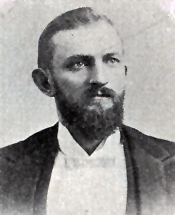
Historical · U.S. House · Wisconsin · District 2
Edward Sauerhering
Former U.S. Representative · Wisconsin District 2 · 1895–1899 · Republican
Edward Sauerhering represented Wisconsin's District 2 in the United States House of Representatives (1895–1899) for the Republican party. The page below collects sourced biographical facts, term history, committee roles, and provenance for Sauerhering.
Bioguide ID: S000071
Key facts
- Full name
- Edward Sauerhering
- State
- Wisconsin
- District
- District 2
- Party
- Republican
- House service
- 1895–1899
- First House term
- 1895
- Status
- Left office
- Current term ends
- —
- Born
- 1864
- Bioguide ID
- S000071
- Committee assignments
- —
- Dataset version
- 1.20260606
Biographical narrative
1,070 words · sourced from the Wikipedia REST extract
Edward Sauerhering was a German American pharmacist and politician who served as a U.S. Representative for Wisconsin's 2nd congressional district from 1895 to 1899. A member of the Republican Party, he was notable for his legislative efforts in the dairy industry, particularly for authoring significant regulations on dairy products. His tenure in Congress coincided with a period of political upheaval and transformation within the United States, reflecting broader economic and social changes of the time.
Early life and career
Edward Sauerhering was born on June 24, 1864, in Mayville, Wisconsin, to Rudolf and Henrietta Sauerhering, both of whom were German American immigrants from East Prussia. He was one of five children in his family. His father, Rudolf, was a prominent figure in the community, serving as the first village president of Mayville and operating a drug store. This early exposure to the pharmacy business would shape Sauerhering's future career.
Sauerhering attended public schools in Mayville until the age of 16, when he began working at his father's drug store. He pursued further education in the field of pharmacy by enrolling at the Chicago College of Pharmacy, where he graduated in 1885. After completing his studies, he spent three years working in the drug business in Chicago before returning to Mayville to continue his career.
In the early 1890s, Sauerhering became increasingly involved in local politics as a member of the Republican Party. His political engagement was somewhat unique for the time, as he was a German Catholic Republican in a region where the German American population was divided along religious lines, with Protestants generally supporting the Republican Party and Catholics leaning toward the Democrats. This division was exacerbated by the passage of the "Bennett Law" in 1889, which mandated English-language education and was perceived by many German Americans as an attack on their cultural identity. The political climate was further complicated by comments from Republican leaders that were interpreted as anti-Catholic.
Sauerhering's early political endeavors included a nomination for the Mayville city council in 1891, although he was not elected. In 1892, he was elected chairman of the Dodge County Republican Party and ran for the Wisconsin State Assembly in the 1st Assembly district. His nomination was delayed due to redistricting litigation, and he ultimately lost the election to the Democratic incumbent, Bennett Sampson, by a significant margin. Undeterred, Sauerhering attempted to secure the mayoralty of Mayville in 1893 but was defeated by Carl A. Barwig, the son of a congressman.
Despite these setbacks, Sauerhering continued to build his political profile. In 1894, he attended the 2nd congressional district convention as the chairman of the Dodge County Republicans. The convention was tasked with selecting a candidate to challenge the incumbent, Charles Barwig. After the preferred candidate declined the nomination, Sauerhering was chosen as the Republican nominee. This decision was influenced by the political dynamics of the time, particularly the growing discontent with the Democratic Party following the economic downturn associated with the Panic of 1893.
House tenure
Edward Sauerhering was elected to the U.S. House of Representatives in 1894, representing Wisconsin's 2nd congressional district. His election came during a significant Republican wave, which saw the party gain numerous seats in Congress due to widespread dissatisfaction with the Democratic administration. Sauerhering's victory over the incumbent Barwig was narrow, with a margin of just 265 votes, making it one of the closest races in the country that election cycle.
During his first term, which began in 1895, Sauerhering focused on issues pertinent to his constituents and the broader agricultural community. He was re-elected in 1896, winning by a more comfortable margin against former Madison mayor William H. Rogers. Throughout his time in Congress, Sauerhering was involved in various legislative efforts, but he is particularly remembered for his work related to the dairy industry.
One of his chief accomplishments was the passage of legislation that defined cheese as a pure dairy product, prohibiting the addition of animal fats or vegetable oils. This act also imposed taxes and regulations on margarine and other products that were not considered true dairy. His efforts were significant in shaping dairy policy and protecting the interests of dairy farmers in Wisconsin, a state known for its robust dairy industry.
Sauerhering's congressional career lasted until March 3, 1899, when he chose not to seek re-election in 1898. After leaving office, he returned to his family drug store in Mayville, where he continued to be involved in local business and civic affairs.
Legislative focus and committees
During his tenure in the House of Representatives, Edward Sauerhering's legislative focus was primarily on issues related to agriculture and the dairy industry. His background as a pharmacist and his deep roots in the community informed his approach to policy-making, particularly in relation to the dairy sector, which was vital to Wisconsin's economy.
Sauerhering's most notable legislative achievement was the introduction and passage of a law that established standards for cheese production, ensuring that only products meeting specific criteria could be labeled as cheese. This legislation aimed to protect consumers and support local dairy farmers by regulating the market against inferior products. The act also addressed the growing concern over margarine and other substitutes that were increasingly competing with traditional dairy products.
In addition to his work on dairy legislation, Sauerhering's role in Congress involved participation in various committees, although specific committee assignments are not detailed in the available records. His contributions to the legislative process were reflective of the broader Republican agenda of the time, which included a focus on economic recovery and support for American industries in the wake of the economic challenges of the 1890s.
After concluding his congressional service, Sauerhering remained active in local governance and community affairs. He served as the superintendent of public works in Mayville from 1909 to 1918, where he played a role in infrastructure development, including the construction of a new waterworks system. Additionally, he held the position of justice of the peace from 1912 to 1920, further demonstrating his commitment to public service and local governance.
Edward Sauerhering passed away on March 1, 1924, in Mayville, Wisconsin, after a prolonged illness. He was interred at Graceland Cemetery in Mayville, leaving behind a legacy as a dedicated public servant and advocate for the dairy industry in Wisconsin. His contributions to both local and national politics reflect the complexities of his time and the challenges faced by immigrant communities in American political life.
Notable legislation
Sponsored and co-sponsored legislation for Edward Sauerhering is pending operator curation. The biographical narrative above carries the same provenance trail until per-bill rows are written.
Sources
- [1]https://en.wikipedia.org/wiki/Edward_SauerheringWikipedia · retrieved 2026-06-06
Notable quotes
Sourced quotes for Edward Sauerhering are pending operator curation. Narrative-scope provenance remains attached below.
Sources
- [1]https://en.wikipedia.org/wiki/Edward_SauerheringWikipedia · retrieved 2026-06-06
Key positions
Curated policy positions for Edward Sauerhering are pending operator review. The biographical narrative above carries the same provenance trail until per-topic positions are written.
Sources
- [1]https://en.wikipedia.org/wiki/Edward_SauerheringWikipedia · retrieved 2026-06-06
Terms served
- 1895–1897U.S. House · Term 1 · Republican
- 1897–1899U.S. House · Term 2 · Republican
Sources & provenance
Every attributable claim above carries a per-section [N] marker that resolves to the corresponding URL below. Each entry records the upstream provider, the canonical URL, and the timestamp at which the source was retrieved by the ingest pipeline.
Key facts
- https://bioguide.congress.gov/search/bio/S000071bioguide · retrieved 2026-06-06
- https://www.govtrack.us/congress/members/409583govtrack · retrieved 2026-06-06
Biographical narrative
- https://en.wikipedia.org/wiki/Edward_Sauerheringwikipedia · retrieved 2026-06-06
Find your representative
Every U.S. state elects representatives by district. Browse Wisconsin’s delegation, the full former-representative roster, or explore the role and term length.
Related on The Candidate
- Preceded by Charles BarwigEarlier holder of the Wisconsin District 2 House seat · Democratic.Open
- Succeeded by Herman DahleLater holder of the Wisconsin District 2 House seat · Republican.Open
- Charles WilliamsFormer U.S. Representative · Wisconsin District 1 · RepublicanOpen
- Clifford RandallFormer U.S. Representative · Wisconsin District 1 · RepublicanOpen
- Clinton BabbittFormer U.S. Representative · Wisconsin District 1 · DemocraticOpen
- Daniel Wells Jr.Former U.S. Representative · Wisconsin District 1 · DemocraticOpen