
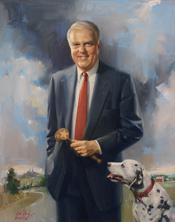
Historical · U.S. House · Wisconsin · District 5
F. Sensenbrenner Jr.
Former U.S. Representative · Wisconsin District 5 · 1979–2021 · Republican
F. Sensenbrenner Jr. represented Wisconsin's District 5 in the United States House of Representatives (1979–2021) for the Republican party. The page below collects sourced biographical facts, term history, committee roles, and provenance for Jr..
Bioguide ID: S000244
Key facts
- Full name
- F. Sensenbrenner Jr.
- State
- Wisconsin
- District
- District 5
- Party
- Republican
- House service
- 1979–2021
- First House term
- 1979
- Status
- Left office
- Current term ends
- —
- Born
- 1943
- Bioguide ID
- S000244
- Committee assignments
- —
- Dataset version
- 1.20260604
Biographical narrative
858 words · sourced from the Wikipedia REST extract
F. Sensenbrenner Jr. is a former American politician who served as a U.S. Representative for Wisconsin's 5th congressional district from 1979 until 2021. A member of the Republican Party, Sensenbrenner's lengthy tenure in Congress spanned over four decades, during which he held significant leadership roles, including chairmanships of both the House Judiciary Committee and the House Science Committee. His legislative career is marked by his involvement in key national issues, particularly in the realms of national security and impeachment proceedings.
Early life and career
Frank James Sensenbrenner Jr. was born on June 14, 1943, in Chicago, Illinois. He grew up in Shorewood, Wisconsin, where he attended the private Milwaukee Country Day School, graduating in 1961. Following high school, Sensenbrenner enrolled at Stanford University, where he earned a Bachelor of Arts degree in political science in 1965. He continued his education at the University of Wisconsin Law School, obtaining his Juris Doctor in 1968.
Sensenbrenner's early political career began shortly after he completed his law degree. He served as a staff assistant to U.S. Congressman J. Arthur Younger from California and worked for Wisconsin State Senator Jerris Leonard. In 1968, he entered public office himself by winning a seat in the Wisconsin State Assembly, where he served until 1975. He then transitioned to the Wisconsin State Senate, representing his constituents until early 1979.
House tenure
Sensenbrenner's entry into the U.S. House of Representatives was prompted by the decision of incumbent Congressman Bob Kasten to vacate his seat in the 9th congressional district to pursue a gubernatorial run in 1978. Sensenbrenner successfully navigated the Republican primary, defeating State Assemblywoman Susan Engeleiter by a narrow margin. He then faced Democratic candidate Matt Flynn in the general election, securing a decisive victory with a significant majority of the vote.
Throughout his congressional career, Sensenbrenner was re-elected 20 additional times, often facing little to no opposition. His district, which was re-designated as the 5th congressional district following the 2000 census, has historically been one of the most Republican-leaning areas in Wisconsin. Sensenbrenner consistently garnered substantial support from voters, never winning re-election with less than 62% of the vote. His most competitive races occurred in 2004 and 2006, where he achieved 67% and 62% of the vote, respectively.
In September 2019, Sensenbrenner announced that he would not seek re-election for a 22nd term, marking the end of his long-standing service in Congress. At the time of his retirement, he was the most senior member of Wisconsin's congressional delegation and the second most senior member in the House overall.
Legislative focus and committees
During his time in the House, Sensenbrenner was involved in a variety of legislative initiatives and held several prominent committee positions. He served as the chairman of the House Judiciary Committee and the House Science Committee, where he played a significant role in shaping policy on various issues. His leadership in these committees allowed him to influence key legislation and oversee critical investigations.
Sensenbrenner's involvement in impeachment proceedings is notable; he served as one of the House managers during the impeachment trial of President Bill Clinton in 1999. He also participated in the impeachment trials of three federal judges, making him the only individual in American history to serve as a manager in multiple federal impeachments.
A significant aspect of Sensenbrenner's legislative focus was national security. He introduced the USA PATRIOT Act to the House shortly after the September 11 attacks in 2001, contributing to the development of policies aimed at enhancing national security measures. Although the primary author of the act was U.S. Assistant Attorney General Viet D. Dinh, Sensenbrenner is recognized as one of its key architects. He was involved in various discussions and legislative actions related to the act, including efforts to amend it in response to concerns about civil liberties.
In 2005, Sensenbrenner authored the Real ID Act, which aimed to tighten identification requirements for driver's licenses and other forms of identification. This legislation was attached to a military spending bill, reflecting Sensenbrenner's strategy of advancing security measures through broader legislative packages.
Sensenbrenner's tenure was also marked by his evolving views on the balance between national security and civil liberties. In 2013, he publicly objected to the FBI and NSA's use of the PATRIOT Act for the bulk collection of phone metadata, expressing concerns about the implications for individual privacy rights. He emphasized the need for oversight and caution in the implementation of national security measures, indicating a nuanced perspective on the legislation he had helped to create.
Throughout his congressional career, Sensenbrenner's legislative focus encompassed a range of issues, including energy independence and global warming, where he served as the ranking Republican on the House Select Committee for Energy Independence and Global Warming from 2007 to 2011. This role highlighted his engagement with environmental policy, although the committee was ultimately disbanded after Republicans regained control of the House.
In summary, F. Sensenbrenner Jr.'s extensive career in the U.S. House of Representatives reflects a commitment to public service and a focus on critical national issues. His leadership roles and legislative initiatives have left a lasting impact on both his constituents and the broader political landscape.
Notable legislation
Sponsored and co-sponsored legislation for F. Sensenbrenner Jr. is pending operator curation. The biographical narrative above carries the same provenance trail until per-bill rows are written.
Sources
- [1]https://en.wikipedia.org/wiki/Jim_SensenbrennerWikipedia · retrieved 2026-06-04
Notable quotes
Sourced quotes for F. Sensenbrenner Jr. are pending operator curation. Narrative-scope provenance remains attached below.
Sources
- [1]https://en.wikipedia.org/wiki/Jim_SensenbrennerWikipedia · retrieved 2026-06-04
Key positions
Curated policy positions for F. Sensenbrenner Jr. are pending operator review. The biographical narrative above carries the same provenance trail until per-topic positions are written.
Sources
- [1]https://en.wikipedia.org/wiki/Jim_SensenbrennerWikipedia · retrieved 2026-06-04
Terms served
- 1979–1981U.S. House · Term 1 · Republican
- 1981–1983U.S. House · Term 2 · Republican
- 1983–1985U.S. House · Term 3 · Republican
- 1985–1987U.S. House · Term 4 · Republican
- 1987–1989U.S. House · Term 5 · Republican
- 1989–1991U.S. House · Term 6 · Republican
- 1991–1993U.S. House · Term 7 · Republican
- 1993–1995U.S. House · Term 8 · Republican
- 1995–1997U.S. House · Term 9 · Republican
- 1997–1999U.S. House · Term 10 · Republican
- 1999–2001U.S. House · Term 11 · Republican
- 2001–2003U.S. House · Term 12 · Republican
- 2003–2005U.S. House · Term 13 · Republican
- 2005–2007U.S. House · Term 14 · Republican
- 2007–2009U.S. House · Term 15 · Republican
- 2009–2011U.S. House · Term 16 · Republican
- 2011–2013U.S. House · Term 17 · Republican
- 2013–2015U.S. House · Term 18 · Republican
- 2015–2017U.S. House · Term 19 · Republican
- 2017–2019U.S. House · Term 20 · Republican
- 2019–2021U.S. House · Term 21 · Republican
Sources & provenance
Every attributable claim above carries a per-section [N] marker that resolves to the corresponding URL below. Each entry records the upstream provider, the canonical URL, and the timestamp at which the source was retrieved by the ingest pipeline.
Key facts
- https://bioguide.congress.gov/search/bio/S000244bioguide · retrieved 2026-06-04
- https://sensenbrenner.house.govhouse.gov · retrieved 2026-06-04
Biographical narrative
- https://en.wikipedia.org/wiki/Jim_Sensenbrennerwikipedia · retrieved 2026-06-04
Find your representative
Every U.S. state elects representatives by district. Browse Wisconsin’s delegation, the full former-representative roster, or explore the role and term length.
Related on The Candidate
- Preceded by Charles KerstenEarlier holder of the Wisconsin District 5 House seat · Republican.Open
- Charles WilliamsFormer U.S. Representative · Wisconsin District 1 · RepublicanOpen
- Clifford RandallFormer U.S. Representative · Wisconsin District 1 · RepublicanOpen
- Clinton BabbittFormer U.S. Representative · Wisconsin District 1 · DemocraticOpen
- Daniel Wells Jr.Former U.S. Representative · Wisconsin District 1 · DemocraticOpen
- Republican PartyFederal candidates and office holders on the Republican line.Open