
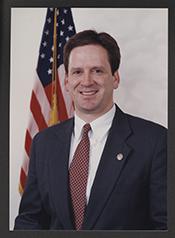
Historical · U.S. House · Wisconsin · District 8
Mark Green
Former U.S. Representative · Wisconsin District 8 · 1999–2007 · Republican
Mark Green represented Wisconsin's District 8 in the United States House of Representatives (1999–2007) for the Republican party. The page below collects sourced biographical facts, term history, committee roles, and provenance for Green.
Bioguide ID: G000545
Key facts
- Full name
- Mark Green
- State
- Wisconsin
- District
- District 8
- Party
- Republican
- House service
- 1999–2007
- First House term
- 1999
- Status
- Left office
- Current term ends
- —
- Born
- 1960
- Bioguide ID
- G000545
- Committee assignments
- —
- Dataset version
- 1.20260605
Biographical narrative
936 words · sourced from the Wikipedia REST extract
Mark Green is an American politician and diplomat who served as a U.S. Representative for Wisconsin's 8th congressional district from 1999 to 2007. A member of the Republican Party, Green has held various leadership roles throughout his career, including serving as the executive director of the McCain Institute for International Leadership and as the administrator of the United States Agency for International Development (USAID). He has also been involved in diplomatic efforts, notably as the U.S. Ambassador to Tanzania from 2007 to 2009. In addition to his political career, Green has contributed to various organizations focused on international leadership and development.
Early life and career
Mark Green was born on June 1, 1960, in Boston, Massachusetts, to Jeremy and Elizabeth Green. His upbringing was marked by frequent relocations, as his family moved across various locations, including Jersey City, New Jersey; Cincinnati, Ohio; England; South Africa; and Australia. This diverse background provided Green with a unique perspective on different cultures and societies. He completed his secondary education at Abbot Pennings High School in De Pere, Wisconsin.
Green pursued higher education at the University of Wisconsin–Eau Claire, where he earned a bachelor's degree in 1983. He continued his studies at the University of Wisconsin–Madison, obtaining a Juris Doctor in 1987. During his time in law school, he demonstrated academic excellence by serving as the managing editor of the Wisconsin Law Review and receiving the Justice Robert Jackson Award for outstanding student writing on foreign law.
Following his graduation from law school, Green joined the law firm Godfrey & Kahn S.C. at their Green Bay, Wisconsin office, where he began his professional career in law.
House tenure
Green entered politics in 1992 when he was elected to the Wisconsin State Assembly, representing District 4. During his six-year tenure, he rose to the position of chairman of the Republican Caucus and chaired the Judiciary Committee. His work in the Assembly focused on reforming state housing policy, and he received recognition from various organizations for his legislative efforts, including awards from the Wisconsin and American Farm Bureau Federations and the National Federation of Independent Business.
In 1998, Green ran for the U.S. House of Representatives, successfully defeating incumbent Representative Jay W. Johnson with a significant majority of the vote. He began his first term in Congress in January 1999 and was re-elected three additional times, consistently winning with over 70% of the vote in subsequent elections. Throughout his four terms, Green represented Wisconsin's 8th congressional district during the 106th to 109th Congresses.
During his time in the House, Green was a member of the House International Relations Committee and played a role in drafting significant legislation, including the Millennium Challenge Act and various acts aimed at addressing global health issues, such as the Global Access to HIV/AIDS Prevention, Awareness and Treatment Act of 2001. He was also involved in the U.S. Leadership Against HIV/AIDS, Tuberculosis and Malaria Act, reflecting his commitment to international health and human rights.
In addition to his work on international issues, Green was appointed as an Assistant Majority Whip in January 1999 and was re-appointed in subsequent sessions. He co-founded the bipartisan Faith-Based Caucus, which aimed to engage faith-based organizations in addressing social issues. His legislative initiatives included efforts to expand the Violence Against Women Act and the introduction of the "Two Strikes and You're Out Child Protection Act," which sought to impose life sentences for repeat child sex offenders. He also supported various measures to enhance law enforcement capabilities, such as the Debbie Smith Act and the Adam Walsh Child Protection and Safety Act.
In 2006, Green sought to advance his political career by running for Governor of Wisconsin. He faced no opposition in the Republican primary and selected State Representative Jean Hundertmark as his running mate. However, he was ultimately defeated by incumbent Governor Jim Doyle in the general election.
Legislative focus and committees
Throughout his congressional tenure, Green's legislative focus was characterized by a commitment to both domestic and international issues. His work on the House International Relations Committee allowed him to advocate for human rights and raise awareness about the plight of marginalized communities, particularly the Hmong people in Laos. Many Hmong Americans had settled in Wisconsin as political refugees, and Green's efforts aimed to address their concerns and promote religious freedom in Southeast Asia.
In addition to his international work, Green's involvement in domestic policy was evident through his participation in the House Judiciary Committee, where he served as vice chair of the Crime, Terrorism and Homeland Security Subcommittee. His legislative initiatives often intersected with issues of public safety and community welfare, reflecting his focus on crime prevention and child protection.
Green's bipartisan approach was evident in his co-founding of the Faith-Based Caucus, which sought to mobilize faith-based organizations to contribute to social initiatives. His advocacy for the Faith-Based Initiative aimed to leverage the resources and networks of religious communities in addressing poverty and social crises.
After leaving Congress in 2007, Green continued his public service as the U.S. Ambassador to Tanzania, a role he held until January 2009. He later served as the administrator of USAID, where he was confirmed by the Senate in 2017 and resigned in 2020. His career has included leadership roles in various organizations, including the International Republican Institute, where he served as president from 2014 to 2017.
Mark Green's career reflects a blend of legal expertise, legislative leadership, and diplomatic service, with a focus on both domestic and international issues that impact communities and promote human rights. His contributions to public service and governance continue to influence discussions on policy and international relations.
Notable legislation
Sponsored and co-sponsored legislation for Mark Green is pending operator curation. The biographical narrative above carries the same provenance trail until per-bill rows are written.
Sources
- [1]https://en.wikipedia.org/wiki/Mark_Green_(Wisconsin_politician)Wikipedia · retrieved 2026-06-05
Notable quotes
Sourced quotes for Mark Green are pending operator curation. Narrative-scope provenance remains attached below.
Sources
- [1]https://en.wikipedia.org/wiki/Mark_Green_(Wisconsin_politician)Wikipedia · retrieved 2026-06-05
Key positions
Curated policy positions for Mark Green are pending operator review. The biographical narrative above carries the same provenance trail until per-topic positions are written.
Sources
- [1]https://en.wikipedia.org/wiki/Mark_Green_(Wisconsin_politician)Wikipedia · retrieved 2026-06-05
Terms served
- 1999–2001U.S. House · Term 1 · Republican
- 2001–2003U.S. House · Term 2 · Republican
- 2003–2005U.S. House · Term 3 · Republican
- 2005–2007U.S. House · Term 4 · Republican
Sources & provenance
Every attributable claim above carries a per-section [N] marker that resolves to the corresponding URL below. Each entry records the upstream provider, the canonical URL, and the timestamp at which the source was retrieved by the ingest pipeline.
Key facts
- https://bioguide.congress.gov/search/bio/G000545bioguide · retrieved 2026-06-05
- http://www.house.gov/markgreenhouse.gov · retrieved 2026-06-05
Biographical narrative
- https://en.wikipedia.org/wiki/Mark_Green_(Wisconsin_politician)wikipedia · retrieved 2026-06-05
Find your representative
Every U.S. state elects representatives by district. Browse Wisconsin’s delegation, the full former-representative roster, or explore the role and term length.
Related on The Candidate
- Preceded by Jay JohnsonEarlier holder of the Wisconsin District 8 House seat · Democratic.Open
- Succeeded by Steve KagenLater holder of the Wisconsin District 8 House seat · Democratic.Open
- Charles WilliamsFormer U.S. Representative · Wisconsin District 1 · RepublicanOpen
- Clifford RandallFormer U.S. Representative · Wisconsin District 1 · RepublicanOpen
- Clinton BabbittFormer U.S. Representative · Wisconsin District 1 · DemocraticOpen
- Daniel Wells Jr.Former U.S. Representative · Wisconsin District 1 · DemocraticOpen