
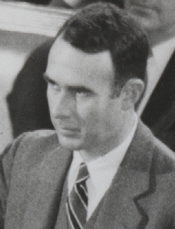
Historical · U.S. House · Wisconsin · District 9
Lester Johnson
Former U.S. Representative · Wisconsin District 9 · 1953–1965 · Democratic
Lester Johnson represented Wisconsin's District 9 in the United States House of Representatives (1953–1965) for the Democratic party. The page below collects sourced biographical facts, term history, committee roles, and provenance for Johnson.
Bioguide ID: J000158
Key facts
- Full name
- Lester Johnson
- State
- Wisconsin
- District
- District 9
- Party
- Democratic
- House service
- 1953–1965
- First House term
- 1953
- Status
- Left office
- Current term ends
- —
- Born
- 1901
- Bioguide ID
- J000158
- Committee assignments
- —
- Dataset version
- 1.20260605
Biographical narrative
962 words · sourced from the Wikipedia REST extract
Lester Roland Johnson was a U.S. Representative from Wisconsin, serving in the House of Representatives as a member of the Democratic Party. His political career spanned over a decade, during which he represented Wisconsin's 9th congressional district from 1953 until 1965. Johnson's tenure in Congress was marked by his involvement in various legislative matters and his commitment to his constituents in Western Wisconsin. Born in 1901, he had a diverse career that included roles in law, local government, and business before entering the federal legislature.
Early life and career
Lester Johnson was born on June 16, 1901, in Brandon, Wisconsin. He was the son of John E. Johnson, who was also involved in politics, which likely influenced Lester's later career choices. Johnson's early education took place in public schools, where he laid the foundation for his future academic pursuits. He attended Lawrence University from 1919 to 1921, where he began to develop his interests and skills that would later serve him in his professional life. After leaving Lawrence University, he graduated from the University of Wisconsin–Madison School of Commerce in 1924, equipping him with a strong background in business and finance.
Following his graduation, Johnson entered the business world, where he worked alongside his father in the lumber, feed, and coal industry from 1924 until 1938. This experience provided him with insights into the economic challenges faced by local businesses and the importance of community resources. In 1938, he shifted his focus to law, enrolling in the University of Wisconsin Law School. He completed his legal education and graduated in February 1941, subsequently being admitted to the Wisconsin bar the same year. He began his legal practice in Black River Falls, Wisconsin, where he served the local community.
In addition to his legal career, Johnson was actively involved in public service. He held the position of Chief Clerk of the Wisconsin State Assembly from 1935 to 1939, which allowed him to gain valuable experience in legislative processes and governance. His commitment to public service continued as he served on the state banking commission in 1942. Johnson also took on the role of district attorney for Jackson County, Wisconsin, first from 1943 to 1946 and again in 1953. His legal and political experiences prepared him for a future in Congress, where he would advocate for his constituents and address pressing issues facing his district.
Johnson's political involvement extended to the national level when he served as a delegate to the Democratic National Conventions in 1952 and 1960. These experiences further solidified his connections within the Democratic Party and provided him with a platform to influence party policies and direction.
House tenure
Lester Johnson's congressional career began with a special election held on October 13, 1953, to fill the vacancy left by the passing of Congressman Merlin Hull. Johnson was elected as a member of the Democratic Party to the Eighty-third Congress, representing Wisconsin's 9th congressional district. He quickly established himself as a dedicated public servant, focusing on the needs and concerns of his constituents in Western Wisconsin.
During his time in office, Johnson was reelected to five successive Congresses, serving from October 13, 1953, until January 3, 1965. His tenure in the House of Representatives was characterized by a commitment to addressing local issues and advocating for policies that would benefit his district. Johnson's ability to connect with constituents and understand their needs contributed to his electoral success and the trust placed in him by the voters.
In 1964, Johnson chose not to seek reelection for the Eighty-ninth Congress. This decision was influenced by the redistricting that occurred that year, which altered the boundaries of his 9th congressional district. The new configuration shifted the district from its original location in Western Wisconsin to the suburbs of Milwaukee. Had he chosen to run, Johnson would have faced a challenging race against incumbent Congressman Vernon Thomson in the newly formed 3rd district.
Johnson's congressional career concluded on January 3, 1965, marking the end of a significant chapter in his life dedicated to public service. After leaving Congress, he continued to reside in Wisconsin, where he remained engaged with his community until his passing.
Legislative focus and committees
Throughout his tenure in the House of Representatives, Lester Johnson was involved in various legislative initiatives and committee assignments that reflected his commitment to serving the interests of his constituents. While specific details regarding the bills he sponsored or the committees he served on are not provided, it is known that his legislative focus was likely influenced by the needs of the 9th congressional district and the broader concerns of Wisconsin residents during the 1950s and early 1960s.
As a member of the Democratic Party, Johnson would have participated in discussions and debates on key issues of the time, including economic development, social welfare, and infrastructure improvements. His background in law and business likely informed his perspectives on legislation related to commerce, finance, and community development. Johnson's experiences as a district attorney and his involvement in local government would have also shaped his approach to criminal justice and public safety matters.
Johnson's commitment to his constituents was evident in his efforts to address local concerns and advocate for policies that would enhance the quality of life in his district. His ability to navigate the complexities of federal legislation while remaining attuned to the needs of his community was a hallmark of his service in Congress.
Lester Johnson passed away on July 24, 1975, in Augusta, Wisconsin. He was laid to rest in Brandon Cemetery, in his hometown, where he is remembered for his contributions to public service and his dedication to the people of Wisconsin. His legacy as a U.S. Representative continues to be recognized as part of the rich political history of the state.
Notable legislation
Sponsored and co-sponsored legislation for Lester Johnson is pending operator curation. The biographical narrative above carries the same provenance trail until per-bill rows are written.
Sources
- [1]https://en.wikipedia.org/wiki/Lester_Johnson_(politician)Wikipedia · retrieved 2026-06-05
Notable quotes
Sourced quotes for Lester Johnson are pending operator curation. Narrative-scope provenance remains attached below.
Sources
- [1]https://en.wikipedia.org/wiki/Lester_Johnson_(politician)Wikipedia · retrieved 2026-06-05
Key positions
Curated policy positions for Lester Johnson are pending operator review. The biographical narrative above carries the same provenance trail until per-topic positions are written.
Sources
- [1]https://en.wikipedia.org/wiki/Lester_Johnson_(politician)Wikipedia · retrieved 2026-06-05
Terms served
- 1953–1955U.S. House · Term 1 · Democratic
- 1955–1957U.S. House · Term 2 · Democratic
- 1957–1959U.S. House · Term 3 · Democratic
- 1959–1961U.S. House · Term 4 · Democratic
- 1961–1963U.S. House · Term 5 · Democratic
- 1963–1965U.S. House · Term 6 · Democratic
Sources & provenance
Every attributable claim above carries a per-section [N] marker that resolves to the corresponding URL below. Each entry records the upstream provider, the canonical URL, and the timestamp at which the source was retrieved by the ingest pipeline.
Key facts
- https://bioguide.congress.gov/search/bio/J000158bioguide · retrieved 2026-06-05
- https://www.govtrack.us/congress/members/406056govtrack · retrieved 2026-06-05
Biographical narrative
- https://en.wikipedia.org/wiki/Lester_Johnson_(politician)wikipedia · retrieved 2026-06-05
Find your representative
Every U.S. state elects representatives by district. Browse Wisconsin’s delegation, the full former-representative roster, or explore the role and term length.
Related on The Candidate
- Preceded by James FrearEarlier holder of the Wisconsin District 9 House seat · Republican.Open
- Charles WilliamsFormer U.S. Representative · Wisconsin District 1 · RepublicanOpen
- Clifford RandallFormer U.S. Representative · Wisconsin District 1 · RepublicanOpen
- Clinton BabbittFormer U.S. Representative · Wisconsin District 1 · DemocraticOpen
- Daniel Wells Jr.Former U.S. Representative · Wisconsin District 1 · DemocraticOpen
- Democratic PartyFederal candidates and office holders on the Democratic line.Open