
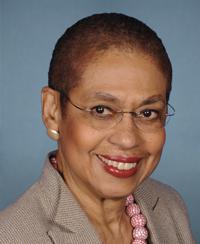
Serving · U.S. House · District of Columbia · At-Large
Eleanor Norton
U.S. Representative · District of Columbia At-Large · 1991–present · Democratic
Eleanor Norton represents District of Columbia's At-Large in the United States House of Representatives (1991–present) for the Democratic party. The page below collects sourced biographical facts, term history, committee roles, and provenance for Norton.
Bioguide ID: N000147
Key facts
- Full name
- Eleanor Norton
- State
- District of Columbia
- District
- At-Large
- Party
- Democratic
- House service
- 1991–present
- First House term
- 1991
- Status
- Currently serving
- Current term ends
- 2027
- Born
- 1937
- Bioguide ID
- N000147
- Committee assignments
- 2
- Dataset version
- 1.20260603
Biographical narrative
1,224 words · sourced from the Wikipedia REST extract
Eleanor Holmes Norton is an American politician, lawyer, and human rights activist currently serving as the U.S. Representative for the District of Columbia. A member of the Democratic Party, she has held this position since 1991, marking her as a prominent figure in American politics and advocacy for civil rights. Throughout her tenure, she has focused on issues pertinent to the District of Columbia, including voting rights, local governance, and social justice. As of January 3, 2027, her current term is set to conclude, and she has announced that she will not seek re-election in 2026.
Early life and career
Eleanor Holmes Norton was born on June 13, 1937, in Washington, D.C. She is the daughter of Vela Lynch, a schoolteacher, and Coleman Holmes, a civil servant. Norton attended Dunbar High School, which was known for its historical significance in educating Black children. She was a member of the last segregated class at the school, where she demonstrated leadership as the junior class president and graduated as a member of the National Honor Society.
Following her high school education, Norton pursued higher education at Antioch College, where she earned a Bachelor of Arts degree in 1960. She continued her studies at Yale University, obtaining a Master of Arts in American Studies in 1963, and later graduated with a Bachelor of Laws from Yale Law School in 1964. During her time in college and graduate school, Norton became actively involved in the civil rights movement, serving as an organizer for the Student Nonviolent Coordinating Committee (SNCC). Her activism included organizing and participating in sit-ins across Washington, D.C., Maryland, and Ohio, which led to her arrest.
Norton’s commitment to civil rights deepened during her law school years when she traveled to Mississippi for the Mississippi Freedom Summer. There, she worked alongside notable civil rights figures, including Medgar Evers. This experience exposed her to the harsh realities of racial violence and oppression in the South, further solidifying her dedication to social justice.
Norton’s involvement in the civil rights movement inspired her lifelong commitment to activism and feminism. She contributed to the 1970 anthology "Sisterhood is Powerful," which highlighted the writings from the women's liberation movement. Additionally, she was a founding member of the advisory board for the Women's Rights Law Reporter, the first legal periodical in the United States dedicated exclusively to women's rights law. In the early 1970s, she also signed the Black Woman's Manifesto, a significant document in the Black feminist movement.
After completing her education, Norton began her legal career as a law clerk for Federal District Court Judge A. Leon Higginbotham Jr. In 1965, she joined the American Civil Liberties Union as the assistant legal director, a role she held until 1970. During this period, she represented a group of female employees from Newsweek who challenged the magazine's discriminatory hiring practices, successfully advocating for their right to work as reporters.
Norton specialized in freedom of speech cases, including her notable involvement in the Supreme Court case Carroll v. President & Commissioners of Princess Anne, where she defended the First Amendment rights of the National States' Rights Party. Her work in this area underscored her belief in the importance of defending civil liberties, even when representing unpopular viewpoints.
In 1970, she was appointed by Mayor John Lindsay as the head of the New York City Human Rights Commission, where she conducted the first hearings in the nation on discrimination against women. Her efforts drew attention to the application of the Civil Rights Act of 1964 concerning women's rights.
In 1977, President Jimmy Carter appointed Norton as the chair of the Equal Employment Opportunity Commission (EEOC), making her the first woman to hold this position. During her tenure, she established the EEOC's first regulations on sexual harassment, affirming that such behavior constituted a violation of federal civil rights laws. Norton also served as a senior fellow at the Urban Institute and became a professor at Georgetown University Law Center in 1982. Throughout this period, she remained an active voice against apartheid in the U.S. and participated in the Free South Africa Movement.
In 1990, Norton co-founded African-American Women for Reproductive Freedom, a group advocating for reproductive rights. She contributed to the 2003 anthology "Sisterhood Is Forever," further showcasing her commitment to feminist issues. In recognition of her contributions, she received a Foremother Award from the National Research Center for Women & Families in 2011.
House tenure
Eleanor Holmes Norton was elected to the U.S. House of Representatives in 1990 as a Democratic delegate for the District of Columbia. She won the Democratic primary against city council member Betty Ann Kane, despite facing scrutiny over her and her husband’s failure to file D.C. income tax returns for several years. Following the primary, Norton and her husband paid over $80,000 in back taxes and fines. Her campaign manager was Donna Brazile, a notable political strategist.
Norton took office in 1991 and has since been re-elected multiple times, serving a total of 18 terms in Congress. As a delegate, she does not have full voting rights in the House but can participate in debates and serve on committees. Her role has been crucial in advocating for the rights and interests of D.C. residents, particularly in the areas of local governance and voting representation.
Throughout her tenure, Norton has focused on various issues affecting the District of Columbia, including budget autonomy, local law enforcement, and civil rights. She has worked to increase awareness of the unique challenges faced by D.C. residents, advocating for greater autonomy and representation in Congress. Norton has also been involved in efforts to secure voting rights for D.C. residents, emphasizing the importance of equal representation in the federal government.
Legislative focus and committees
During her time in the House of Representatives, Eleanor Holmes Norton has served on several committees, allowing her to influence legislation on a range of issues. Her legislative focus has included civil rights, social justice, and local governance, reflecting her long-standing commitment to advocacy and activism.
Norton has been a vocal proponent of voting rights for the District of Columbia, consistently advocating for measures that would grant D.C. residents full representation in Congress. She has introduced legislation aimed at securing statehood for D.C., arguing that residents should have the same rights and privileges as those living in the states. Her efforts in this area have garnered attention and support from various advocacy groups and constituents.
In addition to her work on voting rights, Norton has addressed issues related to education, healthcare, and public safety. She has championed initiatives aimed at improving access to quality education for D.C. students and has worked to secure funding for healthcare programs that benefit low-income residents. Her legislative agenda has often intersected with broader national issues, as she has sought to align local priorities with federal policies.
Norton has also been involved in various caucuses and coalitions within Congress, collaborating with colleagues to advance shared goals. Her experience and expertise in civil rights have positioned her as a respected voice on issues of social justice, and she has been an advocate for marginalized communities throughout her career.
As she approaches the end of her current term, Norton remains a significant figure in the ongoing discussions surrounding D.C. representation and civil rights, leaving a lasting impact on both her constituents and the broader political landscape.
Committees & roles
- House Committee on Oversight and Government ReformMember · since 2025
- House Committee on Transportation and InfrastructureMember · since 2025
Notable legislation
Sponsored and co-sponsored legislation for Eleanor Norton is pending operator curation. The biographical narrative above carries the same provenance trail until per-bill rows are written.
Sources
- [1]https://en.wikipedia.org/wiki/Eleanor_Holmes_NortonWikipedia · retrieved 2026-06-03
Notable quotes
Sourced quotes for Eleanor Norton are pending operator curation. Narrative-scope provenance remains attached below.
Sources
- [1]https://en.wikipedia.org/wiki/Eleanor_Holmes_NortonWikipedia · retrieved 2026-06-03
Key positions
Curated policy positions for Eleanor Norton are pending operator review. The biographical narrative above carries the same provenance trail until per-topic positions are written.
Sources
- [1]https://en.wikipedia.org/wiki/Eleanor_Holmes_NortonWikipedia · retrieved 2026-06-03
Terms served
- 1991–1993U.S. House · Term 1 · Democratic
- 1993–1995U.S. House · Term 2 · Democratic
- 1995–1997U.S. House · Term 3 · Democratic
- 1997–1999U.S. House · Term 4 · Democratic
- 1999–2001U.S. House · Term 5 · Democratic
- 2001–2003U.S. House · Term 6 · Democratic
- 2003–2005U.S. House · Term 7 · Democratic
- 2005–2007U.S. House · Term 8 · Democratic
- 2007–2009U.S. House · Term 9 · Democratic
- 2009–2011U.S. House · Term 10 · Democratic
- 2011–2013U.S. House · Term 11 · Democratic
- 2013–2015U.S. House · Term 12 · Democratic
- 2015–2017U.S. House · Term 13 · Democratic
- 2017–2019U.S. House · Term 14 · Democratic
- 2019–2021U.S. House · Term 15 · Democratic
- 2021–2023U.S. House · Term 16 · Democratic
- 2023–2025U.S. House · Term 17 · Democratic
- 2025–2027U.S. House · Term 18 · Democratic
Sources & provenance
Every attributable claim above carries a per-section [N] marker that resolves to the corresponding URL below. Each entry records the upstream provider, the canonical URL, and the timestamp at which the source was retrieved by the ingest pipeline.
Key facts
- https://bioguide.congress.gov/search/bio/N000147bioguide · retrieved 2026-06-03
- https://norton.house.gov/house.gov · retrieved 2026-06-03
Biographical narrative
- https://en.wikipedia.org/wiki/Eleanor_Holmes_Nortonwikipedia · retrieved 2026-06-03
Find your representative
Every U.S. state elects representatives by district. Browse District of Columbia’s delegation, the full currently-serving-representative roster, or explore the role and term length.
Related on The Candidate
- Democratic PartyFederal candidates and office holders on the Democratic line.Open
- Representatives from District of ColumbiaEvery currently-serving U.S. Representative who has represented District of Columbia.Open
- All serving representativesEvery individual currently serving in the U.S. House, grouped by state and district.Open
- U.S. House of RepresentativesRole, term length, qualifications, and the full House candidate directory.Open