
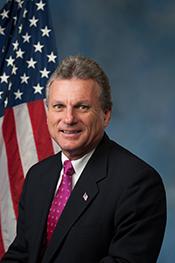
Serving · U.S. House · Georgia · District 1
Buddy Carter
U.S. Representative · Georgia District 1 · 2015–present · Republican
Buddy Carter represents Georgia's District 1 in the United States House of Representatives (2015–present) for the Republican party. The page below collects sourced biographical facts, term history, committee roles, and provenance for Carter.
Bioguide ID: C001103
Key facts
- Full name
- Buddy Carter
- State
- Georgia
- District
- District 1
- Party
- Republican
- House service
- 2015–present
- First House term
- 2015
- Status
- Currently serving
- Current term ends
- 2027
- Born
- 1957
- Bioguide ID
- C001103
- Committee assignments
- 2
- Dataset version
- 1.20260603
Biographical narrative
963 words · sourced from the Wikipedia REST extract
Earl L. "Buddy" Carter is an American politician currently serving as the U.S. Representative for Georgia's 1st congressional district. A member of the Republican Party, he has held this position since 2015. Prior to his tenure in the U.S. House of Representatives, Carter was involved in local and state politics, including serving in the Georgia State Senate. His political career has been marked by a focus on various issues, including health care, immigration, and gun rights.
Early life and career
Buddy Carter was born on September 6, 1957, in Georgia. He completed his secondary education at Robert W. Groves High School in Garden City, Georgia, graduating in 1975. Following high school, he pursued higher education, earning an associate degree from Young Harris College in 1977. He later attended the University of Georgia, where he obtained a Bachelor of Science in pharmacy in 1980. This educational background laid the foundation for his future career in both pharmacy and politics.
Carter's political career began at the local level. He served on the planning and zoning commission for the city of Pooler from 1989 to 1993, which allowed him to gain experience in municipal governance. He then served on Pooler's city council for a brief period from 1994 to 1995. His political ascent continued when he was elected as the mayor of Pooler, a position he held from 1996 to 2004. This role provided him with significant experience in leadership and public service.
After his tenure as mayor, Carter transitioned to state politics. He was elected to the Georgia House of Representatives, serving from 2005 to 2009. Following this, he was elected to the Georgia State Senate, where he served from 2009 until 2014. During his time in the state legislature, Carter was a member of several committees, including Appropriations, Health and Human Services, Higher Education, and Public Safety. His legislative experience at the state level prepared him for his subsequent campaign for the U.S. House of Representatives.
House tenure
Carter's journey to the U.S. House of Representatives began in 2014 when he decided to run for the seat vacated by 22-year incumbent Jack Kingston, who was pursuing a Senate position. In the Republican primary, Carter emerged as the frontrunner, receiving a plurality of the votes but falling short of the majority needed for an outright victory. He subsequently advanced to a runoff election, where he secured his nomination by defeating Bob Johnson.
In the general election, Carter faced Democratic nominee Brian Reese. He won the election decisively, capturing approximately 60.9% of the vote and carrying the majority of counties within the district. Following his initial victory, Carter was re-elected in subsequent elections held in 2016, 2018, 2020, and 2022. His electoral success reflects his strong support within his district and his ability to connect with constituents.
Throughout his tenure in the House, Carter has maintained a focus on various legislative issues and has been active in several committees. For the 119th Congress, he serves on the Committee on Energy and Commerce, where he is involved in subcommittees addressing communications and technology, environmental issues, and health care, among others. Additionally, he is a member of the Committee on the Budget, which plays a crucial role in shaping federal fiscal policy.
Legislative focus and committees
Carter's legislative focus encompasses a range of issues, reflecting both his personal beliefs and the interests of his constituents. He has been vocal about his support for gun rights, earning an "A" grade from the National Rifle Association Political Victory Fund. His stance on gun policy includes advocating for the rights of individuals to bear arms and expressing skepticism about the role of Congress in addressing gun violence.
In the realm of health care, Carter has been a proponent of repealing the Affordable Care Act, commonly known as Obamacare. His views on health care reform have been a significant aspect of his political identity, and he has been involved in discussions surrounding health policy at both the state and federal levels.
Carter's positions on immigration have also been notable. He has co-sponsored legislation allowing illegal immigrants to serve in the U.S. military in exchange for legal residency. Additionally, he has expressed a desire to prohibit federal funding for sanctuary cities in Georgia, which are municipalities that limit cooperation with federal immigration enforcement. His efforts have included advocating for the testing of rape kits in Georgia, with a focus on addressing the backlog of untested kits.
In terms of foreign relations, Carter has shown support for Israel, particularly in the context of recent conflicts. He voted to provide assistance to Israel following attacks in 2023. His legislative actions indicate a commitment to maintaining strong international alliances, particularly with key allies.
Carter's involvement in agricultural policy has also been significant. In 2023, he joined a group of House Republicans in opposing the inclusion of the Ending Agricultural Trade Suppression (EATS) Act in the farm bill, arguing that it would infringe upon states' rights and potentially harm national security.
In addition to his committee assignments, Carter is a member of several caucuses, including the Congressional Blockchain Caucus, the Congressional Western Caucus, and the U.S.–Japan Caucus, among others. These memberships reflect his engagement with various policy areas and his commitment to collaborating with colleagues on issues of mutual interest.
In 2026, Carter announced his candidacy for the U.S. Senate election in Georgia, positioning himself as a candidate aligned with the "MAGA" movement. However, he was ultimately unsuccessful in the Republican primary, finishing behind other candidates.
Overall, Buddy Carter's political career has been characterized by a blend of local governance experience and a focus on key legislative issues at the national level. His ongoing service in the U.S. House of Representatives continues to shape his political legacy and influence within Georgia's 1st congressional district.
Committees & roles
- House Committee on Energy and CommerceMember · since 2025
- House Committee on the BudgetMember · since 2025
Notable legislation
Sponsored and co-sponsored legislation for Buddy Carter is pending operator curation. The biographical narrative above carries the same provenance trail until per-bill rows are written.
Sources
- [1]https://en.wikipedia.org/wiki/Buddy_CarterWikipedia · retrieved 2026-06-03
Notable quotes
Sourced quotes for Buddy Carter are pending operator curation. Narrative-scope provenance remains attached below.
Sources
- [1]https://en.wikipedia.org/wiki/Buddy_CarterWikipedia · retrieved 2026-06-03
Key positions
Curated policy positions for Buddy Carter are pending operator review. The biographical narrative above carries the same provenance trail until per-topic positions are written.
Sources
- [1]https://en.wikipedia.org/wiki/Buddy_CarterWikipedia · retrieved 2026-06-03
Terms served
- 2015–2017U.S. House · Term 1 · Republican
- 2017–2019U.S. House · Term 2 · Republican
- 2019–2021U.S. House · Term 3 · Republican
- 2021–2023U.S. House · Term 4 · Republican
- 2023–2025U.S. House · Term 5 · Republican
- 2025–2027U.S. House · Term 6 · Republican
Sources & provenance
Every attributable claim above carries a per-section [N] marker that resolves to the corresponding URL below. Each entry records the upstream provider, the canonical URL, and the timestamp at which the source was retrieved by the ingest pipeline.
Key facts
- https://bioguide.congress.gov/search/bio/C001103bioguide · retrieved 2026-06-03
- https://buddycarter.house.gov/house.gov · retrieved 2026-06-03
Biographical narrative
- https://en.wikipedia.org/wiki/Buddy_Carterwikipedia · retrieved 2026-06-03
Find your representative
Every U.S. state elects representatives by district. Browse Georgia’s delegation, the full currently-serving-representative roster, or explore the role and term length.
Related on The Candidate
- Mike Collins Jr.Serving U.S. Representative · Georgia District 10 · RepublicanOpen
- Barry LoudermilkServing U.S. Representative · Georgia District 11 · RepublicanOpen
- Rick AllenServing U.S. Representative · Georgia District 12 · RepublicanOpen
- Clay FullerServing U.S. Representative · Georgia District 14 · RepublicanOpen
- Republican PartyFederal candidates and office holders on the Republican line.Open
- Representatives from GeorgiaEvery currently-serving U.S. Representative who has represented Georgia.Open