
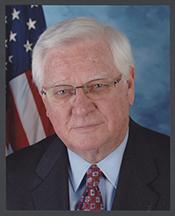
Serving · U.S. House · Kentucky · District 5
Hal Rogers
U.S. Representative · Kentucky District 5 · 1981–present · Republican
Hal Rogers represents Kentucky's District 5 in the United States House of Representatives (1981–present) for the Republican party. The page below collects sourced biographical facts, term history, committee roles, and provenance for Rogers.
Bioguide ID: R000395
Key facts
- Full name
- Hal Rogers
- State
- Kentucky
- District
- District 5
- Party
- Republican
- House service
- 1981–present
- First House term
- 1981
- Status
- Currently serving
- Current term ends
- 2027
- Born
- 1937
- Bioguide ID
- R000395
- Committee assignments
- 1
- Dataset version
- 1.20260604
Biographical narrative
905 words · sourced from the Wikipedia REST extract
Harold Rogers is an American lawyer and politician who has served as the U.S. Representative for Kentucky's 5th congressional district since 1981. A member of the Republican Party, he has been a prominent figure in Congress for over four decades, making him one of the longest-serving members in the history of the U.S. House of Representatives. Rogers has played a significant role in various legislative initiatives and has been recognized for his ability to navigate bipartisan negotiations. He currently holds the distinction of being the dean of the House of Representatives, a title he assumed following the death of fellow congressman Don Young in 2022.
Early life and career
Harold Rogers was born on December 31, 1937, in Barrier, Kentucky. He pursued higher education at Western Kentucky University in Bowling Green before transferring to the University of Kentucky, where he earned both a Bachelor of Arts and a Bachelor of Laws degree. Following his academic pursuits, Rogers served in the Kentucky Army National Guard and the North Carolina Army National Guard, gaining valuable experience that would inform his later career in public service.
After completing his education and military service, Rogers entered private legal practice. His legal career took a significant turn in 1969 when he was elected as the commonwealth's attorney for Pulaski and Rockcastle counties in Kentucky. This position allowed him to gain substantial experience in the legal and political arenas, as he managed legal proceedings and represented the interests of the state at the local level. He held this office until his election to Congress in 1980.
In 1979, Rogers sought higher office as the Republican nominee for lieutenant governor of Kentucky, running alongside former governor Louie B. Nunn. However, he was defeated by the Democratic nominee, John Y. Brown Jr., in a race that highlighted the competitive political landscape of the time. Despite this setback, Rogers's political ambitions remained intact, and he soon turned his focus to a congressional campaign.
House tenure
Rogers's congressional career began in 1981 when he successfully campaigned for Kentucky's 5th congressional district seat after the incumbent, Republican Tim Lee Carter, announced his retirement. Rogers won the Republican primary with a plurality of the vote, defeating several other candidates, including notable figures such as Tom Emberton. He then secured a decisive victory in the general election, receiving a significant majority of the votes cast.
Since his initial election, Rogers has been reelected numerous times, consistently garnering over 65% of the vote in most elections, with the exception of 1992, when he won with a smaller margin against Democratic candidate John Doug Hays. His ability to maintain such a strong electoral base is indicative of the Republican stronghold that characterizes his district, which has historically leaned Republican since the post-Civil War era.
Rogers's long tenure in Congress has made him the longest-serving Kentucky Republican ever elected to federal office. His district, located in south-central Kentucky, shares demographic similarities with parts of East Tennessee, and its voters have traditionally aligned with Republican values. Throughout his career, Rogers has participated as a delegate in nine Republican National Conventions, further solidifying his influence within the party.
Legislative focus and committees
During his time in the House of Representatives, Rogers has focused on a variety of legislative issues, particularly those affecting his constituents in Kentucky's 5th district. He is known for his work on the Appropriations Committee, where he has held multiple roles that have allowed him to develop skills as a bipartisan negotiator. His district, which faces economic challenges, has prompted him to adopt a pragmatic approach to governance, often straying from hard-line conservative positions when necessary.
Rogers has been a proponent of numerous economic development programs aimed at creating job opportunities in economically disadvantaged areas, particularly in Appalachia. His commitment to addressing local issues has led him to support various initiatives that promote economic growth and sustainability. He has also been involved in environmental protection efforts, advocating for large-scale clean-up programs throughout the Appalachian region.
In 1993, Rogers was one of only three Republicans to support then-President Bill Clinton's economic stimulus package, demonstrating his willingness to cross party lines for the benefit of his constituents. His ability to work collaboratively with members of both parties has been a hallmark of his legislative career. In 2003, he was appointed chairman of the subcommittee responsible for overseeing funding for the newly established Department of Homeland Security, a role that underscored his influence in shaping national security policy.
Rogers has also been involved in various community initiatives, such as the establishment of the Center for Rural Development, a nonprofit organization aimed at fostering economic development in southern and eastern Kentucky. His contributions to local infrastructure and community projects have earned him recognition within his district, including the naming of the Hal Rogers Family Entertainment Center in Williamsburg, Kentucky, in appreciation for the federal funds he has secured for the area.
Throughout his congressional career, Rogers has navigated complex legislative challenges, balancing the needs of his constituents with broader national interests. His tenure reflects a commitment to public service and a focus on addressing the unique challenges faced by the communities he represents. As he continues to serve in the U.S. House of Representatives, Rogers remains a significant figure in Kentucky politics and a veteran voice in the legislative process. His current term is set to conclude on January 3, 2027, marking a continuation of his long-standing commitment to public service.
Committees & roles
- House Committee on AppropriationsMember · since 2025
Notable legislation
Sponsored and co-sponsored legislation for Hal Rogers is pending operator curation. The biographical narrative above carries the same provenance trail until per-bill rows are written.
Sources
- [1]https://en.wikipedia.org/wiki/Hal_RogersWikipedia · retrieved 2026-06-04
Notable quotes
Sourced quotes for Hal Rogers are pending operator curation. Narrative-scope provenance remains attached below.
Sources
- [1]https://en.wikipedia.org/wiki/Hal_RogersWikipedia · retrieved 2026-06-04
Key positions
Curated policy positions for Hal Rogers are pending operator review. The biographical narrative above carries the same provenance trail until per-topic positions are written.
Sources
- [1]https://en.wikipedia.org/wiki/Hal_RogersWikipedia · retrieved 2026-06-04
Terms served
- 1981–1983U.S. House · Term 1 · Republican
- 1983–1985U.S. House · Term 2 · Republican
- 1985–1987U.S. House · Term 3 · Republican
- 1987–1989U.S. House · Term 4 · Republican
- 1989–1991U.S. House · Term 5 · Republican
- 1991–1993U.S. House · Term 6 · Republican
- 1993–1995U.S. House · Term 7 · Republican
- 1995–1997U.S. House · Term 8 · Republican
- 1997–1999U.S. House · Term 9 · Republican
- 1999–2001U.S. House · Term 10 · Republican
- 2001–2003U.S. House · Term 11 · Republican
- 2003–2005U.S. House · Term 12 · Republican
- 2005–2007U.S. House · Term 13 · Republican
- 2007–2009U.S. House · Term 14 · Republican
- 2009–2011U.S. House · Term 15 · Republican
- 2011–2013U.S. House · Term 16 · Republican
- 2013–2015U.S. House · Term 17 · Republican
- 2015–2017U.S. House · Term 18 · Republican
- 2017–2019U.S. House · Term 19 · Republican
- 2019–2021U.S. House · Term 20 · Republican
- 2021–2023U.S. House · Term 21 · Republican
- 2023–2025U.S. House · Term 22 · Republican
- 2025–2027U.S. House · Term 23 · Republican
Sources & provenance
Every attributable claim above carries a per-section [N] marker that resolves to the corresponding URL below. Each entry records the upstream provider, the canonical URL, and the timestamp at which the source was retrieved by the ingest pipeline.
Key facts
- https://bioguide.congress.gov/search/bio/R000395bioguide · retrieved 2026-06-04
- https://halrogers.house.gov/house.gov · retrieved 2026-06-04
Biographical narrative
- https://en.wikipedia.org/wiki/Hal_Rogerswikipedia · retrieved 2026-06-04
Find your representative
Every U.S. state elects representatives by district. Browse Kentucky’s delegation, the full currently-serving-representative roster, or explore the role and term length.
Related on The Candidate
- James ComerServing U.S. Representative · Kentucky District 1 · RepublicanOpen
- Brett GuthrieServing U.S. Representative · Kentucky District 2 · RepublicanOpen
- Morgan McGarveyServing U.S. Representative · Kentucky District 3 · DemocraticOpen
- Thomas MassieServing U.S. Representative · Kentucky District 4 · RepublicanOpen
- Republican PartyFederal candidates and office holders on the Republican line.Open
- Representatives from KentuckyEvery currently-serving U.S. Representative who has represented Kentucky.Open