
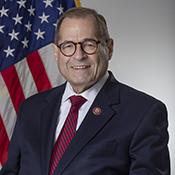
Serving · U.S. House · New York · District 12
Jerrold Nadler
U.S. Representative · New York District 12 · 1992–present · Democratic
Jerrold Nadler represents New York's District 12 in the United States House of Representatives (1992–present) for the Democratic party. The page below collects sourced biographical facts, term history, committee roles, and provenance for Nadler.
Bioguide ID: N000002
Key facts
- Full name
- Jerrold Nadler
- State
- New York
- District
- District 12
- Party
- Democratic
- House service
- 1992–present
- First House term
- 1992
- Status
- Currently serving
- Current term ends
- 2027
- Born
- 1947
- Bioguide ID
- N000002
- Committee assignments
- 2
- Dataset version
- 1.20260604
Biographical narrative
929 words · sourced from the Wikipedia REST extract
Jerrold Lewis Nadler is an American lawyer and politician who has served as a U.S. Representative for New York's 12th congressional district since 2023. A member of the Democratic Party, Nadler has been a prominent figure in the U.S. House of Representatives since he first took office in 1992. Over his lengthy career, he has represented various districts in Manhattan and Brooklyn, and he is known for his liberal political stance and strong local connections. As of January 3, 2027, he is expected to complete his current term.
Early life and career
Jerrold Nadler was born on June 13, 1947, in Brooklyn, New York, into a Jewish family. His parents, Miriam and Emanuel "Max" Nadler, played a significant role in shaping his early political views. His father was a dedicated Democrat who faced financial difficulties when he lost his poultry farm in New Jersey during Nadler's childhood. This upbringing in a politically active family likely influenced Nadler's later career in public service.
Nadler's education began at Crown Heights Yeshiva, and he later graduated from Stuyvesant High School in 1965. During his high school years, he was involved in student government, where he was elected president with the assistance of future political strategist Dick Morris. Following high school, he pursued higher education at Columbia University, earning a Bachelor of Arts degree in 1969. While at Columbia, he became a member of the Alpha Epsilon Pi fraternity, which is known for its Jewish heritage.
After completing his undergraduate studies, Nadler began his professional career in law. He worked as a legal assistant and clerk for several firms, including Corporation Trust Company and the Morris, Levin and Shein law firm. In 1972, he took on the role of legislative assistant in the New York State Assembly, which marked the beginning of his political career. He later served as a shift manager at the New York City Off-Track Betting Corporation before returning to law as a clerk at Morgan, Finnegan, Pine, Foley and Lee in 1976.
While attending evening classes at the Fordham University School of Law, Nadler was elected to the New York State Assembly in 1976. He completed his Juris Doctor degree at Fordham in 1978. His tenure in the New York State Assembly lasted until 1992, during which he represented multiple legislative sessions. He was known for his involvement with the Democratic Socialist Organizing Committee and its successor, the Democratic Socialists of America, remaining active in the organization until the late 1990s.
Nadler's political aspirations extended beyond the Assembly. He ran for Manhattan Borough President in 1985 but lost to David Dinkins in the Democratic primary. He also sought the position of New York City Comptroller in 1989 but was unsuccessful in the Democratic primary against Elizabeth Holtzman. Throughout his time in the Assembly, Nadler was particularly focused on issues related to mass transit and rail freight, founding and chairing the Assembly Subcommittee on Mass Transit and Rail Freight.
House tenure
Jerrold Nadler was elected to the U.S. House of Representatives in 1992, following the death of incumbent Ted Weiss. Initially representing New York's 8th congressional district, Nadler's district underwent several changes in numbering and boundaries over the years due to redistricting. From 1992 until 2022, he represented the 8th district, which was renumbered to the 10th district in 2013. This district included significant portions of Manhattan and parts of Brooklyn, encompassing many well-known landmarks and neighborhoods.
During his time in Congress, Nadler has consistently won re-election with a significant majority of the vote. His electoral success is reflected in his performance, where he has never received less than 75 percent of the vote in a general election. The districts he has represented have been historically Democratic, maintaining a Democratic presence for over a century. In 2020, he faced a primary challenge from activist Lindsey Boylan, where he received less than 75 percent of the vote for the first time in his career. In 2022, following redistricting, he competed against fellow incumbent Carolyn Maloney in a three-way Democratic primary, securing 56 percent of the vote and subsequently winning the general election for the newly drawn 12th district.
Legislative focus and committees
Throughout his tenure in the House, Jerrold Nadler has been involved in various legislative efforts and has held significant committee positions. He is currently the ranking member of the House Judiciary Committee and has served as its chair from 2019 to 2023. His work on the Judiciary Committee has included oversight of various legal and constitutional issues, including matters related to impeachment. Nadler has been vocal about the need for a clear and substantial basis for impeachment proceedings, emphasizing the importance of evidence and public support in such cases.
In addition to his role on the Judiciary Committee, Nadler is also a member of the House Transportation and Infrastructure Committee. His legislative focus has often aligned with progressive and liberal values, advocating for civil rights, social justice, and infrastructure improvements. His long-standing commitment to these issues has made him a prominent figure in discussions surrounding legal reforms and transportation policy.
Nadler's influence extends beyond legislative committees, as he has been involved in significant national conversations regarding impeachment and accountability in government. He has articulated a framework for evaluating the legitimacy of impeachment proceedings, underscoring the need for serious offenses and clear evidence.
As of now, Nadler continues to serve in the U.S. House of Representatives, with his current term set to conclude on January 3, 2027. His extensive experience and established presence in Congress position him as a key player in ongoing legislative discussions and initiatives.
Committees & roles
- House Committee on the JudiciaryMember · since 2025
- House Committee on Transportation and InfrastructureMember · since 2025
Notable legislation
Sponsored and co-sponsored legislation for Jerrold Nadler is pending operator curation. The biographical narrative above carries the same provenance trail until per-bill rows are written.
Sources
- [1]https://en.wikipedia.org/wiki/Jerry_NadlerWikipedia · retrieved 2026-06-04
Notable quotes
Sourced quotes for Jerrold Nadler are pending operator curation. Narrative-scope provenance remains attached below.
Sources
- [1]https://en.wikipedia.org/wiki/Jerry_NadlerWikipedia · retrieved 2026-06-04
Key positions
Curated policy positions for Jerrold Nadler are pending operator review. The biographical narrative above carries the same provenance trail until per-topic positions are written.
Sources
- [1]https://en.wikipedia.org/wiki/Jerry_NadlerWikipedia · retrieved 2026-06-04
Terms served
- 1992–1993U.S. House · Term 1 · Democratic
- 1993–1995U.S. House · Term 2 · Democratic
- 1995–1997U.S. House · Term 3 · Democratic
- 1997–1999U.S. House · Term 4 · Democratic
- 1999–2001U.S. House · Term 5 · Democratic
- 2001–2003U.S. House · Term 6 · Democratic
- 2003–2005U.S. House · Term 7 · Democratic
- 2005–2007U.S. House · Term 8 · Democratic
- 2007–2009U.S. House · Term 9 · Democratic
- 2009–2011U.S. House · Term 10 · Democratic
- 2011–2013U.S. House · Term 11 · Democratic
- 2013–2015U.S. House · Term 12 · Democratic
- 2015–2017U.S. House · Term 13 · Democratic
- 2017–2019U.S. House · Term 14 · Democratic
- 2019–2021U.S. House · Term 15 · Democratic
- 2021–2023U.S. House · Term 16 · Democratic
- 2023–2025U.S. House · Term 17 · Democratic
- 2025–2027U.S. House · Term 18 · Democratic
Sources & provenance
Every attributable claim above carries a per-section [N] marker that resolves to the corresponding URL below. Each entry records the upstream provider, the canonical URL, and the timestamp at which the source was retrieved by the ingest pipeline.
Key facts
- https://bioguide.congress.gov/search/bio/N000002bioguide · retrieved 2026-06-04
- https://nadler.house.govhouse.gov · retrieved 2026-06-04
Biographical narrative
- https://en.wikipedia.org/wiki/Jerry_Nadlerwikipedia · retrieved 2026-06-04
Find your representative
Every U.S. state elects representatives by district. Browse New York’s delegation, the full currently-serving-representative roster, or explore the role and term length.
Related on The Candidate
- Nicolas LaLotaServing U.S. Representative · New York District 1 · RepublicanOpen
- Dan GoldmanServing U.S. Representative · New York District 10 · DemocraticOpen
- Nicole MalliotakisServing U.S. Representative · New York District 11 · RepublicanOpen
- Adriano EspaillatServing U.S. Representative · New York District 13 · DemocraticOpen
- Democratic PartyFederal candidates and office holders on the Democratic line.Open
- Representatives from New YorkEvery currently-serving U.S. Representative who has represented New York.Open