
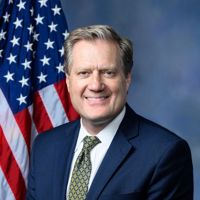
Serving · U.S. House · Ohio · District 10
Michael Turner
U.S. Representative · Ohio District 10 · 2003–present · Republican
Michael Turner represents Ohio's District 10 in the United States House of Representatives (2003–present) for the Republican party. The page below collects sourced biographical facts, term history, committee roles, and provenance for Turner.
Bioguide ID: T000463
Key facts
- Full name
- Michael Turner
- State
- Ohio
- District
- District 10
- Party
- Republican
- House service
- 2003–present
- First House term
- 2003
- Status
- Currently serving
- Current term ends
- 2027
- Born
- 1960
- Bioguide ID
- T000463
- Committee assignments
- 2
- Dataset version
- 1.20260604
Biographical narrative
996 words · sourced from the Wikipedia REST extract
Michael R. Turner is an American politician currently serving as a U.S. Representative for Ohio's 10th congressional district. A member of the Republican Party, Turner has held this office since 2003, having been first elected to Congress in 2002. His political career includes a notable tenure as the mayor of Dayton, Ohio, from 1994 to 2002. Throughout his time in office, Turner has engaged in various legislative activities and has held leadership roles, including serving as president of the NATO Parliamentary Assembly from 2014 to 2016 and as chair of the House Intelligence Committee from 2023 until his removal from that position. His current term in the House of Representatives is set to conclude on January 3, 2027.
Early life and career
Michael Ray Turner was born on January 11, 1960, in Dayton, Ohio, to Vivian and Ray Turner. His mother was an educator who taught in the Huber Heights City Schools, while his father was a long-serving member of the International Union of Electrical Workers Local 801 after having served in the military. Turner grew up in East Dayton alongside his sister and was raised in a non-denominational Protestant household.
Turner completed his secondary education at Belmont High School, graduating in 1978. He pursued higher education, earning a Bachelor of Arts degree in political science from Ohio Northern University in 1982. He continued his academic journey by obtaining a Juris Doctor from Case Western Reserve University in 1985. Furthering his education, he received a Master of Business Administration from the University of Dayton in 1992 and, later, a Doctor of Liberal Studies in urban economic development from Georgetown University in 2022.
Before entering the political arena, Turner practiced law in the Dayton area, working with various local firms and businesses. His legal experience provided him with a foundation that would later inform his political career. Following his tenure as mayor of Dayton and prior to his election to Congress, Turner continued to practice law, which allowed him to maintain a connection to the legal community while transitioning into a more prominent political role.
House tenure
Turner’s political career at the federal level began when he was elected to the U.S. House of Representatives in 2002. He won the Republican nomination with a significant majority, defeating Roy Brown, and subsequently secured victory in the general election against Rick Carne, who was the chief of staff for the retiring Democratic Congressman Tony P. Hall. This election was notable as it followed Hall's retirement after being appointed by President George W. Bush as a U.N. special envoy for hunger issues. The redistricting process prior to the election had also shifted the political landscape, adding Republican-leaning suburbs to the district, which contributed to Turner's electoral success.
Turner’s first term in the House began in 2003, and he has since been re-elected multiple times, demonstrating a sustained level of support from his constituents. In the subsequent elections, he faced various challengers, including former businesswoman Jane Mitakides in 2004 and Democratic attorney Sharon Neuhardt in 2012, both of whom he defeated by substantial margins. His electoral victories often focused on economic issues, job creation, and support for workers, which resonated with voters in his district.
In 2012, after redistricting, Turner’s congressional district was renumbered to the 10th district, which absorbed much of the neighboring 7th district. This change altered the political dynamics of the area, but Turner successfully navigated this transition, securing his nomination without facing a primary challenge after his fellow Republican, Steve Austria, opted not to run.
Throughout his tenure, Turner has been involved in various legislative activities and has served on multiple committees, including the Armed Services and Government Reform committees. His role in these committees has allowed him to influence policy on a range of issues, particularly those related to national security and government operations.
Legislative focus and committees
During his time in Congress, Turner has focused on a variety of legislative issues, reflecting the interests and needs of his constituents in Ohio's 10th district. His work has often centered on economic development, job creation, and national security, areas that are critical to the residents of his district and the broader Ohio region.
Turner has been a member of the Armed Services Committee, where he has contributed to discussions and legislation concerning military readiness, defense appropriations, and veterans' affairs. His legal background and experience as a former mayor have informed his understanding of the complexities surrounding these issues, allowing him to advocate effectively for policies that support both military personnel and their families.
In addition to his work on the Armed Services Committee, Turner has also served on the Government Reform Committee, where he has engaged in efforts to improve government efficiency and accountability. His legislative initiatives have often aimed at reducing bureaucratic red tape and enhancing the effectiveness of government programs.
Turner’s leadership roles have included serving as president of the NATO Parliamentary Assembly from 2014 to 2016, where he represented the interests of the United States in discussions with international partners on security and defense matters. This position underscored his commitment to fostering strong alliances and addressing global security challenges.
In 2022, Turner was appointed to the House Intelligence Committee, where he played a significant role in overseeing intelligence operations and national security matters. He served as chair of this committee in 2023, further emphasizing his influence in shaping U.S. intelligence policy. However, his tenure in this leadership position was marked by controversy, leading to his removal from the chairmanship.
Throughout his congressional career, Turner has aligned himself with the moderate Republican Governance Group, reflecting a centrist approach to governance that seeks bipartisan solutions to pressing issues. His legislative focus and committee assignments illustrate his commitment to addressing the needs of his constituents while navigating the complexities of federal policymaking. As he continues his service in the House of Representatives, Turner remains a prominent figure in Ohio politics, with a career that has evolved through various roles in local and national government.
Committees & roles
- House Committee on Armed ServicesMember · since 2025
- House Committee on Oversight and Government ReformMember · since 2025
Notable legislation
Sponsored and co-sponsored legislation for Michael Turner is pending operator curation. The biographical narrative above carries the same provenance trail until per-bill rows are written.
Sources
- [1]https://en.wikipedia.org/wiki/Mike_TurnerWikipedia · retrieved 2026-06-04
Notable quotes
Sourced quotes for Michael Turner are pending operator curation. Narrative-scope provenance remains attached below.
Sources
- [1]https://en.wikipedia.org/wiki/Mike_TurnerWikipedia · retrieved 2026-06-04
Key positions
Curated policy positions for Michael Turner are pending operator review. The biographical narrative above carries the same provenance trail until per-topic positions are written.
Sources
- [1]https://en.wikipedia.org/wiki/Mike_TurnerWikipedia · retrieved 2026-06-04
Terms served
- 2003–2005U.S. House · Term 1 · Republican
- 2005–2007U.S. House · Term 2 · Republican
- 2007–2009U.S. House · Term 3 · Republican
- 2009–2011U.S. House · Term 4 · Republican
- 2011–2013U.S. House · Term 5 · Republican
- 2013–2015U.S. House · Term 6 · Republican
- 2015–2017U.S. House · Term 7 · Republican
- 2017–2019U.S. House · Term 8 · Republican
- 2019–2021U.S. House · Term 9 · Republican
- 2021–2023U.S. House · Term 10 · Republican
- 2023–2025U.S. House · Term 11 · Republican
- 2025–2027U.S. House · Term 12 · Republican
Sources & provenance
Every attributable claim above carries a per-section [N] marker that resolves to the corresponding URL below. Each entry records the upstream provider, the canonical URL, and the timestamp at which the source was retrieved by the ingest pipeline.
Key facts
- https://bioguide.congress.gov/search/bio/T000463bioguide · retrieved 2026-06-04
- https://turner.house.gov/house.gov · retrieved 2026-06-04
Biographical narrative
- https://en.wikipedia.org/wiki/Mike_Turnerwikipedia · retrieved 2026-06-04
Find your representative
Every U.S. state elects representatives by district. Browse Ohio’s delegation, the full currently-serving-representative roster, or explore the role and term length.
Related on The Candidate
- Greg LandsmanServing U.S. Representative · Ohio District 1 · DemocraticOpen
- Shontel BrownServing U.S. Representative · Ohio District 11 · DemocraticOpen
- Troy BaldersonServing U.S. Representative · Ohio District 12 · RepublicanOpen
- Emilia SykesServing U.S. Representative · Ohio District 13 · DemocraticOpen
- Republican PartyFederal candidates and office holders on the Republican line.Open
- Representatives from OhioEvery currently-serving U.S. Representative who has represented Ohio.Open