
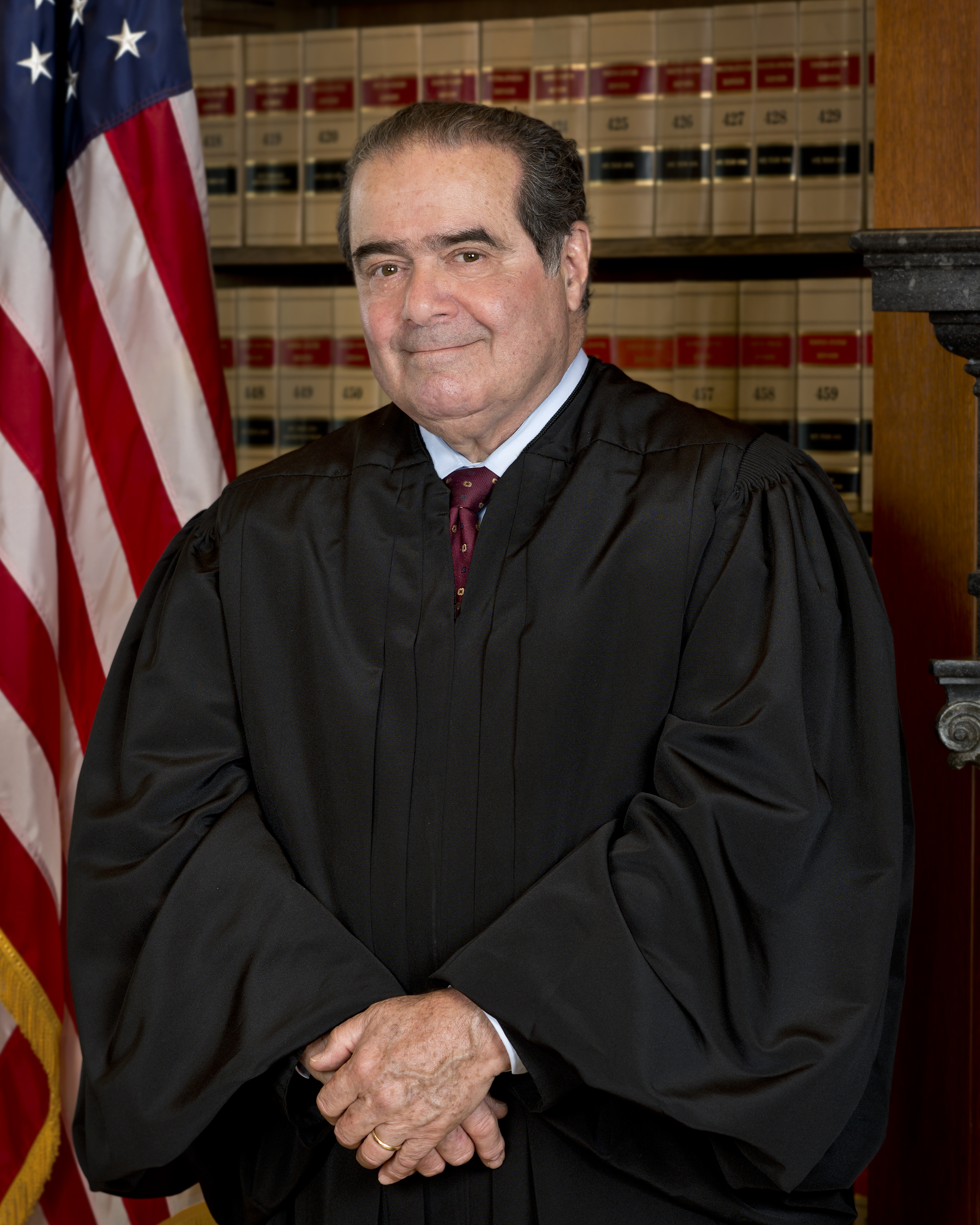
Historical · U.S. Court of Appeals for the District of Columbia Circuit
Antonin Scalia
Former Circuit Judge · U.S. Court of Appeals for the District of Columbia Circuit · 1982–1986 · Appointed by Ronald Reagan
Antonin Scalia served as a circuit judge of the U.S. Court of Appeals for the District of Columbia Circuit (1982–1986). Scalia was appointed by Ronald Reagan.
Key facts
- Full name
- Antonin Scalia
- Court
- U.S. Court of Appeals for the District of Columbia Circuit
- Office
- Circuit Judge (U.S. Court of Appeals)
- Status
- Former circuit judge
- Duty status
- Not serving
- Appointment
- Senate-confirmed
- FJC seat
- CADC0406
- Tenure
- 1982–1986
- Confirmed
- 1982-08-05
- Born
- 1936-03-11
- Died
- 2016-02-13
- First year on the bench
- 1982
- Dataset version
- 1.20260711
Appointment & service record
U.S. Court of Appeals for the District of Columbia Circuit · 1982–1986
- Seat
- CADC0406
- Appointment
- Senate-confirmed
- Appointing president
- Ronald Reagan
- Confirmed
- 1982-08-05
- Commissioned
- 1982-08-17
- Senior status
- —
Court, FJC seat, appointment type (Senate-confirmed or recess), appointing president, confirmation and commission dates, and senior-status date are drawn from the Federal Judicial Center Biographical Directory and Wikidata.[1][2][3]
Sources
- [1]https://www.fjc.gov/node/1387421fjc · retrieved 2026-07-11
- [2]https://www.fjc.gov/history/judges/biographical-directory-article-iii-federal-judges-exportfjc-directory · retrieved 2026-07-11
- [3]https://www.wikidata.org/wiki/Q11156Wikidata · retrieved 2026-07-11
Biographical narrative
1,288 words · sourced from the Wikipedia REST extract
Antonin Gregory Scalia was a federal appellate judge who served on the United States Court of Appeals for the District of Columbia Circuit from 1982 to 1986, before his elevation to the Supreme Court of the United States, where he served as an Associate Justice until his death in 2016. Born in Trenton, New Jersey in 1936, he became one of the most influential legal figures of the twentieth century, known for championing originalist and textualist approaches to constitutional and statutory interpretation. His four-year tenure on the D.C. Circuit, widely considered the second most important federal court in the nation, came during a pivotal period in his career and preceded his historic appointment as the first Italian-American justice on the Supreme Court.
Early life and legal career
Antonin Scalia was born on March 11, 1936, in Trenton, New Jersey, the only child of Salvatore Eugenio Scalia and Catherine Louise Panaro. His father, an immigrant from Sommatino, Sicily, had graduated from Rutgers University and was working as a graduate student at Columbia University and as a clerk at the time of his son's birth. The elder Scalia would go on to become a professor of Romance languages at Brooklyn College, where he adhered to the formalist New Criticism school of literary theory. Scalia's mother, born in Trenton to Italian immigrant parents, worked as an elementary school teacher.
In 1939, the Scalia family relocated to Elmhurst, Queens, where young Antonin attended P.S. 13 Clement C. Moore School. After completing eighth grade, he earned an academic scholarship to Xavier High School, a Jesuit military school in Manhattan. He excelled academically, graduating first in his class in 1953 with a 97.5 average. During his time at Xavier, he earned distinctions in Latin, Greek, and debate, among other subjects, and was a distinguished member of the school's Glee club. He later recalled spending much of his time focused on schoolwork, acknowledging that he "was never cool." As a youth, Scalia was also active in the Boy Scouts and became a member of the Order of the Arrow, the Scouts' national honor society. A classmate who later became a New York State official remembered the teenage Scalia as already displaying conservative views and being "brilliant, way above everybody else."
In 1953, Scalia enrolled at Georgetown University, where he majored in history. He became a champion collegiate debater in Georgetown's Philodemic Society and earned praise for his theatrical performances. He spent his junior year studying abroad at the University of Fribourg in Switzerland. Scalia graduated from Georgetown in 1957 as class valedictorian with a Bachelor of Arts degree, summa cum laude. He then attended Harvard Law School, where he served as a notes editor for the Harvard Law Review and graduated in 1960 with a Bachelor of Laws degree, magna cum laude, ranking among the top of his class. During his time at Harvard, he was awarded a Sheldon Fellowship, which enabled him to travel throughout Europe during 1960 and 1961.
Scalia began his legal career in 1961 at the law firm Jones, Day, Cockley & Reavis (now known as Jones Day) in Cleveland, Ohio, where he worked for six years until 1967. He was highly regarded at the firm and appeared likely to be made a partner, but he later indicated that he had long intended to pursue an academic career. In 1967, he left Jones Day to become a professor at the University of Virginia School of Law, relocating his family to Charlottesville.
After four years teaching in Charlottesville, Scalia entered public service in 1971 when President Richard Nixon appointed him general counsel for the Office of Telecommunications Policy. In this role, one of his principal responsibilities was formulating federal policy for the growth of cable television. He continued in government service during the Ford administration, eventually becoming an assistant attorney general. Following the conclusion of the Ford presidency, Scalia spent most of the Carter years as a faculty member at the University of Chicago Law School, where he became one of the first faculty advisers of the newly established Federalist Society, an organization that would grow to become highly influential in conservative legal circles.
Federal appellate service
In 1982, President Ronald Reagan, a Republican, appointed Scalia to serve as a judge on the United States Court of Appeals for the District of Columbia Circuit. He was confirmed by the Senate on August 5, 1982. The D.C. Circuit is often regarded as the nation's second most important court due to its jurisdiction over challenges to federal agency actions and its role as a frequent stepping stone to the Supreme Court.
Scalia served on the D.C. Circuit for four years, from 1982 to 1986. During this period, he developed and refined the judicial philosophy that would later define his career on the Supreme Court. His tenure on the appellate court provided him with experience in administrative law and regulatory matters, areas in which the D.C. Circuit has particular expertise given its oversight of federal agencies. The position also gave him the opportunity to work alongside other distinguished jurists and to establish himself as a significant voice in federal appellate jurisprudence.
His service on the D.C. Circuit came to an end in 1986 when President Reagan elevated him to the Supreme Court of the United States. Scalia's nomination to the nation's highest court was met with broad approval, and he was confirmed unanimously by the Senate in a 98-0 vote, becoming the first Italian-American justice in the Court's history. This transition from circuit judge to Supreme Court justice represented a natural progression in his judicial career and provided him with a much larger platform from which to advance his legal philosophy.
Jurisprudence and legacy
During his time on the D.C. Circuit and throughout his subsequent Supreme Court career, Scalia became known for advocating textualism in statutory interpretation and originalism in constitutional interpretation. These approaches emphasized interpreting legal texts according to their original public meaning at the time of enactment, rather than considering evolving social standards or policy considerations. His intellectual rigor and forceful advocacy for these interpretive methods helped catalyze a broader movement in American law that continues to influence legal thinking and judicial appointments.
Scalia's judicial philosophy reflected conservative principles, including a strong defense of executive branch powers and skepticism toward judicial recognition of rights not explicitly enumerated in the Constitution. He believed the Constitution permitted capital punishment and did not guarantee rights to abortion or same-sex marriage. He viewed affirmative action and policies providing special protected status to minority groups as constitutionally problematic. These positions established him as one of the most conservative members of the Supreme Court during his tenure.
Known for his intellectual vigor and sharp writing style, Scalia frequently filed separate opinions and was not hesitant to criticize the reasoning of his colleagues, sometimes in pointed terms. He circulated memoranda to fellow justices, nicknamed "Ninograms" after his nickname "Nino," in efforts to persuade them to his viewpoint. His influence extended beyond his own votes and opinions; he shaped legal discourse and inspired a generation of lawyers and judges who embraced his interpretive methods.
Antonin Scalia died on February 13, 2016, while still serving as an Associate Justice of the Supreme Court. His impact on American law was widely recognized across the political spectrum. In 2018, he was posthumously awarded the Presidential Medal of Freedom. The Antonin Scalia Law School at George Mason University was named in his honor, reflecting his lasting influence on legal education and scholarship. He has been described as one of the most influential jurists of the twentieth century and one of the most important justices in Supreme Court history, having fundamentally shaped how judges and lawyers approach questions of constitutional and statutory interpretation.
Sources & provenance
Every quantitative or attributable claim above carries a per-section [N] marker that resolves to the corresponding URL below. Each entry records the upstream provider, the canonical URL, and the timestamp at which the underlying source was retrieved.
Key facts
- https://www.fjc.gov/node/1387421fjc · retrieved 2026-07-11
- https://www.fjc.gov/history/judges/biographical-directory-article-iii-federal-judges-exportfjc-directory · retrieved 2026-07-11
- https://www.wikidata.org/wiki/Q11156Wikidata · retrieved 2026-07-11
Biographical narrative
- https://en.wikipedia.org/wiki/Antonin_ScaliaWikipedia · retrieved 2026-07-11
Explore the federal judiciary
The U.S. Courts of Appeals are the intermediate appellate courts of the federal judiciary — thirteen circuits sitting between the district courts and the Supreme Court. Browse the full roster of judges on the U.S. Court of Appeals for the District of Columbia Circuit, or explore how the appointed federal judiciary fits into the federal government.