
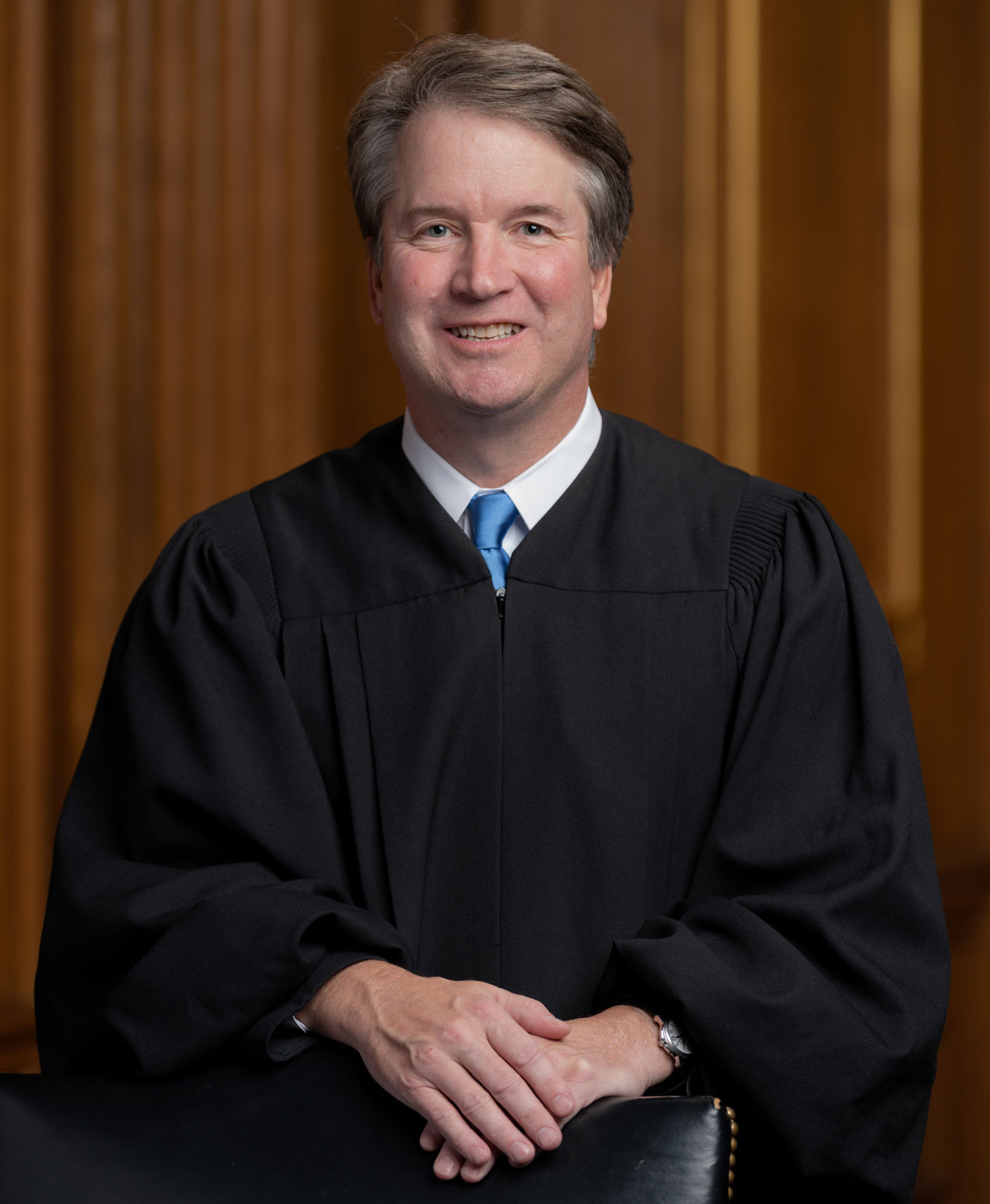
Historical · U.S. Court of Appeals for the District of Columbia Circuit
Brett M. Kavanaugh
Former Circuit Judge · U.S. Court of Appeals for the District of Columbia Circuit · 2006–2018 · Appointed by George W Bush
Brett M. Kavanaugh served as a circuit judge of the U.S. Court of Appeals for the District of Columbia Circuit (2006–2018). Kavanaugh was appointed by George W Bush.
Key facts
- Full name
- Brett M. Kavanaugh
- Court
- U.S. Court of Appeals for the District of Columbia Circuit
- Office
- Circuit Judge (U.S. Court of Appeals)
- Status
- Former circuit judge
- Duty status
- Not serving
- Appointment
- Senate-confirmed
- FJC seat
- CADC1302
- Tenure
- 2006–2018
- Confirmed
- 2006-05-26
- Born
- 1965
- Died
- —
- First year on the bench
- 2006
- Dataset version
- 1.20260711
Appointment & service record
U.S. Court of Appeals for the District of Columbia Circuit · 2006–2018
- Seat
- CADC1302
- Appointment
- Senate-confirmed
- Appointing president
- George W Bush
- Confirmed
- 2006-05-26
- Commissioned
- 2006-05-30
- Senior status
- —
Court, FJC seat, appointment type (Senate-confirmed or recess), appointing president, confirmation and commission dates, and senior-status date are drawn from the Federal Judicial Center Biographical Directory and Wikidata.[1][2][3]
Sources
- [1]https://www.fjc.gov/node/1392406fjc · retrieved 2026-07-11
- [2]https://www.fjc.gov/history/judges/biographical-directory-article-iii-federal-judges-exportfjc-directory · retrieved 2026-07-11
- [3]https://www.wikidata.org/wiki/Q4962244Wikidata · retrieved 2026-07-11
Biographical narrative
1,333 words · sourced from the Wikipedia REST extract
Brett M. Kavanaugh is an American jurist who served as a circuit judge on the United States Court of Appeals for the District of Columbia Circuit from 2006 to 2018. Born in 1965, he was appointed to the D.C. Circuit by President George W. Bush, a Republican, and confirmed by the Senate in May 2006. During his twelve years on what is often considered the nation's second-highest court, Kavanaugh participated in numerous cases involving administrative law, separation of powers, and national security matters before his elevation to the Supreme Court of the United States in 2018.
Early life and legal career
Kavanaugh was born in February 1965 in Washington, D.C., into a family with Irish Catholic heritage on both sides. His father worked as a lawyer and led the Cosmetic, Toiletry and Fragrance Association for approximately two decades. His mother initially worked as a history teacher at public high schools in Washington during the 1960s and 1970s before pursuing legal education herself. She obtained a law degree from American University in the late 1970s and later served as a Maryland Circuit Court judge in Montgomery County during the latter half of the 1990s and into the early 2000s.
Raised in Bethesda, Maryland, Kavanaugh attended Georgetown Preparatory School, a Jesuit college preparatory institution for boys. During his time there, he was actively involved in athletics, serving as captain of the basketball team and playing as both a wide receiver and cornerback on the football team. Notably, he attended the school alongside Neil Gorsuch, who was two years behind him, and with whom he would later share professional experiences in the federal judiciary.
Following his graduation from Georgetown Prep in 1983, Kavanaugh enrolled at Yale University, continuing a family tradition as his paternal grandfather had also attended the institution. At Yale, classmates recalled him as a dedicated student with a strong interest in sports, particularly basketball. He attempted to join the varsity basketball team but was unsuccessful; however, he played on the junior varsity squad for two years. He contributed sports writing, including articles about basketball, to the Yale Daily News and joined the Delta Kappa Epsilon fraternity. He completed his undergraduate studies in 1987, earning a Bachelor of Arts degree cum laude with a concentration in history.
Kavanaugh continued his education at Yale Law School, where he lived in shared housing with future federal judge James E. Boasberg and participated in basketball games with faculty members. He became involved with the Yale Law Journal, serving as a notes editor during his third year of study. He earned his Juris Doctor degree from Yale Law in 1990.
Upon graduating from law school, Kavanaugh began his legal career with a clerkship for Judge Walter King Stapleton of the United States Court of Appeals for the Third Circuit, serving from 1990 to 1991. During this clerkship, Judge Stapleton authored the majority opinion in a significant abortion-related case in which the Third Circuit upheld various Pennsylvania restrictions on abortion procedures. Kavanaugh then clerked for Judge Alex Kozinski of the United States Court of Appeals for the Ninth Circuit from 1991 to 1992. Judge Kozinski had a reputation as a feeder judge whose clerks frequently went on to clerk at the Supreme Court. Kavanaugh interviewed for a Supreme Court clerkship with Chief Justice William Rehnquist during the 1992 term but was not selected for the position.
After working briefly as a summer associate at the law firm Munger, Tolles & Olson, Kavanaugh obtained a fellowship with the Office of the Solicitor General under Ken Starr, serving from 1992 to 1993. He subsequently secured a clerkship with Supreme Court Justice Anthony Kennedy, serving from 1993 to 1994 alongside Neil Gorsuch and future federal judge Gary Feinerman.
Following his Supreme Court clerkship, Kavanaugh joined Ken Starr's Office of the Independent Counsel as an Associate Counsel, working there until 1997 alongside colleagues who would later hold prominent government positions. In this role, he participated in investigations related to the Clinton administration, including work on matters that culminated in a report recommending presidential impeachment. He also worked on an investigation into a 1993 death that concluded with a finding of suicide after a three-year inquiry.
Kavanaugh later joined the administration of President George W. Bush, serving in the White House Counsel's office and eventually as White House Staff Secretary. In the latter role, he played a significant part in the administration's judicial selection process, helping to identify and advance candidates for federal judicial appointments.
Federal appellate service
President George W. Bush nominated Kavanaugh to the United States Court of Appeals for the District of Columbia Circuit in 2003. The nomination proved controversial and faced significant delays in the confirmation process. The proceedings were marked by disputes over his role in the Bush administration and questions about potential partisanship, resulting in a confirmation process that extended for three years. Kavanaugh was ultimately confirmed by the Senate on May 26, 2006, and took his seat on the D.C. Circuit.
The D.C. Circuit is widely regarded as one of the most influential federal appellate courts due to its jurisdiction over cases involving federal agencies, regulatory matters, and questions of executive power. During his tenure on the court from 2006 to 2018, Kavanaugh participated in a wide range of cases that came before the eleven-judge panel. The court's docket regularly included complex matters involving administrative law, challenges to federal regulations, separation of powers disputes, and national security issues.
Over the course of his twelve years on the D.C. Circuit, Kavanaugh authored numerous opinions as part of the court's work reviewing decisions by federal agencies and lower courts within the circuit's jurisdiction. His service on the court provided him with extensive experience in the types of cases that frequently arise in the nation's capital, including matters involving the interpretation of federal statutes and the scope of executive authority.
Kavanaugh's time on the D.C. Circuit came to an end in 2018 when he was nominated to the Supreme Court of the United States by President Donald Trump, a Republican, to fill the vacancy created by the retirement of Justice Anthony Kennedy, for whom Kavanaugh had clerked more than two decades earlier.
Jurisprudence and legacy
Kavanaugh's tenure on the D.C. Circuit established him as a jurist with substantial experience in administrative law and regulatory matters, areas that constitute a significant portion of the court's caseload. The D.C. Circuit's unique position as the primary venue for challenges to federal agency actions meant that Kavanaugh regularly engaged with questions about the proper scope of administrative authority and the relationship between the executive and legislative branches.
His twelve years of service on the court provided him with a substantial body of judicial work that was later scrutinized during his Supreme Court confirmation process. The D.C. Circuit has historically served as a stepping stone to the Supreme Court for numerous justices, and Kavanaugh's appointment continued this pattern. His experience on the court, combined with his earlier work in the executive branch and his Supreme Court clerkship, gave him exposure to multiple branches of the federal government before his elevation to the nation's highest court.
The D.C. Circuit during Kavanaugh's tenure heard cases involving significant questions of contemporary governance, including challenges to environmental regulations, financial regulatory frameworks, and national security policies. His participation in these cases contributed to the development of administrative law jurisprudence during a period of ongoing debate about the proper role of federal agencies in the regulatory state.
Kavanaugh's elevation to the Supreme Court in 2018 created a vacancy on the D.C. Circuit that was later filled through the standard presidential nomination and Senate confirmation process. His service on the circuit court represents a significant chapter in his judicial career, bridging his earlier work in government service and his current role on the Supreme Court. The D.C. Circuit continues to be regarded as an important training ground for federal jurists, and Kavanaugh's path from that court to the Supreme Court reflects its ongoing significance in the federal judicial system.
Sources & provenance
Every quantitative or attributable claim above carries a per-section [N] marker that resolves to the corresponding URL below. Each entry records the upstream provider, the canonical URL, and the timestamp at which the underlying source was retrieved.
Key facts
- https://www.fjc.gov/node/1392406fjc · retrieved 2026-07-11
- https://www.fjc.gov/history/judges/biographical-directory-article-iii-federal-judges-exportfjc-directory · retrieved 2026-07-11
- https://www.wikidata.org/wiki/Q4962244Wikidata · retrieved 2026-07-11
Biographical narrative
- https://en.wikipedia.org/wiki/Brett_KavanaughWikipedia · retrieved 2026-07-11
Explore the federal judiciary
The U.S. Courts of Appeals are the intermediate appellate courts of the federal judiciary — thirteen circuits sitting between the district courts and the Supreme Court. Browse the full roster of judges on the U.S. Court of Appeals for the District of Columbia Circuit, or explore how the appointed federal judiciary fits into the federal government.