
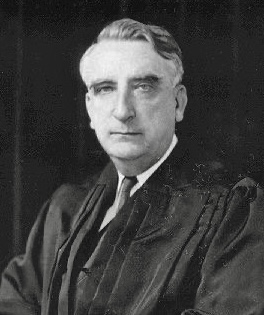
Historical · U.S. Court of Appeals for the District of Columbia Circuit
Frederick Moore Vinson
Former Circuit Judge · U.S. Court of Appeals for the District of Columbia Circuit · 1937–1943 · Appointed by Franklin D Roosevelt
Frederick Moore Vinson served as a circuit judge of the U.S. Court of Appeals for the District of Columbia Circuit (1937–1943). Vinson was appointed by Franklin D Roosevelt.
Key facts
- Full name
- Frederick Moore Vinson
- Court
- U.S. Court of Appeals for the District of Columbia Circuit
- Office
- Circuit Judge (U.S. Court of Appeals)
- Status
- Former circuit judge
- Duty status
- Not serving
- Appointment
- Senate-confirmed
- FJC seat
- CADC0304
- Tenure
- 1937–1943
- Confirmed
- 1937-12-09
- Born
- 1890-01-22
- Died
- 1953-09-08
- First year on the bench
- 1937
- Dataset version
- 1.20260711
Appointment & service record
U.S. Court of Appeals for the District of Columbia Circuit · 1937–1943
- Seat
- CADC0304
- Appointment
- Senate-confirmed
- Appointing president
- Franklin D Roosevelt
- Confirmed
- 1937-12-09
- Commissioned
- 1937-12-15
- Senior status
- —
Court, FJC seat, appointment type (Senate-confirmed or recess), appointing president, confirmation and commission dates, and senior-status date are drawn from the Federal Judicial Center Biographical Directory and Wikidata.[1][2][3]
Sources
- [1]https://www.fjc.gov/node/1389186fjc · retrieved 2026-07-11
- [2]https://www.fjc.gov/history/judges/biographical-directory-article-iii-federal-judges-exportfjc-directory · retrieved 2026-07-11
- [3]https://www.wikidata.org/wiki/Q460151Wikidata · retrieved 2026-07-11
Biographical narrative
1,366 words · sourced from the Wikipedia REST extract
Frederick Moore Vinson was an American attorney and public servant who served as a judge on the United States Court of Appeals for the District of Columbia Circuit from 1937 to 1943, appointed by President Franklin D. Roosevelt, a Democrat. Born in Kentucky in 1890, Vinson had an extensive career in public service that spanned all three branches of the federal government. Before his appointment to the federal appellate bench, he served multiple terms as a United States Representative from Kentucky. After leaving the circuit court, he held senior positions in the executive branch during World War II and its aftermath, and later became the thirteenth Chief Justice of the United States, serving in that capacity from 1946 until his death in 1953.
Early life and legal career
Frederick Moore Vinson was born on January 22, 1890, in Louisa, Kentucky, in a newly constructed eight-room brick house located in front of the Lawrence County jail. His father served as the Lawrence County Jailer, and young Vinson, known to family and friends as Fred, assisted his father with duties at the jail during his childhood. He developed relationships with some of the prisoners, who would later recall his considerate treatment when he entered political life. To support himself during his school years, Vinson worked various jobs while pursuing his education.
He completed his studies at Kentucky Normal School in 1909 and subsequently enrolled at Centre College, where he distinguished himself academically by graduating at the top of his class with a Bachelor of Arts degree. During his time at Centre College, he became a member of the Kentucky Alpha Delta chapter of the Phi Delta Theta fraternity. Following his undergraduate education, Vinson obtained a Bachelor of Laws degree from the College of Law, an institution that no longer exists. After completing his legal education, he returned to Louisa to establish a private law practice. His first foray into elected office came when he successfully ran for the position of City Attorney of Louisa.
When the United States entered World War I, Vinson attempted to contribute to the military effort. He participated in civilian activities supporting the war, delivering speeches to promote bond drives and Red Cross fundraising appeals. Despite his eagerness to serve in uniform, he faced initial rejection from the United States Army on two occasions because he was deemed underweight. His persistence eventually paid off, and in August 1918 he was accepted for military service. He underwent basic training with the 9th Company, 34th Training Battalion, 159th Depot Brigade at Camp Zachary Taylor in Kentucky. Demonstrating leadership potential, he was selected for officer training and was attending the officer training school at Camp Pike, Arkansas, when the Armistice was signed on November 11, 1918, bringing the war to a close.
After his military service concluded, Vinson returned to Kentucky and won election as Commonwealth's Attorney for the Thirty-Second Judicial District of Kentucky, a prosecutorial position. On January 24, 1924, he married Julia Roberta Dixon in Ashland, Kentucky. The couple would have two sons together.
Vinson's entry into national politics came in 1924 when he ran in a special election to fill a congressional seat representing his Kentucky district. The vacancy had been created when William J. Fields resigned from the House of Representatives to assume the governorship of Kentucky. Running as a Democrat, Vinson won the special election and subsequently won re-election twice. However, he suffered a defeat in 1928, a loss that was attributed to his decision not to distance his campaign from the presidential campaign of Alfred E. Smith. Undeterred by this setback, Vinson mounted a successful comeback campaign in 1930, regaining his congressional seat. He would continue to serve in the House of Representatives through 1937.
During his tenure in Congress, Vinson developed a close friendship with Senator Harry S. Truman of Missouri, a relationship that would prove significant throughout both men's careers. The two became not only political allies but personal friends, with Vinson serving as an advisor and confidant to Truman. They were known to be card-playing companions, and their friendship endured for the remainder of Vinson's life. In 1930, Vinson relocated his law practice from Louisa to Ashland, Kentucky, approximately thirty miles to the north. With ambitions to return to Congress, he cultivated a network of professional and political contacts in Ashland, including his next-door neighbor Paul G. Blazer. When Vinson returned to Washington as a congressman in 1931, he became a strong supporter of President Roosevelt and the New Deal legislative agenda advanced by the administration.
Federal appellate service
On November 26, 1937, President Franklin D. Roosevelt nominated Vinson to serve as a judge on the United States Court of Appeals for the District of Columbia, which is now known as the United States Court of Appeals for the District of Columbia Circuit. The nomination was to fill a vacancy that had been created by the departure of Judge Charles Henry Robb. The United States Senate confirmed Vinson's appointment on December 9, 1937, and he received his commission six days later, on December 15. This appointment marked a transition from Vinson's legislative career to the federal judiciary.
During his service on the D.C. Circuit, Vinson was designated by Chief Justice Harlan F. Stone to serve as Chief Judge of the Emergency Court of Appeals, a specialized tribunal. His tenure on the Court of Appeals for the District of Columbia Circuit lasted from 1937 until 1943, a period of approximately six years. The D.C. Circuit was and remains one of the most important federal appellate courts, often handling cases involving federal administrative agencies and matters of national significance.
Vinson's time on the federal appellate bench came to an end in 1943 when he resigned from the court to accept an appointment in the executive branch. President Roosevelt named him Director of the Office of Economic Stabilization, a wartime agency responsible for managing economic policy during World War II. This move reflected both Vinson's expertise in economic and fiscal matters, which he had developed during his years in Congress, and the administration's need for experienced leadership in managing the home front economy during the war.
Jurisprudence and legacy
Following his departure from the Court of Appeals for the District of Columbia Circuit, Vinson continued to serve in prominent government positions. After President Roosevelt's death in 1945 and the succession of Harry S. Truman to the presidency, Truman appointed his longtime friend to serve as Secretary of the Treasury. In this capacity, Vinson played a significant role in shaping the post-war international economic order. He negotiated the terms of the Anglo-American loan and oversaw the American participation in establishing major international financial institutions, including the International Bank for Reconstruction and Development, commonly known as the World Bank, and the International Monetary Fund.
When Chief Justice Harlan F. Stone died in 1946, President Truman nominated Vinson to serve as Chief Justice of the United States, and he was confirmed to that position. As Chief Justice, Vinson presided over the Supreme Court during a consequential period in American history. He dissented in the landmark case of Youngstown Sheet & Tube Co. v. Sawyer, in which the Court ruled against the Truman administration's seizure of steel mills during a labor dispute. Vinson also ordered a rehearing in Briggs v. Elliott, a school segregation case that was later consolidated with other cases into Brown v. Board of Education, one of the most significant Supreme Court decisions of the twentieth century.
In the early 1950s, when President Truman decided not to seek another term, he attempted to persuade Vinson to pursue the Democratic Party's presidential nomination. Vinson declined the offer, remaining skeptical about entering the presidential race. After also failing to recruit General Dwight D. Eisenhower, Truman ultimately supported Governor Adlai Stevenson of Illinois as the Democratic nominee in the 1952 presidential election.
Frederick Moore Vinson died on September 8, 1953, while still serving as Chief Justice. He remains the most recent Chief Justice to have been appointed by a president from the Democratic Party. His career exemplified public service across multiple branches of government, from local prosecutor to congressman, federal appellate judge, cabinet secretary, and ultimately Chief Justice of the United States.
Sources & provenance
Every quantitative or attributable claim above carries a per-section [N] marker that resolves to the corresponding URL below. Each entry records the upstream provider, the canonical URL, and the timestamp at which the underlying source was retrieved.
Key facts
- https://www.fjc.gov/node/1389186fjc · retrieved 2026-07-11
- https://www.fjc.gov/history/judges/biographical-directory-article-iii-federal-judges-exportfjc-directory · retrieved 2026-07-11
- https://www.wikidata.org/wiki/Q460151Wikidata · retrieved 2026-07-11
Biographical narrative
- https://en.wikipedia.org/wiki/Fred_M._VinsonWikipedia · retrieved 2026-07-11
Explore the federal judiciary
The U.S. Courts of Appeals are the intermediate appellate courts of the federal judiciary — thirteen circuits sitting between the district courts and the Supreme Court. Browse the full roster of judges on the U.S. Court of Appeals for the District of Columbia Circuit, or explore how the appointed federal judiciary fits into the federal government.